
Palacio de La Moneda, a neoclassical block at Chile’s civic core
Published on 09/18/2026 at 22:22 | Editorial responsibility: Rafael Müller, Editor-in-Chief AD HOC NEWS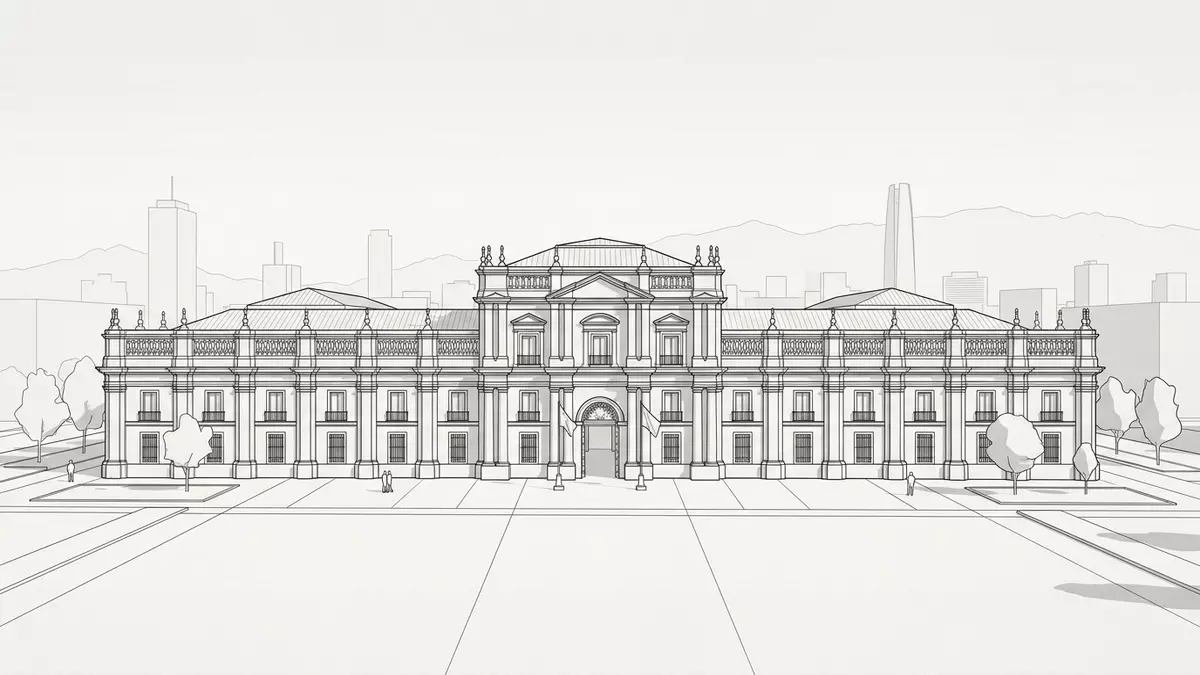
Palacio de La Moneda in Santiago de Chile is a neoclassical government palace that occupies a full city block and stands at the centre of Chile’s political life. Built at the end of the eighteenth century as the Royal Mint of Santiago and inaugurated in 1805, it later became the seat of the President of Chile, a change of use that visitors can read directly in its façades and courtyards.
A palace born as a mint
Palacio de La Moneda began life as a specialised building for coin production in the late eighteenth century, when a mint was commissioned for the colonial Captaincy General of Chile. Construction started in 1784 on a site in the centre of Santiago, giving the city a dedicated complex for housing workshops and machinery related to currency. The project was entrusted to Joaquín Toesca, an Italian architect trained in European neoclassical traditions whose work established the palace as a main example of neoclassicism in Chile.Designed by Joaquín Toesca The building was inaugurated in 1805 as the Royal Mint of Santiago, with its name drawn directly from this original function and its early years closely linked to the minting of coins for the Spanish Crown in the Americas.Inaugurated in 1805 as a mint
The palace’s first decades were defined by this industrial role, and coin production continued there well after Chile moved from colonial rule to an independent republic. The complex provided space for the machinery and staff required to produce national currency, and the association between La Moneda and money remained strong over time. The production of coins in Chile took place in this building until 1929, long after its political role had expanded, leaving a layered identity that combined industrial infrastructure with civic authority.Coin production continued until 1929
From Royal Mint to presidential palace
In the nineteenth century, Palacio de La Moneda was adapted from its original minting function to serve as Chile’s seat of government. After Chilean independence in the early nineteenth century, the building was selected to house the executive branch, reflecting the consolidation of republican institutions in Santiago. In 1845 it became the seat of government and the official presidential residence, anchoring Chile’s presidency in the same neoclassical structure that had once supervised coin production.Seat of the executive branch since 1845 This shift from industrial use to political symbol turned La Moneda into the building most closely associated with the country’s executive power.
Over the decades, various Chilean presidents occupied parts of Palacio de La Moneda as a residence, while other parts housed offices and ceremonial rooms. The palace’s courtyards and interior spaces came to frame official events and day-to-day governmental work, and later interventions adjusted the layout while keeping its neoclassical character. The building sits within Santiago’s Civic District, between major plazas that mark the core of the city’s governmental quarter, so a walk around La Moneda gives a clear sense of how the palace forms part of a wider ensemble of ministries and public spaces.Located in the Civic District
Neoclassical architecture on a city block
Architecturally, Palacio de La Moneda is a horizontal, rectilinear volume in brick masonry and lime mortar, organised over two main floors with additional height at some street-front entrances. Its neoclassical style draws on Roman Doric influences expressed in ordered façades, clear lines and a focus on proportion rather than elaborate ornament, which gives the building an appearance of stability around its perimeter.Main neoclassical work in Chile The complex takes up an entire city block, and each side addresses a different street, with gates leading into interior courtyards.
Inside, La Moneda is arranged around several patios, with corridors and rooms opening onto these planted spaces and linking the industrial origins of the building to its governmental role.Organised around interior patios The façades show rhythmic window placement and framed entrances in keeping with Joaquín Toesca’s neoclassical design, and the relationship between the exterior block and the internal courtyards can be observed by walking around the perimeter and viewing the palace from the nearby plazas. The contrast between the building’s measured architecture and the busy streets around it underlines its role as a fixed reference point in Santiago’s civic centre.
Visiting Palacio de La Moneda: what travellers from Western Europe should know
- Palacio de La Moneda stands in the civic centre of Santiago de Chile, between Plaza de la Constitución and Plaza de la Libertad, and is reached by city streets and public transport services that converge on the downtown area.
- The palace occupies a complete urban block, so walking around it involves covering city pavements on level ground, with access points opening into courtyards and interior areas via gateways and stairways.
- The official language is Spanish and the currency is the Chilean peso. Entry requirements depend on your nationality; UK travellers can check the FCDO travel advice at gov.uk/foreign-travel-advice, Irish travellers the Department of Foreign Affairs at ireland.ie.
Searching for Palacio de La Moneda on social platforms
These links open searches for Palacio de La Moneda on each platform.
Frequently asked questions about Palacio de La Moneda
Where is Palacio de La Moneda located?
Palacio de La Moneda is located in the centre of Santiago de Chile, within the Civic District, between major plazas that frame Chile’s governmental quarter.
What can visitors expect when they see Palacio de La Moneda?
Visitors encounter a neoclassical palace that fills an entire city block, with ordered façades, interior patios and a setting surrounded by civic buildings and public squares.
What makes Palacio de La Moneda distinctive among government palaces?
Its combination of neoclassical architecture, origin as the Royal Mint of Santiago and long-standing role as Chile’s presidential seat gives La Moneda a dual identity that few government palaces share.


