
Palacio de La Moneda, neoclassical power house of Santiago de Chile
Published on 09/12/2026 at 17:42 | Editorial responsibility: Rafael Müller, Editor-in-Chief AD HOC NEWS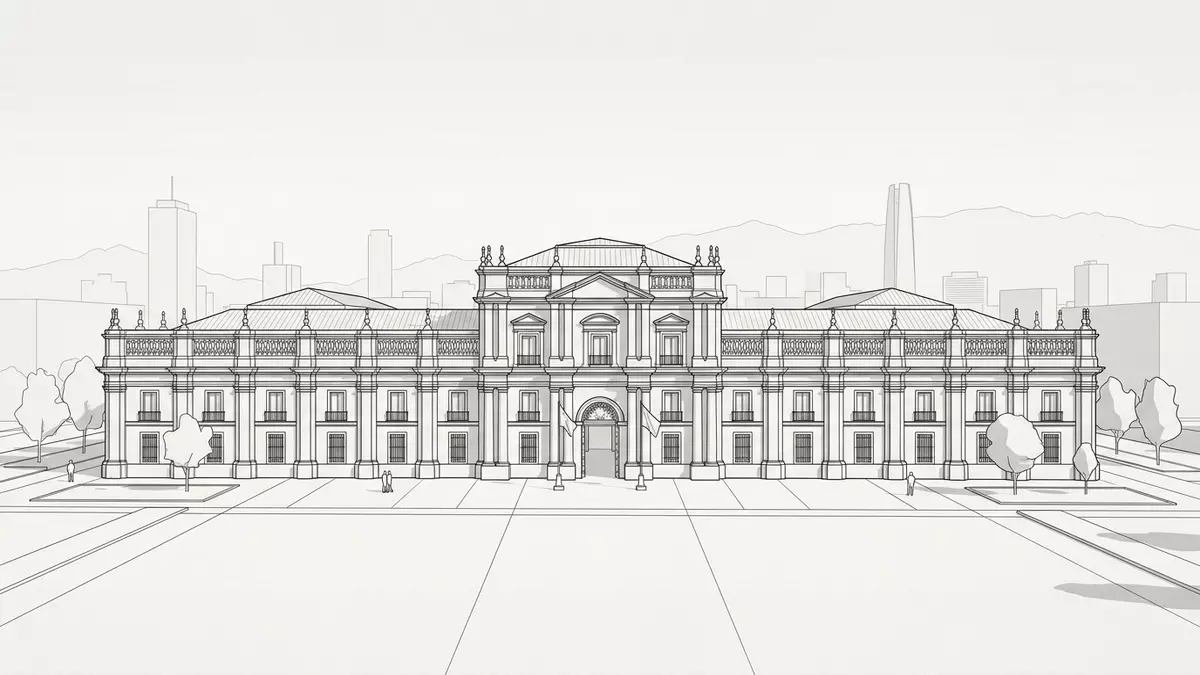
Palacio de La Moneda in Santiago de Chile is a neoclassical government palace that occupies an entire city block and links Chile’s colonial minting past with its presidential present. Built in the late eighteenth century to house the Royal Mint of Santiago and inaugurated in 1805, it later became the seat of the President of Chile in the nineteenth century, a layered story that visitors can read directly in its façades and courtyards.
A neoclassical palace shaped for government
Palacio de La Moneda was designed in the late eighteenth century by the Italian architect Joaquín Toesca, who had trained in Rome and brought European neoclassical principles to the emerging Chilean capital. Construction began in 1784 and the building was inaugurated in 1805 as the Royal Mint of Santiago, giving it a clear industrial role at the centre of the colonial city.Construction began in 1784 The palace is regarded as one of the main examples of neoclassicism in Chile, with Roman Doric influences expressed in its horizontal composition and ordered façades.Main example of neoclassicism in Chile
The external elevations of Palacio de La Moneda present a disciplined rhythm of pilasters and evenly spaced openings, emphasising proportion rather than ornament. The main front faces Moneda Street, with a central entrance framed by classical detailing that signals its governmental role to anyone approaching from the north.Horizontal composition with Roman Doric influences Behind the façades, a sequence of courtyards organises the interior, including Los Cañones courtyard and Los Naranjos courtyard, where an old fountain recalls the period when water and coin production were practical concerns of the city.
From Royal Mint to presidential seat
Palacio de La Moneda began life as a mint, conceived to house workshops and machinery for producing coins for the Spanish Crown in the Americas, and serving this function through the end of the colonial period and into the early republican era.Used originally to mint coins The production of coins in Chile took place in this building well into the twentieth century, even as its political role expanded.Coin production continued until 1929
In the nineteenth century, Palacio de La Moneda was adapted from an industrial complex into the seat of government, reflecting the consolidation of Chile’s republican institutions. In 1845 it became the seat of the executive branch and the official presidential residence, under President Manuel Bulnes, placing the offices of the President of the Republic and ministries linked to the presidency inside a building originally laid out for minting.Seat of government and residence since 1845 This change of function is still legible in the internal patios and wings, where sober neoclassical forms frame spaces used for state ceremonies and day-to-day administration.
Palacio de La Moneda in Santiago’s civic landscape
Palacio de La Moneda occupies a prominent position in Santiago de Chile’s Civic District, filling a rectangular city block between major streets and aligning with plazas that host demonstrations and official ceremonies.Occupies an entire city block in the Civic District The palace’s long façades create a strong horizontal presence among surrounding buildings, and its ordered classical language anchors the government quarter visually within the wider city.
The building has also been recognised beyond Chile’s borders. La Moneda Palace appears on Chile’s tentative list for UNESCO World Heritage status, proposed as a cultural site that represents both architectural neoclassicism and the country’s political history.Listed on Chile’s UNESCO tentative list Around the palace, plazas, memorials and adjoining government buildings form a wider ensemble, making Palacio de La Moneda a focal point when tracing Chile’s path from colonial administration to independent republic through its built environment.
Visiting Palacio de La Moneda: what travellers from Western Europe should know
- Palacio de La Moneda stands in Santiago de Chile’s central Civic District, occupying a full city block between streets such as Moneda and the Alameda, and is reached on foot or by urban transport within the downtown area.
- The palace forms a compact urban complex with internal courtyards and formal entrances; approaches from surrounding plazas involve ground-level routes without long climbs, though interior staircases connect its levels.
- Palacio de La Moneda is surrounded by civic spaces including Plaza de la Constitución and other government buildings, so a visit naturally combines views of the palace with the wider governmental quarter of Santiago de Chile.
- The official language is Spanish and the currency is the Chilean peso.
- Entry requirements depend on your nationality; UK travellers can check the FCDO travel advice at gov.uk/foreign-travel-advice, Irish travellers the Department of Foreign Affairs at ireland.ie.
Searching for Palacio de La Moneda on social platforms
These links open searches for Palacio de La Moneda on each platform.
Frequently asked questions about Palacio de La Moneda
Where is Palacio de La Moneda located?
Palacio de La Moneda stands in the Civic District of central Santiago de Chile, occupying a complete city block between Moneda Street, the Alameda and surrounding plazas.
What can visitors expect when seeing Palacio de La Moneda?
Visitors encounter a large neoclassical government palace with ordered façades and internal courtyards, set among plazas and other state buildings that together form Chile’s principal governmental ensemble.
What makes Palacio de La Moneda distinctive among Chilean landmarks?
Palacio de La Moneda combines Joaquín Toesca’s neoclassical architecture with a rare continuity of function, evolving from the Royal Mint of Santiago into the seat of the President of Chile while retaining its original palace-like form.


