
Palacio de La Moneda, a neoclassical palace at Chile’s civic core
Published on 08/28/2026 at 16:56 | Editorial responsibility: Rafael Müller, Editor-in-Chief AD HOC NEWS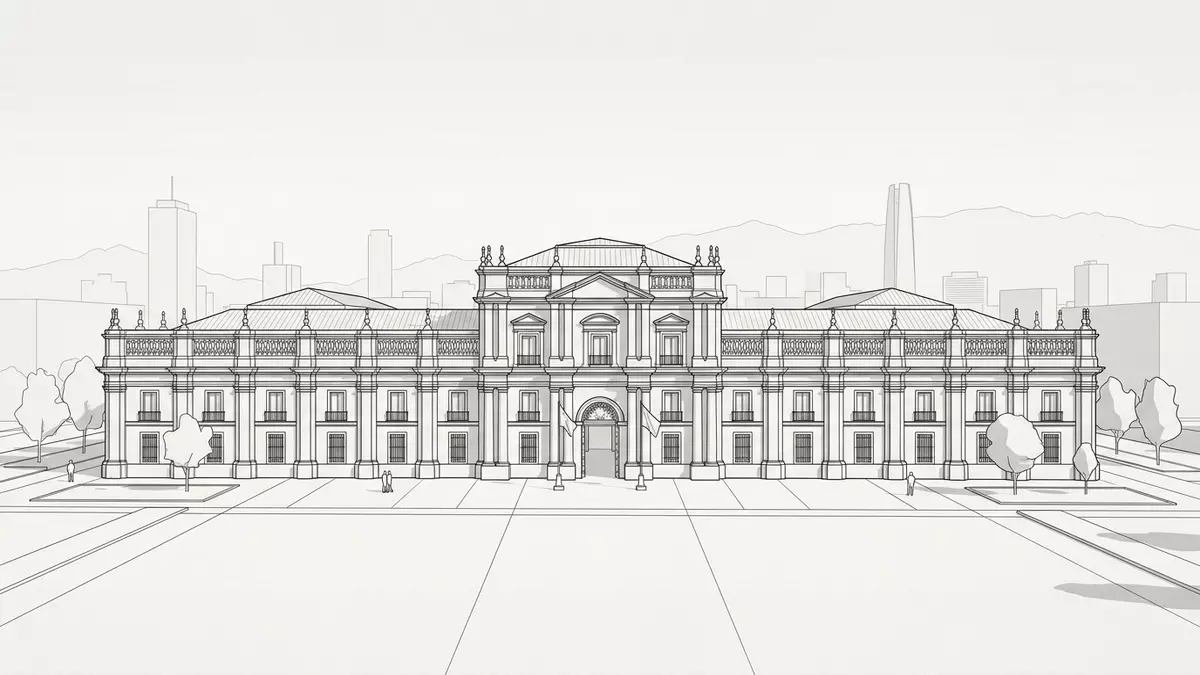
Palacio de La Moneda in Santiago de Chile is a neoclassical government palace that occupies an entire city block in the city’s Civic District and serves as the seat of the President of Chile. Designed in the late eighteenth century by the Italian architect Joaquín Toesca and inaugurated as the Royal Mint of Santiago in 1805, it later became the presidential palace in the nineteenth century.
A mint that became a seat of government
Palacio de La Moneda began life as an industrial building, conceived to serve as the Royal Mint for the Kingdom of Chile under the Spanish Crown. The project was entrusted to Joaquín Toesca, an Italian architect active in the service of King Charles III of Spain, who developed a sober neoclassical design with Roman Doric influences for the new mint.neoclassical design with Roman Doric influences Construction is recorded as having begun in the 1780s, and the building was inaugurated in 1805 as the Royal Mint of Santiago, housing the machinery and workshops for coin production for the colonial economy.inaugurated in 1805 as the Royal Mint of Santiago
After Chile achieved independence in the early nineteenth century, Palacio de La Moneda gradually shifted from industrial use to political and residential functions. In 1845 the building became the seat of government and the official presidential residence, establishing its role at the centre of the republic’s executive power.in 1845 the building became the seat of government Through this change of use, the palace’s architecture, originally conceived for minting, came to frame the offices and ceremonial spaces of the President and key ministries.
Neoclassical architecture across a full city block
Architecturally, Palacio de La Moneda is one of the clearest examples of neoclassicism in Chile, with a horizontal composition and classical detailing that emphasise order and stability.one of the clearest examples of neoclassicism in Chile The palace occupies an entire block in downtown Santiago, bounded by Moneda Street to the north, Morandé Street to the east, the Alameda del Libertador Bernardo O’Higgins to the south and Teatinos Street to the west.occupies an entire block in the Civic District Its principal façade faces Moneda Street and presents a disciplined rhythm of pilasters and evenly spaced openings, arranged around a central entrance framed by classical elements.
Behind the façades, the palace is organised along transverse and longitudinal axes that create a series of interior courtyards. These patios bring light into the surrounding rooms and form calm enclosed spaces within the dense urban fabric.interior courtyards distributed along transverse and longitudinal axes Over the nineteenth and twentieth centuries the building underwent extensions and alterations, including work in the early 1930s that added new wings and another storey on part of the structure,extensions carried out between 1930 and 1934 but the neoclassical language and courtyard-based plan still define the character of Palacio de La Moneda.
Civic plazas and contemporary governmental life
In its present form Palacio de La Moneda houses the offices of the President of the Republic of Chile together with several key ministries, including the Ministry of the Interior and Public Security, the General Secretariat of the Presidency and the General Secretariat of Government.houses the offices of the President and key ministries The palace is surrounded by formal civic spaces, notably the Plaza de la Constitución on one side and the broader alignment of the Alameda, which together frame governmental ceremonies and public life.
Palacio de La Moneda is recognised as a monument of national importance and has been declared a historic monument under Chilean law, reflecting its architectural value and central role in the country’s political history.declared a monumento histórico under Chilean heritage legislation For visitors, the juxtaposition of the palace’s neoclassical façades, its interior courtyards and the surrounding plazas offers a clear view of how architecture, urban planning and state institutions meet in the centre of Santiago.
Visiting Palacio de La Moneda: what travellers from Western Europe should know
- Palacio de La Moneda stands in the Civic District of central Santiago de Chile, occupying a full block between Moneda, Morandé, Teatinos and the Alameda del Libertador Bernardo O’Higgins.
- The palace’s setting is urban and flat, with access from surrounding streets and adjacent plazas; the courtyards and ceremonial spaces are arranged within a multi-storey neoclassical structure.
- The official language is Spanish and the currency is the Chilean peso.
- Entry requirements depend on your nationality; UK travellers can check the FCDO travel advice at gov.uk/foreign-travel-advice, Irish travellers the Department of Foreign Affairs at ireland.ie.
Searching for Palacio de La Moneda on social platforms
These links open searches for Palacio de La Moneda on each platform.Frequently asked questions about Palacio de La Moneda
Where is Palacio de La Moneda located in Santiago de Chile?
Palacio de La Moneda stands in central Santiago de Chile’s Civic District, occupying a full block bounded by Moneda, Morandé, Teatinos and the Alameda del Libertador Bernardo O’Higgins.
What can a visitor expect when approaching Palacio de La Moneda?
Visitors encounter a neoclassical palace with formal façades facing surrounding streets and plazas, and, within the block, a sequence of interior courtyards framed by governmental offices and ceremonial rooms.
What makes Palacio de La Moneda distinctive among Chile’s government buildings?
The palace combines its origin as an eighteenth-century Royal Mint, its nineteenth-century adoption as the presidential seat and its neoclassical courtyard plan, all concentrated in a single block at the heart of Chile’s civic centre.


