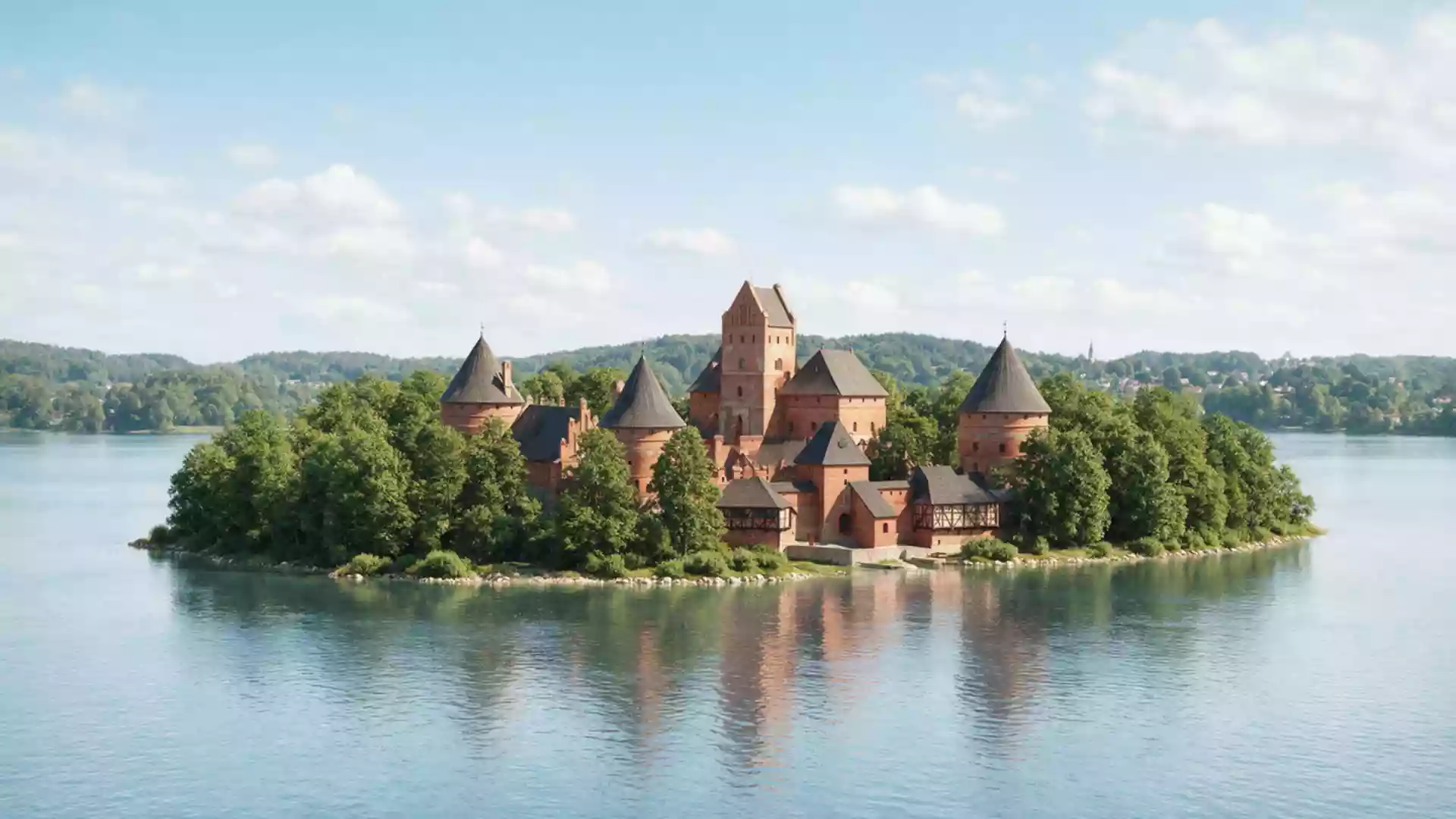
Traku salos pilis and its red-brick island setting
Published on 09/14/2026 at 16:47 | Editorial responsibility: Rafael Müller, Editor-in-Chief AD HOC NEWS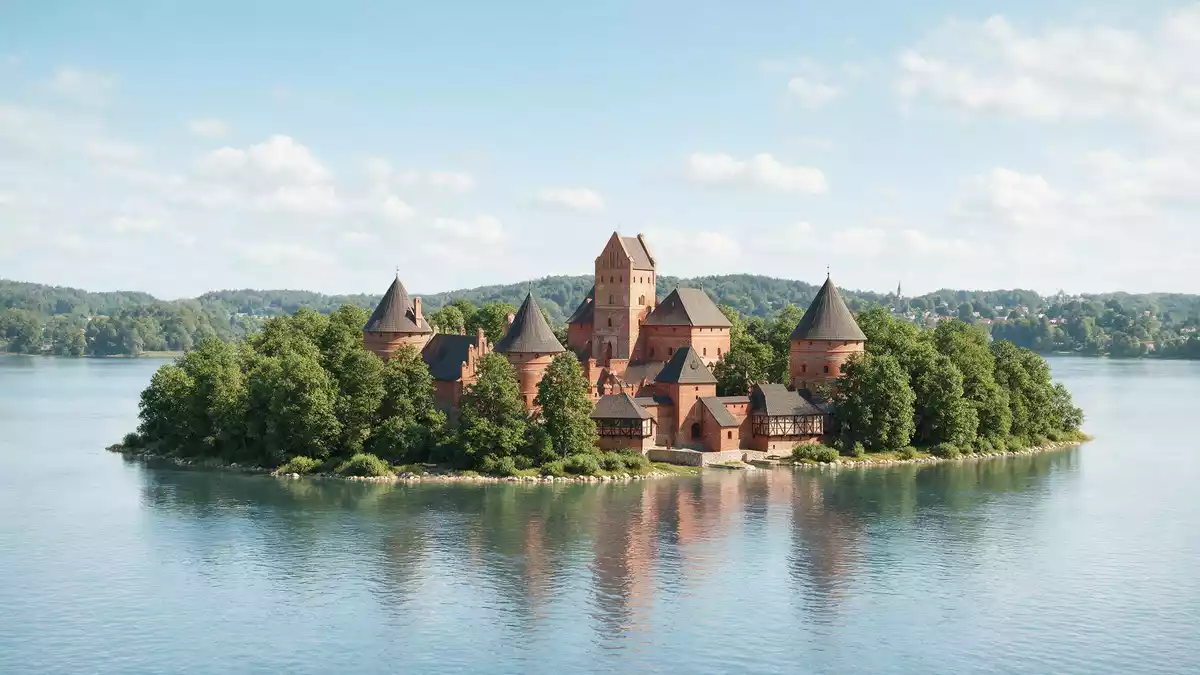
Traku salos pilis rises on an island in Lake Galv? in Trakai, where red brick and Gothic forms define its silhouette. It is the Lithuanian name for Trakai Island Castle, one of the best-known survivals of the Grand Duchy of Lithuania.
Red brick above Lake Galv?
The castle is part of the Trakai island landscape, with water on all sides and a bridge linking it to the town. Its walls, towers and palace blocks are built in brick with stone foundations, and the ensemble reads as a fortified residence rather than a single compact tower. Gothic fortress remains the simplest way to describe its overall character.
The site belongs to the late medieval world of Lithuanian statehood. Trakai stood among the important centres of the Grand Duchy of Lithuania, and the castle became tied to the rule of K?stutis and his son Vytautas the Great. late fourteenth century gives the complex its historical frame, while the island setting keeps that period visible in the present form of the place.
K?stutis, Vytautas and the medieval residence
Construction began under K?stutis in the fourteenth century, and major work was completed under Vytautas the Great around 1409. The castle then served as a residence within a political landscape centred on the Grand Duchy of Lithuania, with halls and defensive walls sharing the same island footprint.
Vytautas the Great remains closely linked with the castle’s history, and his name gives the site a clear human anchor. The building’s masonry vocabulary is still legible: brick walls, towers, and a palace mass arranged behind outer defences. Vytautas the Great is the figure most associated with the castle’s completed form.
From ruins to museum halls
The castle changed function after its medieval life as a residence and stronghold. It later became the home of the Trakai History Museum, and restored halls now carry exhibitions rather than courtly or military use. museum in 1962 marks the point at which the rebuilt complex took on that role.
The building’s second life is visible in the contrast between the water-bound fortress form and the museum function inside it. Traku salos pilis therefore belongs to both medieval architectural history and the civic memory of Trakai, with the island site holding those layers together.
Visiting Traku salos pilis: what travellers from Western Europe should know
- The castle stands in Trakai, south-west of Vilnius, on an island in Lake Galv?. A bridge leads across the water from the town side.
- The setting is flat around the lake, but the castle itself is spread across courtyards, towers and linked buildings. Brick, stone and water are the main permanent elements.
- Trakai belongs to Lithuania, and Lithuanian is the official language. The currency is the euro.
- Traku salos pilis stands within Trakai Historical National Park, a protected landscape around the lakes and the historic town.
- The castle complex is a museum site, with halls, defensive walls and towers forming the main parts of the visit.
Searching for Traku salos pilis on social platforms
These links open searches for Traku salos pilis on each platform.
Frequently asked questions about Traku salos pilis
Where is Traku salos pilis?
It stands in Trakai, on an island in Lake Galv?, west of Vilnius. The town and the castle are linked by a bridge across the water.
What does a visit involve?
The site centres on the castle buildings, towers and museum halls inside the restored complex. The island setting and brick fortifications are the main features to look for.
What makes it distinctive?
Its red-brick Gothic character and island location give Traku salos pilis a clear identity. The castle also carries the names of K?stutis and Vytautas the Great in its history.