
Traku salos pilis, the red-brick island castle of Trakai
Published on 09/07/2026 at 06:57 | Editorial responsibility: Rafael Müller, Editor-in-Chief AD HOC NEWS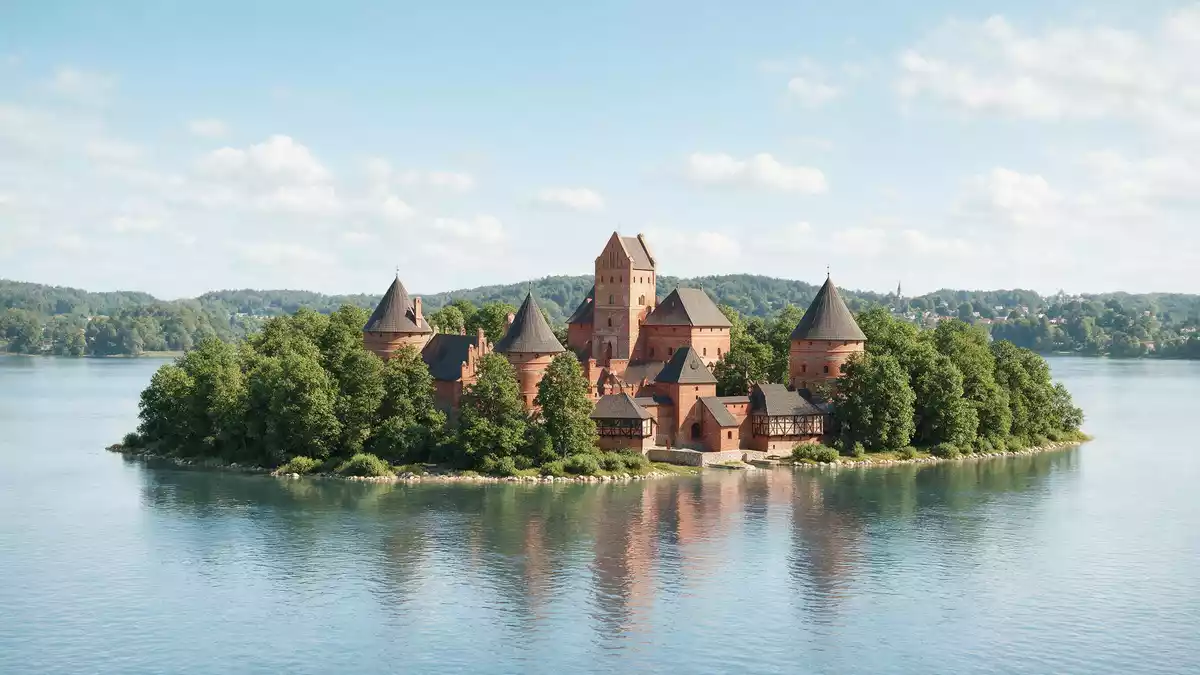
Traku salos pilis is the Lithuanian name for Trakai Island Castle, a red-brick Gothic fortress standing on an island in Lake Galv? beside the town of Trakai in Lithuania. Built as a residence and stronghold for rulers of the Grand Duchy of Lithuania in the late fourteenth and early fifteenth centuries, it now houses the Trakai History Museum inside restored halls and towers.
An island fortress of the Grand Duchy of Lithuania
Traku salos pilis occupies a low island in Lake Galv?, one of the lakes that shape the landscape around Trakai. The castle stands on what is now a single larger island, reached from the shore by a long wooden footbridge that crosses the water and leads directly through the outer gate towards the inner courtyard.Trakai Island Castle The position on the lake gave the medieval stronghold natural protection, with the water forming a wide moat around its curtain walls.
Construction of Traku salos pilis began in the second half of the fourteenth century under Grand Duke K?stutis and continued into the early fifteenth century under his son Vytautas, known as Vytautas the Great.began in the mid-14th century The castle is built in brick in the Gothic style, with high walls, battlements and towers arranged around a palace of the convent type and a forecourt enclosed by further defences.convent-type palace with a keep In the fifteenth century Traku salos pilis functioned as one of the residences of the Grand Dukes of Lithuania, placing it among the political centres of the late medieval state.residence of rulers
Red brick, Gothic details and a reconstructed interior
Seen from the lakeshore, Traku salos pilis is characterised by its red brick walls and steeply pitched roofs, with towers rising above the surrounding water and forested shore. The main palace block is arranged around an inner courtyard, where galleries and staircases give access to rooms on several levels within the envelope of the outer walls.red-brick Gothic towers The Gothic character appears in elements such as pointed arches in the arcades, decorative brickwork around window openings and vaults inside some of the halls.
Parts of the interior have been reconstructed to evoke the period when the castle served as a residence, including chambers with timber ceilings, stone fireplaces and displays of armour, weapons and courtly artefacts. The architecture combines defensive features, such as massive walls and towers, with residential spaces that once accommodated the court of Vytautas and other members of the ruling elite.Salos pilis description Walking through the courtyard and up into the galleries, visitors encounter views across the lake framed by the castle’s masonry and rooflines.
From decline to museum at Lake Galv?
Like many medieval fortresses, Traku salos pilis experienced a period of decline after its military and residential importance faded. Damage in the seventeenth century left the structure in ruins, and for a long time the brick walls and towers stood as remnants on the island before systematic restoration brought them back to a more complete form.fell into disarray in the 17th century After restoration campaigns in the twentieth century, the castle became home to the Trakai History Museum in 1962, a function it continues to hold.passed into the hands of Trakai History Museum
The museum uses the rooms of Traku salos pilis to display material connected with the Grand Duchy of Lithuania and with everyday and ceremonial life in the castle. Exhibitions include medieval weaponry and armour, religious art and objects related to the multi-ethnic history of Trakai and its surroundings.Trakai History Museum exhibits Outside the castle walls, Lake Galv? forms a setting of open water with other islands and peninsulas visible, and the rebuilt fortress stands as a prominent landmark within this landscape.
Visiting Traku salos pilis: what travellers from Western Europe should know
- Traku salos pilis stands on an island in Lake Galv? next to the town of Trakai in south-eastern Lithuania, west of Vilnius, and is reached on foot via a wooden bridge from the lakeshore.situated on an island on Lake Galv?
- Inside the castle, movement between levels uses stairways and wooden galleries around the courtyard, and visitors encounter stone floors, steps and uneven surfaces typical of a medieval fortress.courtyard and galleries
- Traku salos pilis lies within Lithuania, where the official language is Lithuanian and the currency is the euro.
Searching for Traku salos pilis on social platforms
These links open searches for Traku salos pilis on each platform.
Frequently asked questions about Traku salos pilis
Where is Traku salos pilis located?
Traku salos pilis stands on an island in Lake Galv? beside the town of Trakai in Lithuania, south-west of Vilnius in the country’s lake district.
What can visitors expect inside the castle?
Inside Traku salos pilis, visitors walk through a courtyard ringed by galleries and stairways, entering brick-built halls that house exhibitions of medieval weaponry, armour and historical artefacts.
What makes Traku salos pilis distinctive among European castles?
Traku salos pilis is distinctive for its red-brick Gothic architecture and its setting as a restored medieval fortress occupying an island completely surrounded by the waters of Lake Galv?.


