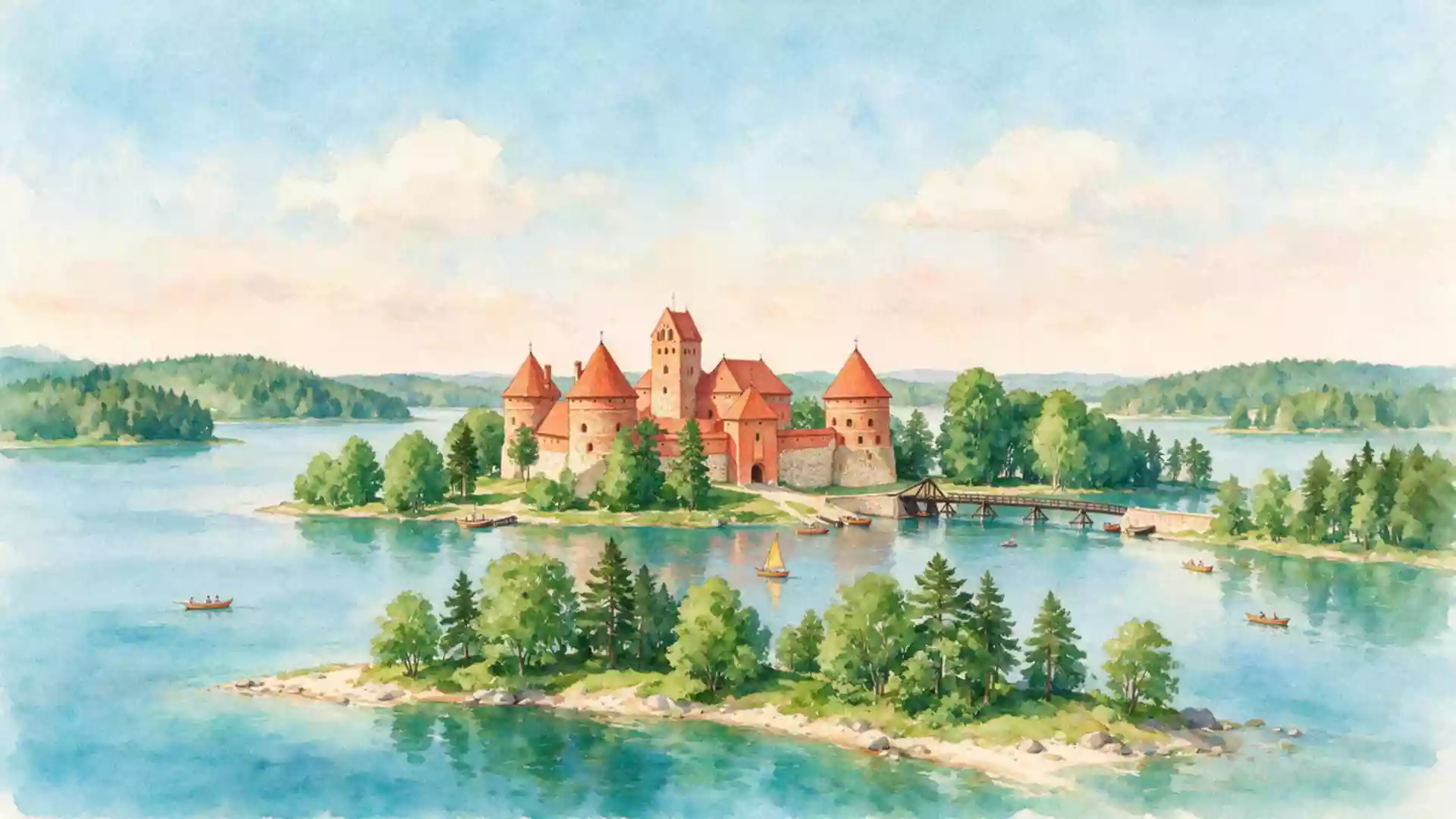
Traku salos pilis: a Gothic water castle on Lake Galv?
Published on 08/18/2026 at 14:01 | Editorial responsibility: Rafael Müller, Editor-in-Chief AD HOC NEWS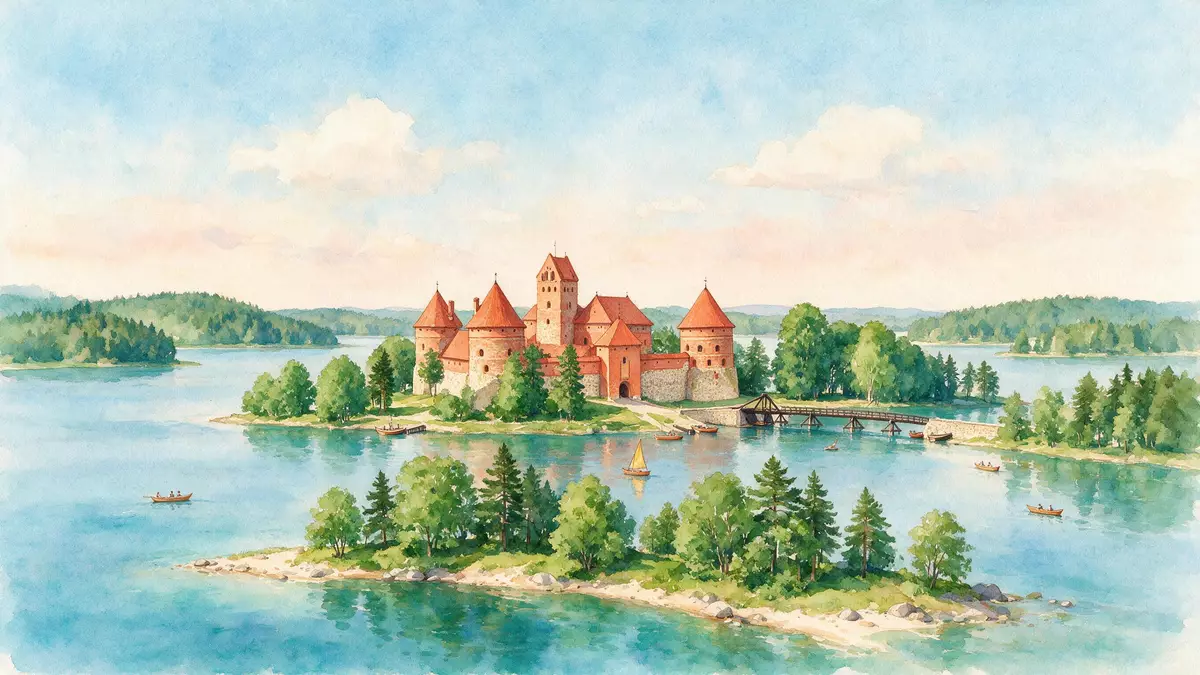
Traku salos pilis is better known in English as Trakai Island Castle, a red-brick Gothic fortress set on an island in Lake Galv? in the historic town of Trakai in Lithuania. Built for the medieval Grand Dukes of Lithuania in the late fourteenth and early fifteenth centuries, it now serves as the Trakai History Museum inside walls that still read as a water-bound stronghold.
A brick Gothic castle in the Grand Duchy of Lithuania
Traku salos pilis stands within what was once one of the main centres of the Grand Duchy of Lithuania, its island position giving a clear sense of how power and landscape intertwined.Trakai was one of the main centres of the Grand Duchy of Lithuania Construction of the stone and brick complex is dated to the later part of the fourteenth century under Grand Duke K?stutis, with major works completed in the early fifteenth century by his son Vytautas the Great.The construction of the Castle was started by Grand Duke K?stutis of Lithuania and finished by his son Vytautas
The castle’s architectural language is largely Gothic, with red brick upper walls rising above stone foundations laid from blocks of varying size.Stone blocks were used in the foundations and upper parts of the buildings but the rest of the construction was done using red Gothic bricks Behind the fortifications was a residence and treasury for the Grand Dukes, combining defensive features such as towers and outer walls with an inner palace arranged around a courtyard. In the twentieth century the damaged complex was rebuilt, and by 1962 it had taken on its role as a museum presenting the history of Trakai and the wider region.In 1962, the castle became a part of the Trakai History Museum
On an island in Lake Galv?
The defining experience of Traku salos pilis is its setting on an island in Lake Galv?, a lake dotted with numerous islands and fringed by forested slopes.The castle consists of a convent-type palace with a keep and a forecourt The castle occupies one of the larger islands, surrounded by water on all sides, and is linked to the town by a straight timber bridge that carries visitors across the lake towards the gate. From the approach the structure reads as a compact ensemble of brick walls, towers and rooflines rising above the shoreline, with the water reflecting its colour.
The lake itself, within Trakai Historical National Park, gives the monument a distinct character compared with land-based castles elsewhere in Lithuania.Lake Galv?, Trakai, Trakai District The surrounding landscape combines low wooded hills, additional islands and views towards the Peninsula Castle, so a visit to Traku salos pilis includes both the built fabric and the wider setting of water and forest. From the outer walls and the bridge, the outlook extends across Lake Galv? to other parts of the national park.
Palace, courtyard and towers
Within the outer defences, Traku salos pilis follows what is described as a convent-type arrangement, with two three-storey palace blocks and a keep forming an enclosed courtyard paved in stone.VLE describes the palace of Island Castle as convent-type architecture: two three-storey blocks with galleries and a keep Galleries run along the upper levels, giving access to rooms that preserve or recreate details such as ribbed vaulting, traces of fifteenth-century fresco painting with Byzantine-style features, stained glass and an underground hypocaust heating system in the basement. These elements underline the castle’s status not only as a fortress but also as a princely residence.
Beyond the palace proper lies a forecourt defended by high walls and towers. Sources describe three round towers rising several storeys, together with a gate tower that controls access between the bridge and the inner spaces.A defensive wall surrounded the palace, while the fore-castle had a courtyard with three round four-storey towers and a gate tower In plan, the ensemble shows how medieval defensive ideas were combined with an orderly residential plan, and the mixture of brick and stone construction is visible in the textures of walls, corners and interior surfaces. Exhibitions within the rooms display objects such as arms, armour, glassware and religious art, presenting the world for which the castle was built.Trakai Island Castle Museum stands as a meticulously restored 14th-15th century Gothic castle perched on an island in Lake Galv?
Visiting Traku salos pilis: what travellers from Western Europe should know
- Traku salos pilis stands on an island in Lake Galv? at Trakai, west of Vilnius, reached from the town by a wooden bridge across the water.
- The approach to the castle includes an uncovered walk across the bridge and through the outer courtyard, with stone paving and steps inside the towers and palace.
- The area forms part of Trakai Historical National Park, with Lake Galv? and neighbouring islands offering further viewpoints around the castle.
- The official language is Lithuanian and the currency is the euro.
Searching for Traku salos pilis on social platforms
These links open searches for Traku salos pilis on each platform.Frequently asked questions about Traku salos pilis
Where is Traku salos pilis located?
Traku salos pilis stands on an island in Lake Galv? at Trakai in Lithuania, west of Vilnius, within Trakai Historical National Park.
What can visitors expect inside the castle?
Inside the brick Gothic palace and towers, visitors find courtyards, vaulted rooms and museum exhibitions covering medieval Lithuania, arms, artefacts and the history of Trakai.
What makes Traku salos pilis distinctive among castles?
Its combination of Gothic brick architecture, island setting on Lake Galv? and role as a former residence of Grand Dukes such as Vytautas the Great makes it a distinctive water castle.