
Sobor Vasiliya Blazhennogo and its painted brick towers over Red Square
Published on 09/09/2026 at 10:14 | Editorial responsibility: Rafael Müller, Editor-in-Chief AD HOC NEWS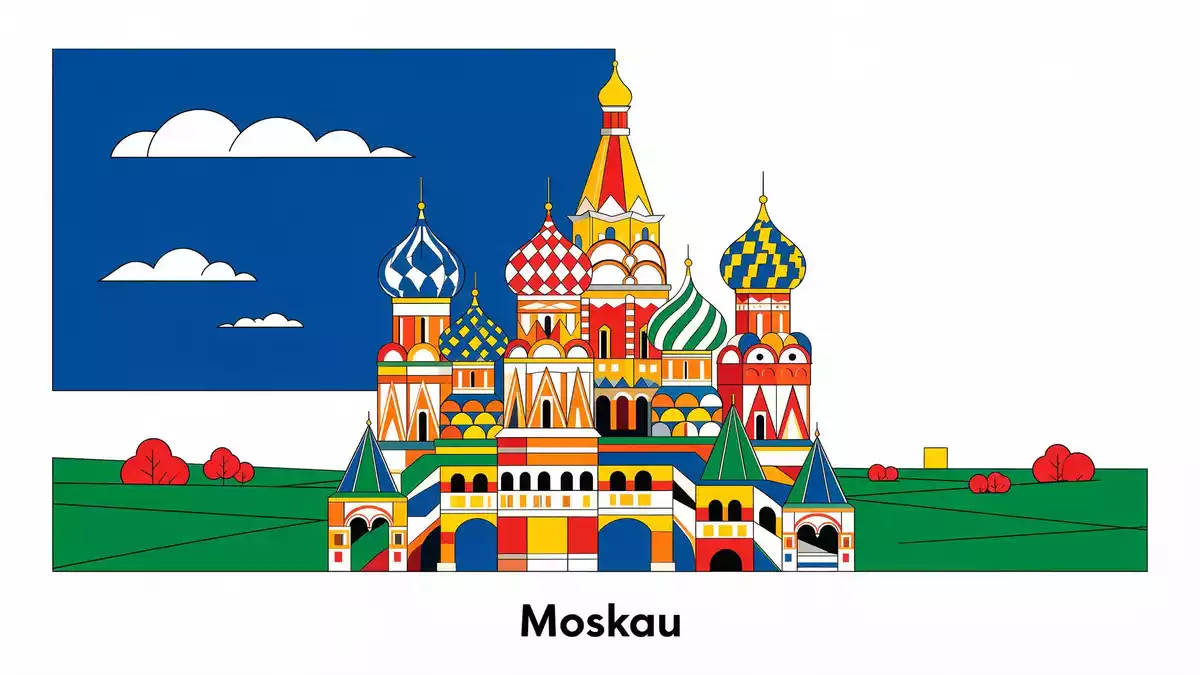
Sobor Vasiliya Blazhennogo, better known in English as Saint Basil’s Cathedral, stands on Red Square in Moskau as a compact cluster of chapels crowned by vividly coloured domes. Built under the rule of Ivan IV in the mid-sixteenth century, it combines brick construction with an intricate plan that has become one of the most recognisable silhouettes in Russia.
Brick, chapels and a clustered plan
The official name of Sobor Vasiliya Blazhennogo is the Cathedral of the Intercession of the Most Holy Theotokos on the Moat, a Russian Orthodox church that historically formed part of the religious ensemble around the Kremlin.Cathedral of the Intercession The present brick building was constructed between 1555 and 1561 during a period of expansion under Ivan IV, widely known as Ivan the Terrible.built between 1555 and 1561
The cathedral brings together several individual chapels on a single brick base, arranged around a taller central tower that rises above the ensemble.complex of churches on one substructure Inside, passages and galleries thread between the chapels, creating a sequence of relatively small interiors rather than one dominant nave. The clustered plan, with its central tower and surrounding chapels, sets Sobor Vasiliya Blazhennogo apart from the more linear layouts of many Western European cathedrals.
Sixteenth-century Moscow and the patron saint
Sobor Vasiliya Blazhennogo belongs to the architectural and political landscape of the sixteenth century, a period when Moscow was asserting itself as the centre of a growing state. Ivan IV ordered the construction following campaigns against the Khanate of Kazan, giving the cathedral a direct link to that phase of expansion.Ivan IV ordered the building in 1555 The church’s dedication connects it to the Intercession of the Theotokos, while its more familiar name in Russian refers to Basil the Blessed, a local saint associated with Moscow.Basil the Blessed as namesake
Basil the Blessed, who lived in the late fifteenth and early sixteenth centuries, became closely tied to the city’s spiritual identity, and his name in turn became attached to the cathedral’s image abroad.Saint Basil as an Orthodox saint The building also reflects the development of Russian church architecture from earlier white-stone structures into more elaborate compositions, combining traditional forms with the possibilities of brick masonry in the mid-sixteenth century.sixteenth-century Moscow church architecture
Red Square setting and painted domes
Sobor Vasiliya Blazhennogo stands at the southern edge of Red Square in Moskau, immediately beside the Kremlin walls and near the embankment of the Moskva River.on Red Square beside the Kremlin Its position makes it a visual anchor at one end of the square, with the Historical Museum and the State Kremlin Palace forming other points of reference around the open space.next to Red Square monuments
From the outside, the most striking feature is the set of painted domes rising above the brick chapels. Each dome has its own colour scheme and ornamental pattern, giving the ensemble a skyline that stands out against the more uniform roofs and towers of the Kremlin. The brick walls below carry arches, cornices and narrow openings that frame the approach routes into the interior.
Visiting Sobor Vasiliya Blazhennogo: what travellers from Western Europe should know
- Sobor Vasiliya Blazhennogo stands on Red Square in central Moskau, immediately south of the Kremlin and close to the Moskva River embankment; several metro stations, including Ploshchad Revolyutsii, Teatralnaya and Okhotny Ryad, lie within walking distance.
- The approach from Red Square includes a stair and stepped thresholds into the lower level, and the interior routes between the chapels pass through relatively narrow corridors and staircases.
- The cathedral is in Russia, where the official language is Russian and the currency is the rouble.
- Entry requirements depend on your nationality; UK travellers can check the FCDO travel advice at gov.uk/foreign-travel-advice, Irish travellers the Department of Foreign Affairs at ireland.ie.
Searching for Sobor Vasiliya Blazhennogo on social platforms
These links open searches for Sobor Vasiliya Blazhennogo on each platform.
Frequently asked questions about Sobor Vasiliya Blazhennogo
Where is Sobor Vasiliya Blazhennogo located?
Sobor Vasiliya Blazhennogo stands on Red Square in central Moskau, immediately beside the Kremlin walls and close to the embankment of the Moskva River.
What should visitors expect inside the cathedral?
Visitors encounter a sequence of relatively small chapels linked by corridors and staircases, with brick walls, painted surfaces and arches defining the interiors.
What makes Sobor Vasiliya Blazhennogo distinctive among Russian churches?
Its clustered plan of chapels around a central tower, combined with individually painted domes above a brick base on Red Square, gives the cathedral a distinctive profile in Moscow’s skyline.


