
Sobor Vasiliya Blazhennogo in Red Square’s brick and colour
Published on 08/29/2026 at 15:35 | Editorial responsibility: Rafael Müller, Editor-in-Chief AD HOC NEWS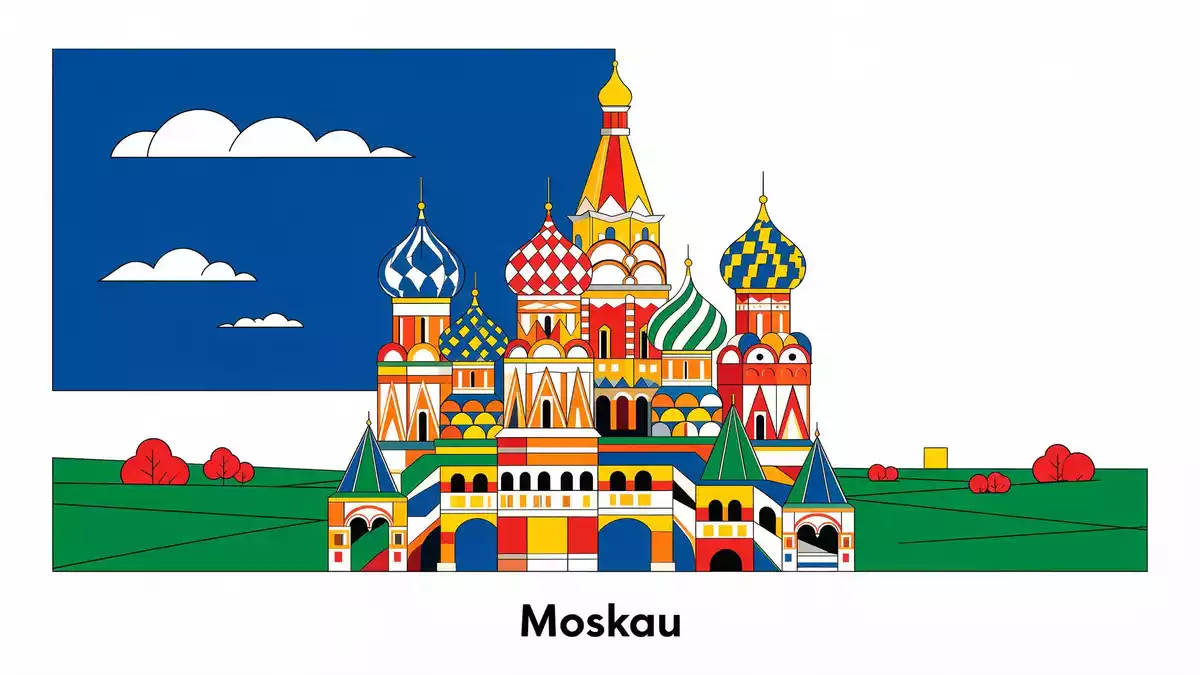
Sobor Vasiliya Blazhennogo rises on Red Square in Moskau as a compact cluster of chapels, domes and galleries. Built under Ivan IV between 1555 and 1561, it is better known in English as Saint Basil’s Cathedral.
A ring of chapels in red brick
The building is not a single hall but a grouped composition around a central core. Its red-brick walls stand on white-stone foundations, and the exterior is broken by domes, porches and linked passages.
The plan brings together the central church and surrounding chapels into one dense mass. That arrangement gives Sobor Vasiliya Blazhennogo its unusual profile on the square, with each part reading separately and as part of a larger whole.1555 to 1561
Ivan IV and the Moscow of the sixteenth century
The cathedral belongs to the world of Ivan IV, the ruler remembered in English as Ivan the Terrible. Its construction in the mid-sixteenth century places it among the most recognisable monuments of Muscovite architecture.
The official name is Cathedral of the Intercession of the Most Holy Theotokos on the Moat. The name Sobor Vasiliya Blazhennogo entered common use through the chapel linked with Vasily the Blessed, whose burial is part of the building’s later history.official name The cathedral also belongs to the Moscow Kremlin and Red Square World Heritage site.World Heritage site
Domes, galleries and later additions
The upper parts are the feature most people recognise first. Different domes crown the chapels, and later galleries wrap around the core, giving the whole structure a layered outline.
Inside, narrow corridors connect the chapels and create a sequence of small, separate spaces. The cathedral’s present appearance reflects work across the sixteenth and seventeenth centuries, with colour, masonry and added elements accumulating over time.present appearance
Visiting Sobor Vasiliya Blazhennogo: what travellers from Western Europe should know
- It stands on Red Square in central Moskau, beside the Kremlin wall and close to the square’s main pedestrian routes.
- The interior is arranged through narrow passages and small chapels, so the visit feels more like moving through a sequence of rooms than through one large nave.
- Many travellers combine it with the wider Red Square ensemble, which includes the Kremlin and the historic buildings around the square.
- The building sits on a paved city square rather than open parkland, so the approach is entirely urban.
Searching for Sobor Vasiliya Blazhennogo on social platforms
These links open searches for Sobor Vasiliya Blazhennogo on each platform.
Frequently asked questions about Sobor Vasiliya Blazhennogo
Where is Sobor Vasiliya Blazhennogo?
It stands on Red Square in Moskau, close to the Kremlin and the historic centre of the city.
What does a visit involve?
The visit centres on chapels, galleries and narrow internal passages. The building reads as a compact ensemble rather than a single vast room.
What makes it distinctive?
Its identity comes from the clustered plan, the red-brick structure and the colourful domes. The combination is closely tied to sixteenth-century Moscow.


