
Rocamadour, the cliffside sanctuary above the Alzou gorge
Published on 09/14/2026 at 11:59 | Editorial responsibility: Rafael Müller, Editor-in-Chief AD HOC NEWS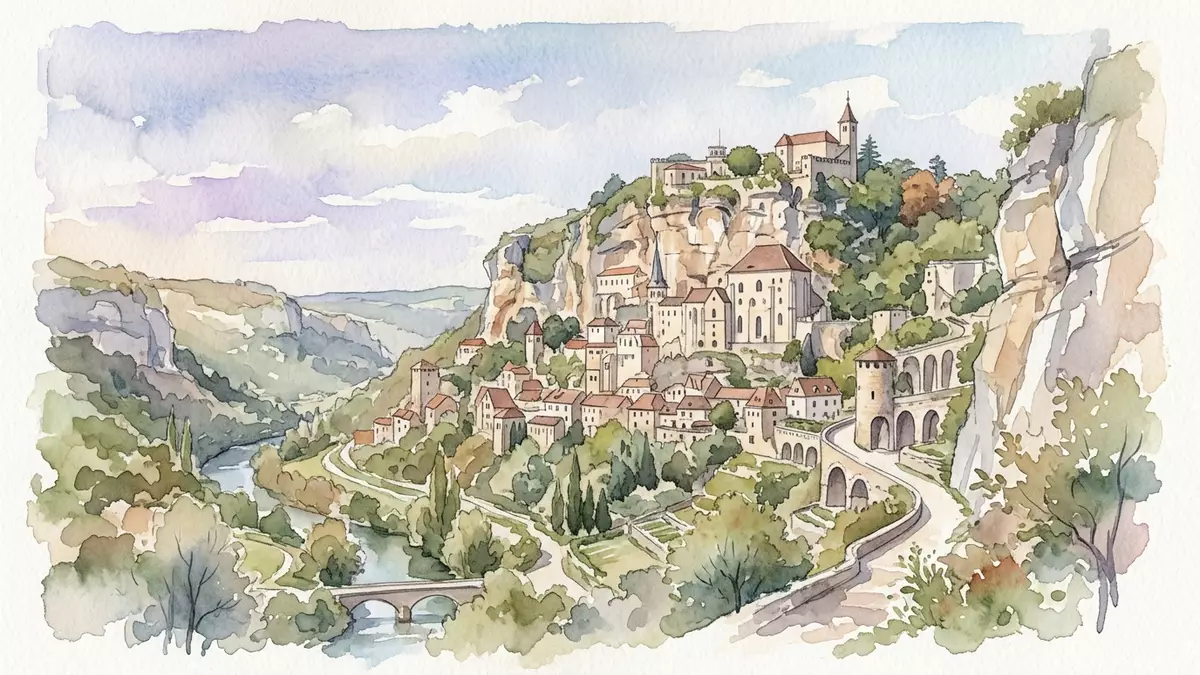
Rocamadour is a medieval village in south?west France that climbs in terraces up a limestone cliff above the Alzou gorge, where houses, chapels and ramparts form a vertical sanctuary of stone linked to centuries of pilgrimage to the Virgin Mary and the hermit Saint Amadour.
A village stacked against a limestone cliff
Rocamadour lies in the Lot department of south?west France, in a narrow gorge carved by the Alzou, a tributary of the Dordogne.The village rises against a limestone cliff on the gorge’s northern side, with its buildings arranged in successive levels between the riverbed and the plateau above.Inhabited since the Paleolithic, the site took on its present form in the Middle Ages when the built terraces linked an older sanctuary with a growing settlement below.
At the lowest level, traditional stone houses line a single main street along the base of the cliff, pressed closely against the rock where the gorge is narrow.Above them a fortified gateway and defensive walls mark the transition to the religious core of Rocamadour, with flights of steps and steep lanes climbing towards the sanctuary. Higher still, on the plateau, stand remnants of ramparts and a château that once guarded the pilgrimage approaches, commanding wide views over the surrounding Causses landscape.
The sanctuary of the Virgin Mary and Saint Amadour
The heart of Rocamadour is its sanctuary complex midway up the cliff, a cluster of medieval chapels and churches gathered around a small paved courtyard cut directly into the rock face.The Cite Religieuse dates largely from the twelfth century, when hermits and clergy consolidated earlier devotional sites into a more formal group of buildings. Pilgrims approach the courtyard by a long stair known as the Grand Escalier, which rises from the village street below and passes through successive gates in the cliff.
Within the sanctuary stands the Chapelle Notre?Dame, which houses a wooden statue of the Virgin Mary known as the Black Virgin or Our Lady of Rocamadour.The cult of the Black Virgin is documented from the twelfth century and has drawn pilgrims for centuries from across Europe. Beside it are other chapels and the basilica of Saint?Sauveur, while below lies the crypt of Saint Amadour, associated with the hermit whose presence on the cliff is traditionally dated to the early Middle Ages.Saint Amadour is linked by tradition to the site’s origins, and the discovery of an incorrupt body identified with him in 1166 greatly increased the sanctuary’s fame.
Pilgrimage routes and medieval devotion
Rocamadour’s reputation as a place of devotion is documented from at least the tenth century, when a chapel here was given to a Benedictine abbey, and written records from 968 mention the site.By the second half of the twelfth century the pilgrimage had grown rapidly, with collections of miracle stories compiled around 1170 to record healings and interventions attributed to the Virgin and Saint Amadour. The discovery of the preserved body in 1166, near the chapel, and the presence of the Black Virgin intensified interest, and the sanctuary became one of the major destinations of medieval Christendom, linked with Rome, Jerusalem and Santiago de Compostela.
Rocamadour stands on one of the French routes of the Way of Saint James that lead towards Santiago de Compostela in Spain.Pilgrims walked or rode across the plateau, descending to the gorge to reach the sanctuary and leaving ex?votos and other offerings in gratitude for perceived miracles. Kings, nobles and church figures are recorded among the visitors, including Henry II of England and Louis IX of France, underlining Rocamadour’s role as both a spiritual centre and a place woven into wider political and religious networks of medieval Europe.
Rocamadour’s layered history and present landscape
Evidence from nearby caves such as the Grotte des Merveilles shows that the wider area around Rocamadour has been inhabited since prehistoric times, with painted chambers attesting to human presence long before Christian devotion took form in the gorge.Written tradition connects later settlement with Saint Amadour, while archaeological and documentary work point to gradual development of the sanctuary between the eleventh and thirteenth centuries. The site suffered damage during the Wars of Religion in the sixteenth century and during the French Revolution, after which nineteenth?century restoration stabilised many of the buildings that visitors see.
Standing on the upper terraces, the spatial arrangement of Rocamadour becomes clear: the gorge floor with its houses and street, the intermediate level of chapels and church façades pressed directly against the cliff, and the plateau above with its paths and viewpoints across the limestone Causses of the Dordogne valley.The combination of geology and architecture gives Rocamadour a distinctive profile when seen from the opposite side of the gorge, where the stacked walls and towers appear almost suspended over the valley.
Visiting Rocamadour: what travellers from Western Europe should know
- Rocamadour lies in the Lot department in south?west France, reachable by road from larger centres such as Brive?la?Gaillarde or Cahors, with regional trains serving nearby stations and local roads descending into the Alzou gorge.
- The site is built on a steep limestone cliff, with many staircases linking the village street, the sanctuary courtyard and the plateau; visits involve sustained climbing on stone steps and walking on sloping lanes.
- The surrounding landscape is a high limestone plateau cut by gorges, with footpaths on the causse above the village leading to viewpoints over Rocamadour and the Alzou valley.
- The official language is French and the currency is the euro.
Searching for Rocamadour on social platforms
These links open searches for Rocamadour on each platform.
Frequently asked questions about Rocamadour
Where is Rocamadour and what kind of place is it?
Rocamadour is a medieval village and sanctuary in the Lot department of south?west France, built against a limestone cliff above the Alzou gorge.
What should visitors expect during a visit to Rocamadour?
Visitors encounter a steep, terraced village with stone houses, staircases and a compact sanctuary courtyard on the cliff, together with viewpoints from the plateau above.
What makes Rocamadour distinctive among French villages?
Rocamadour is distinctive for its vertical layout, where a Marian pilgrimage sanctuary, crypt and chapels are integrated directly into the rock face between the gorge and the plateau.


