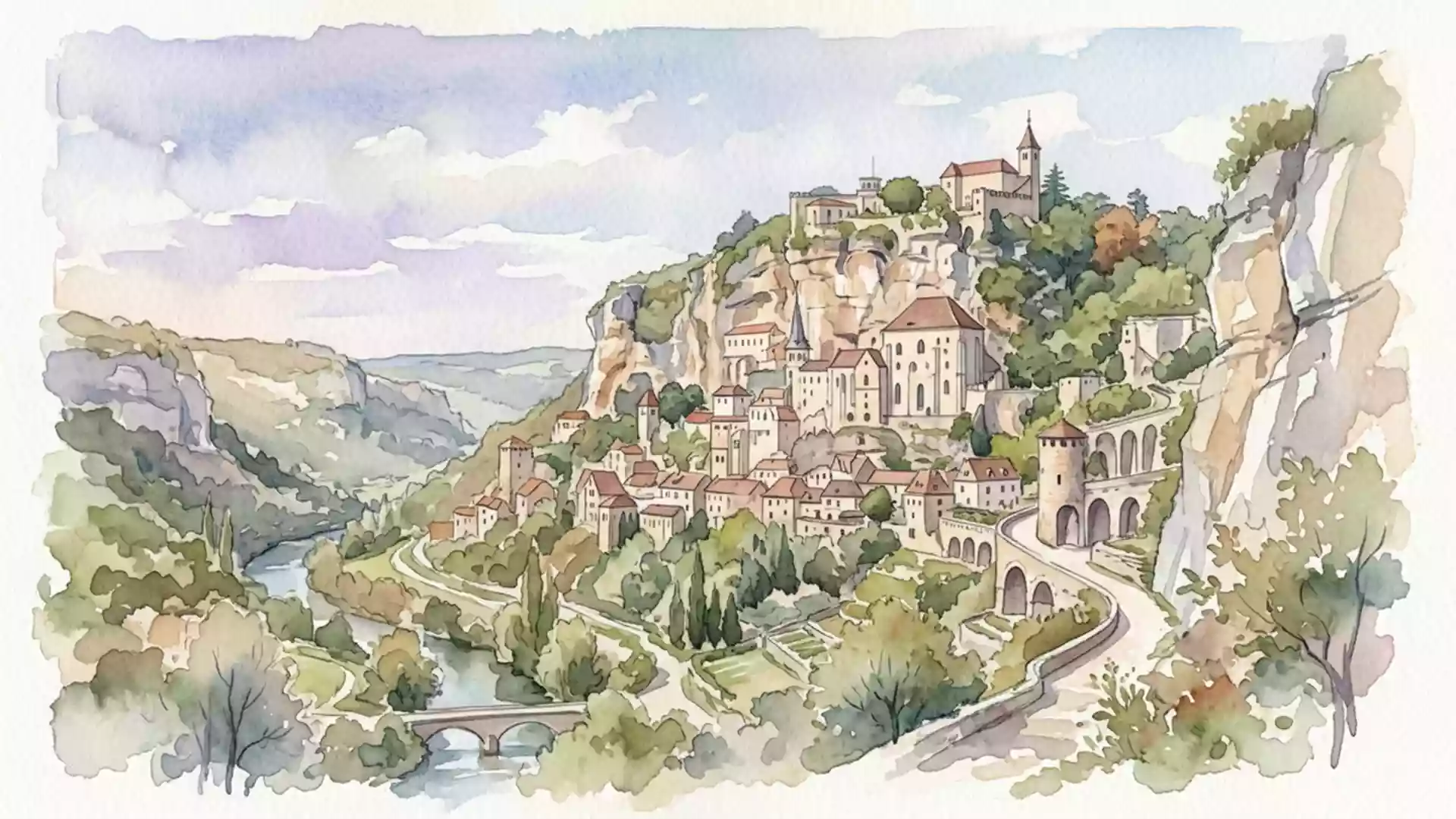
Rocamadour, the cliffside sanctuary above the Alzou gorge
Published on 09/08/2026 at 13:00 | Editorial responsibility: Rafael Müller, Editor-in-Chief AD HOC NEWS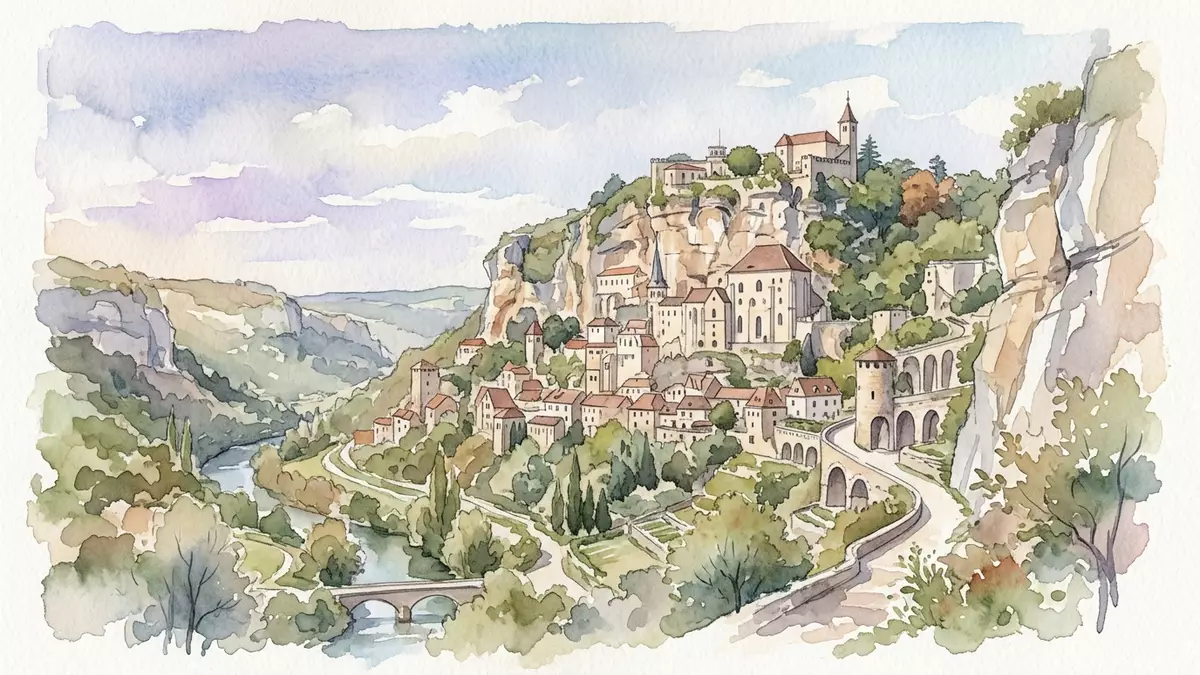
Rocamadour is a medieval village in south-west France, built in terraces against a limestone cliff above the Alzou gorge, where chapels, houses and ramparts form a vertical sanctuary of stone and faith dating back to the Middle Ages.
A village stacked on a cliff
Rocamadour rises in three main tiers from the floor of the Alzou canyon to the cliff-top fortifications, with its streets, chapels and castle arranged on ledges cut into the rock.Built on three successive levels gives the village a striking profile, with the lowest tier formed by the main street and houses resting at the base of the cliff.
Above the village street, a broad platform carries the religious complex known as the cité religieuse, a cluster of churches, chapels and supporting buildings cut into and against the rock face.The medieval centre's main pilgrimage site stands on this middle level, while the upper tier is crowned by towers and a castle keep that guard the edge of the plateau.
Sanctuaries of the Black Madonna and Saint Amadour
The heart of Rocamadour is its sanctuary complex, developed between the eleventh and thirteenth centuries, where several chapels and churches cluster around a small courtyard carved out of the cliff.A series of medieval churches and chapels were built here, many in a Romanesque style that later absorbed Gothic elements.
One of the most important buildings is the Basilica of Saint-Sauveur, a parish church whose architecture sits at the transition between Romanesque and Gothic and which is recognised as part of the UNESCO World Heritage Routes of Santiago de Compostela in France.The Basilica of Saint-Sauveur and the crypt of Saint-Amadour share this designation, linking Rocamadour to the wider network of pilgrimage sites.
Nearby, the Chapelle Notre-Dame houses a small Black Madonna statue, carved from wood in the twelfth century, which has long been associated with miraculous interventions and sea-going legends.The Black Madonna dating from the twelfth century sits above the chapel altar, and a bell in the sanctuary is traditionally linked to stories of sailors saved at sea.
A millennium of pilgrimage on the Way of Saint James
Rocamadour’s reputation as a place of devotion is documented from at least the tenth century, when a chapel here was given to a Benedictine abbey, and it developed into a major pilgrimage destination during the twelfth century.The site enters the record in 968, and the discovery of an incorrupt body identified as Saint Amadour in 1166, in front of the Virgin’s chapel, greatly increased its fame.
In the decades around that discovery, donations from pilgrims funded extensive building works on the sanctuary, overseen by Géraud d’Escorailles, abbot from 1152 to 1188.Pilgrims' donations under Abbot Géraud d’Escorailles helped create the ensemble of chapels and churches that visitors see today, and pilgrims included figures such as Henry II of England and King Louis IX of France, who came to give thanks for recoveries and victories.
The pilgrimage traditions at Rocamadour are also linked to the wider Camino de Santiago network, with the sanctuary recognised as part of the Way of Saint James through France.Rocamadour belongs to the Camino de Santiago, and medieval accounts such as the Livre des Miracles record healings, rescues and other events associated with prayers offered to Our Lady of Rocamadour.
Visiting Rocamadour: what travellers from Western Europe should know
- Rocamadour lies in the Lot department of south-west France, in the Occitanie region, above the Alzou gorge; it is reached by road from nearby towns and by regional rail connections to stations in the Dordogne valley.
- The village climbs steeply from the canyon floor to the plateau, with stairways of many steps linking the lower street, the sanctuary terrace and the ramparts, including a long pilgrim staircase between the village and the religious complex.
- The surrounding landscape is limestone plateau cut by deep valleys, so approaches on foot involve gradients and rocky paths, and the village streets themselves follow the narrow ledge at the base of the cliff.
- The official language is French and the currency is the euro.
Searching for Rocamadour on social platforms
These links open searches for Rocamadour on each platform.
Frequently asked questions about Rocamadour
Where is Rocamadour and what kind of place is it?
Rocamadour is a medieval village and pilgrimage site in the Lot department of the Occitanie region in south-west France, built against a limestone cliff above the Alzou gorge.
What should visitors expect during a visit to Rocamadour?
Visitors encounter a layered village of houses, chapels and fortifications stacked on three levels, linked by steep stairways, with a central sanctuary complex reached from the lower street.
What makes Rocamadour distinctive among French pilgrimage sites?
Rocamadour combines a dramatic cliffside setting with a long-documented pilgrimage tradition focused on the Black Madonna and the relics of Saint Amadour, and its basilica and crypt form part of the UNESCO-listed Routes of Santiago de Compostela.