
Pungthang Dewachen Phodrang on a river junction
Published on 09/12/2026 at 12:44 | Editorial responsibility: Rafael Müller, Editor-in-Chief AD HOC NEWS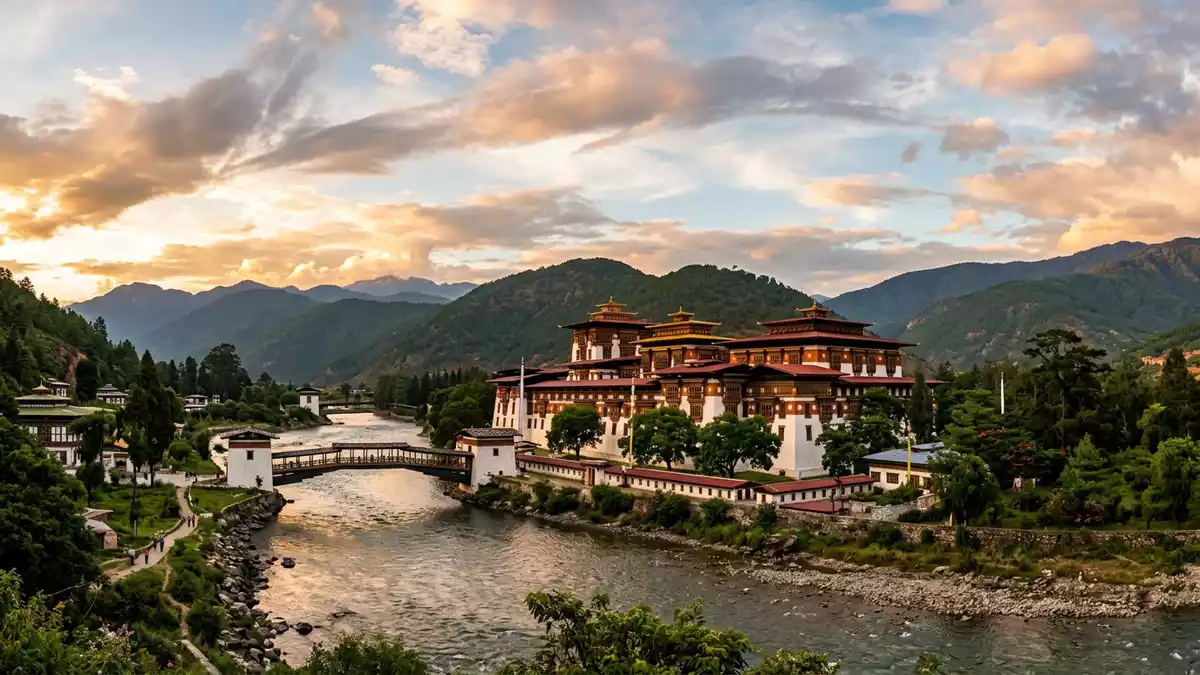
Pungthang Dewachen Phodrang rises at the meeting point of the Pho Chhu and Mo Chhu in Punakha, Bhutan. Built in the seventeenth century under Zhabdrung Ngawang Namgyal, it combines monastic spaces with district administration.
The river junction that shapes Pungthang Dewachen Phodrang
The site occupies a narrow tongue of land between two rivers, so water frames the whole approach. Its long, white walls and red upper sections give the complex a layered profile against the valley slopes.
The main name, Pungthang Dewachen Phodrang, is widely associated with the meaning “palace of great happiness”. The complex is also known in English as Punakha Dzong, and both names point to the same fortress-monastery.
seventeenth century and the name Pungthang Dewachen Phodrang anchor its identity. Between the two rivers, the complex sits in a setting that remains central to its character.
Ngawang Namgyal and the dzong tradition
Zhabdrung Ngawang Namgyal is the historical figure most closely linked with the place. The fortress belongs to the dzong tradition of Bhutan, where religious and administrative functions sit within the same substantial compound.
Its whitewashed mass, inward-sloping walls and red roofline belong to a Bhutanese architectural language that is immediately recognisable. The main tower and courtyard arrangement create a strong sense of enclosure, while the outer walls extend the building across the riverbank.
The structure also connects with the early political history of Bhutan. It served as a centre of government, and that role explains its lasting prominence in the country’s public memory.
dzong tradition and the administrative centre describe its dual role. Shabdrung Ngawang Namgyel remains the key name tied to its foundation.
Religious spaces inside a working stronghold
The complex contains monastic quarters and spaces for ritual life alongside the administrative rooms. That mix gives the place a working character that distinguishes it from a purely ceremonial monument.
Its broad walls, timber details and painted surfaces are visible from different parts of the valley. The ensemble reads as both fortress and monastery, with the river setting adding to the scale of the whole.
The building’s importance also comes from continuity. It remains one of Bhutan’s best-known examples of dzong architecture, and its form preserves the classical relationship between power, worship and enclosure.
administrative rooms and monastic life appear in the same compound. Punakha valley provides the setting for that combination.
Visiting Pungthang Dewachen Phodrang: what travellers from Western Europe should know
- The complex stands in Punakha valley in central Bhutan, reached by road from other Bhutanese towns.
- The ground falls to the rivers on two sides, and the site is spread across a long river tongue.
- Its broad scale and fortress walls reward a slow approach on foot.
- The official language is Dzongkha and the currency is the Bhutanese ngultrum.
- Entry requirements depend on your nationality; UK travellers can check the FCDO travel advice at gov.uk/foreign-travel-advice, Irish travellers the Department of Foreign Affairs at ireland.ie.
Searching for Pungthang Dewachen Phodrang on social platforms
These links open searches for Pungthang Dewachen Phodrang on each platform.
Frequently asked questions about Pungthang Dewachen Phodrang
Where is Pungthang Dewachen Phodrang?
It stands in Punakha, Bhutan, between the Pho Chhu and Mo Chhu rivers. The setting is central to the place’s identity.
What can be seen on a visit?
The site presents a fortress-monastery with white walls, red roofs and monastic spaces inside the compound. The scale of the riverbank setting is part of the experience.
What makes it distinctive?
Its combination of religious and administrative functions is unusual in a single complex. The historical link with Zhabdrung Ngawang Namgyal also gives it a defined place in Bhutanese history.


