
Pungthang Dewachen Phodrang, the palace of great happiness in Punakha
Published on 08/30/2026 at 10:48 | Editorial responsibility: Rafael Müller, Editor-in-Chief AD HOC NEWS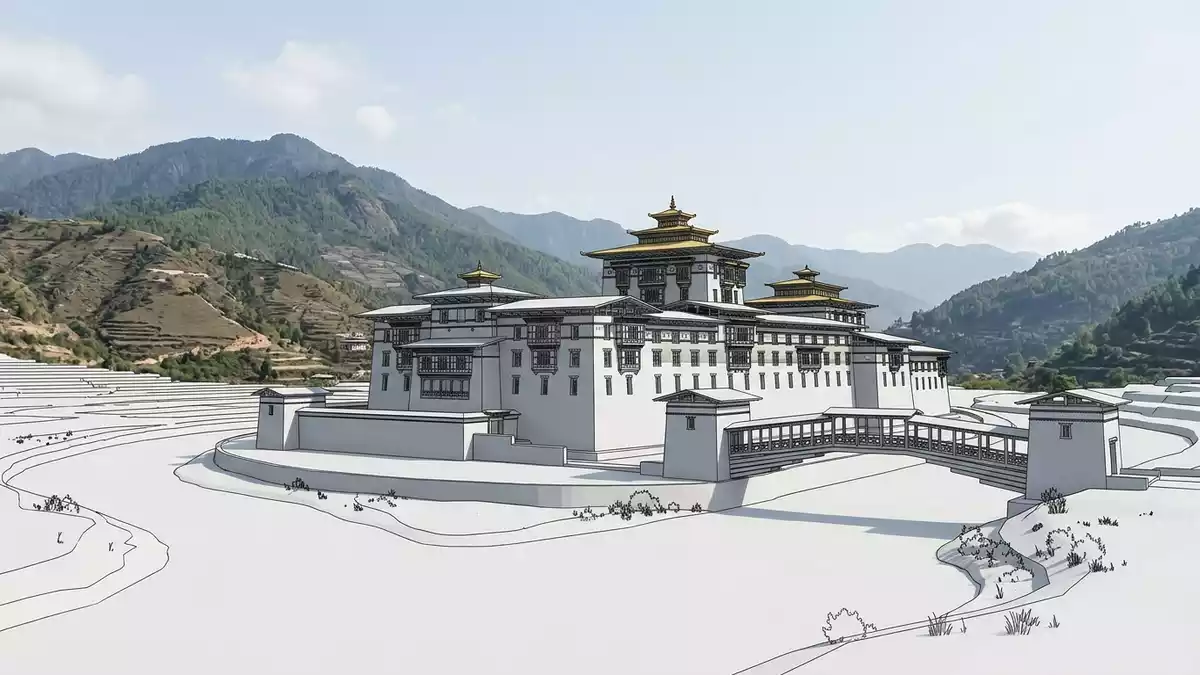
Pungthang Dewachen Phodrang, the “palace of great happiness”, rises on a tongue of land between two rivers in Punakha in central Bhutan. Built in the seventeenth century as a fortress-monastery, it still serves as the administrative centre of Punakha District and a key seat of Bhutanese religious life.
A fortress-monastery between two rivers
Pungthang Dewachen Phodrang stands precisely where the Pho Chhu and Mo Chhu rivers meet, on a low ridge of land that pushes into their confluence like the prow of a ship.the confluence of the Pho Chhu and Mo Chhu From many angles the building appears to float above water, its walls dropping steeply to the riverbanks and reflected in fluctuating currents.
The complex is a dzong, the fortified monastery form that defines much of Bhutan’s architecture, and its position at the confluence has made it a reference point in descriptions of the Punakha–Wangdue valley.Punakha–Wangdue valley On the approach from the valley floor, the rivers frame the view: pale, sloping walls rise above cobbled terraces, punctuated by timber balconies and crowned by the deep eaves of a central tower.
Seventeenth-century origins and national history
The dzong was founded in 1637 and completed around 1638 under the direction of Ngawang Namgyal, the first Zhabdrung Rinpoche, at a time when Bhutan was being consolidated as a unified state.constructed by Zhabdrung Ngawang Namgyal in 1637 In Bhutanese tradition it marks both political and religious authority: for a long period it served as the seat of government, and coronations for Bhutan’s kings have taken place within its main temple halls.kings have been crowned here
Pungthang Dewachen Phodrang is also a repository for important relics of the southern Drukpa Lineage of the Kagyu school of Tibetan Buddhism, including remains associated with Ngawang Namgyal and the treasure revealer Pema Lingpa.sacred relics of the southern Drukpa Lineage For centuries its courtyards have hosted elaborate monastic rituals and seasonal movements of the central monk body, which uses the dzong as its winter residence while summer quarters lie further north.winter residence of the dratshang
Scale, layout and materials
The building complex is large even by dzong standards, traditionally described as the second oldest and second largest fortress-monastery in Bhutan.second oldest and second largest dzong Its main body measures roughly 180 m (590 ft) in length and about 72 m (236 ft) in width, with the mass of the walls and roofs occupying most of the spur between the rivers.180 m in length and 72 m wide
The plan is organised around three internal courtyards, or docheys, aligned from the entrance side towards the sacred heart of the complex.organised around three courtyards The first courtyard contains administrative offices; the second is monastic, edged with monks’ quarters and a prominent bodhi tree; the innermost courtyard focuses on the principal temples and shrines where many of the dzong’s rituals take place.the administrative, monastic and sacred courtyards
Architectural character and craftsmanship
Pungthang Dewachen Phodrang displays the characteristic elements of Bhutanese fortress architecture: inward-sloping walls built from stone and rammed earth, whitewashed surfaces and a broad red-brown band below the roofline that frames the upper levels.rammed-earth and stone walls whitewashed with a red-brown band Timber balconies project from the facades, their carved latticework adding texture against the smooth expanses of masonry.
Within the complex, wooden galleries and stairways connect the courtyards and towers, many assembled without iron nails using traditional joinery techniques.doors and windows without nails The central tower, or utse, rises above the surrounding roofs with gilded cresting, and from its upper levels the setting becomes clear: bands of river water, cultivated terraces and the broader Punakha valley stretching towards surrounding hillsides.the utse as focal point
Visiting Pungthang Dewachen Phodrang: what travellers from Western Europe should know
- Pungthang Dewachen Phodrang stands at the junction of the Pho Chhu and Mo Chhu rivers in Punakha Valley in central Bhutan, south-east of the town of Punakha.located at the confluence in Punakha Valley
- The dzong is reached by a bridge over the river and an ascent through gateways and courtyards, including stairways and internal galleries typical of Bhutanese fortress architecture.access via a bridge
- The official language is Dzongkha and the currency is the Bhutanese ngultrum.
- Entry requirements depend on your nationality; UK travellers can check the FCDO travel advice at gov.uk/foreign-travel-advice, Irish travellers the Department of Foreign Affairs at ireland.ie.
Searching for Pungthang Dewachen Phodrang on social platforms
These links open searches for Pungthang Dewachen Phodrang on each platform.
Frequently asked questions about Pungthang Dewachen Phodrang
Where is Pungthang Dewachen Phodrang located?
Pungthang Dewachen Phodrang stands in Punakha Valley in central Bhutan, on land between the Pho Chhu and Mo Chhu rivers in Punakha District.
What can visitors expect when they enter the dzong?
Visitors encounter a sequence of courtyards framed by whitewashed fortress walls, timber galleries and the rising central tower, with administrative and monastic areas sharing the same complex.
What makes Pungthang Dewachen Phodrang distinctive among Bhutan’s dzongs?
Its riverside setting, three-courtyard layout, seventeenth-century origins under Zhabdrung Ngawang Namgyal and continuing roles in government, coronation ritual and monastic life give the dzong a particular national weight.


