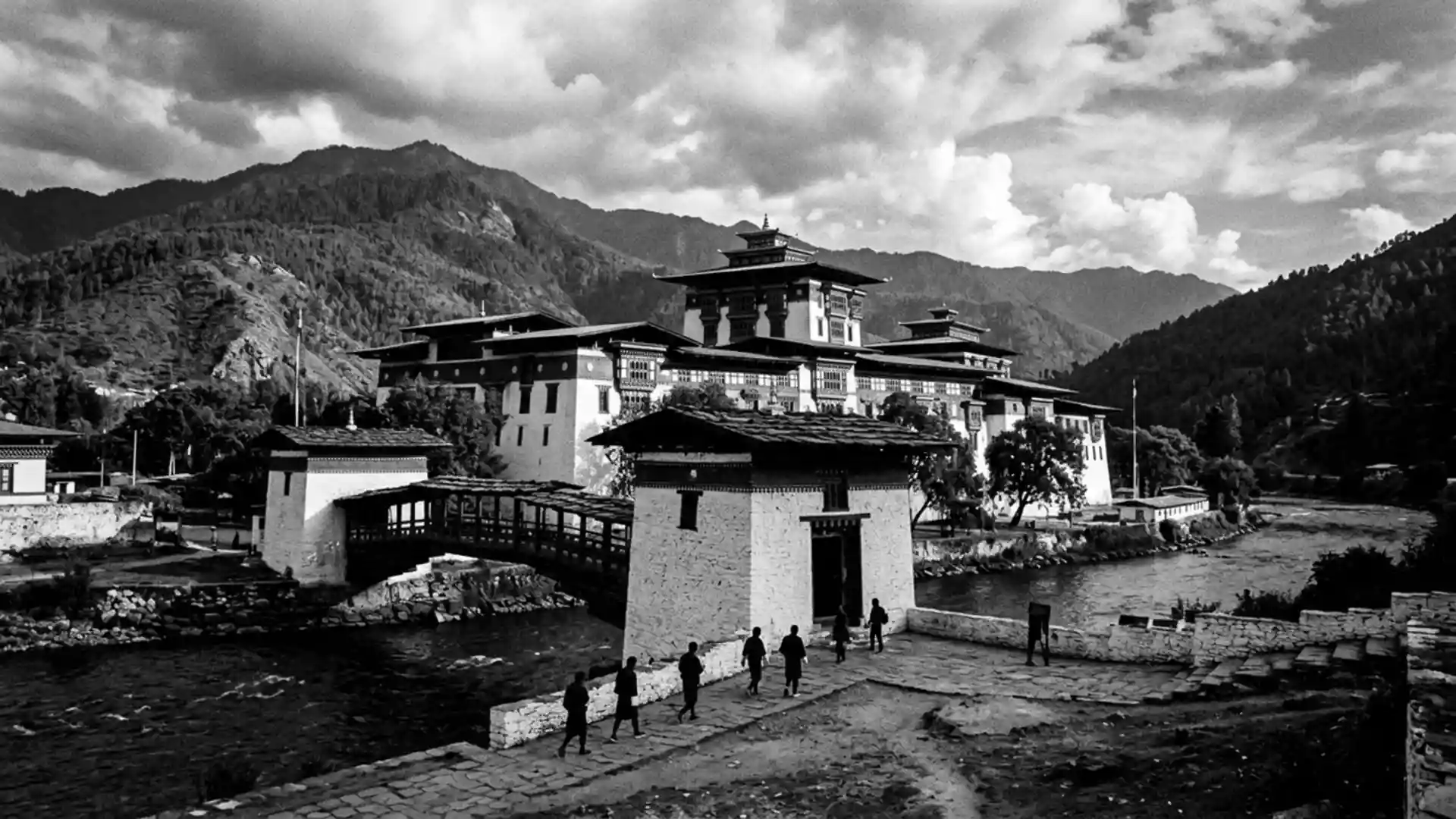
Pungthang Dewachen Phodrang, the palace of great happiness in Punakha
Published on 09/08/2026 at 11:53 | Editorial responsibility: Rafael Müller, Editor-in-Chief AD HOC NEWS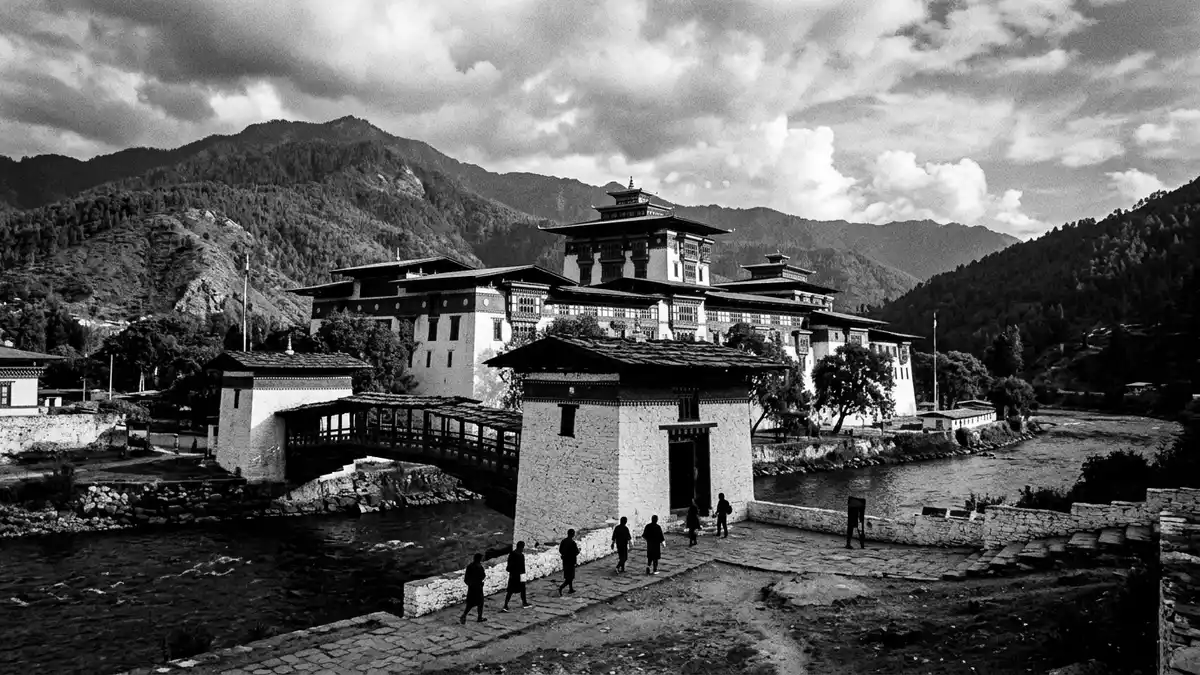
Pungthang Dewachen Phodrang, meaning “palace of great happiness”, is the great fortress?monastery that dominates Punakha in Bhutan. Rising on land between two mountain rivers, it has served since the seventeenth century as both a religious centre and the administrative heart of Punakha District.
The fortress between two rivers
Pungthang Dewachen Phodrang stands on a narrow tongue of land at the junction of the Mo Chhu and Pho Chhu rivers in the Punakha valley of western Bhutan, with steep water on two sides and mountains closing the view beyond the valley. The location gives the dzong a clear outline against the riverbanks and makes its long walls and tiered roofs visible from across the valley floor.Confluence of Mo Chhu and Pho Chhu
The structure is a fortified monastery in the Bhutanese dzong tradition, built with thick whitewashed walls, timber cornices and prominent golden roofs over the central tower. It is formally known as Pungtang Dechen Photrang Dzong and serves as the administrative centre of Punakha District, while also housing a large monastic community and major religious relics of the Drukpa Kagyu school of Buddhism.Administrative centre and monastery
Seventeenth?century foundation and royal history
The dzong was commissioned by Zhabdrung Ngawang Namgyal, the Tibetan lama who unified Bhutan, and construction is recorded as having taken place in 1637 and 1638. In the seventeenth century it became the seat of government and the principal fortress?monastery for the young Bhutanese state, a role it continued to play for centuries while successive rulers expanded its courtyards and halls.Built in 1637–1638 under Zhabdrung Ngawang Namgyal
For much of Bhutan’s history the country’s capital was at Pungthang Dewachen Phodrang, and the dzong hosted major national events, including the coronation of the first hereditary king, Ugyen Wangchuck, in 1907. The fortress later saw the coronations of subsequent kings and the first National Assembly in 1953, before the political capital moved to Thimphu in 1955.Royal coronations and capital until 1955
Architecture, courtyards and sacred relics
Pungthang Dewachen Phodrang is a multi?storey complex of rammed earth, stone and timber, with a tall central tower rising above lower ranges of buildings and gates. The dzong’s long rectangular plan holds several successive courtyards, with administrative offices on one side and monastic buildings, temples and living quarters on the other, reflecting the dual religious and civic function that defines Bhutanese dzongs.Rammed earth, stone and timber construction
Inside, the complex houses revered Buddhist relics of the southern Drukpa Lineage, including the Rangjung Kharsapani and the sacred remains of Zhabdrung Ngawang Namgyal and the treasure?finder Pema Lingpa. The dzong also serves as the winter residence of Bhutan’s Central Monastic Body led by the Je Khenpo, bringing hundreds of monks to Punakha during the colder months when the climate in the valley is gentler than in higher regions.Winter residence of the Central Monastic Body
Visiting Pungthang Dewachen Phodrang: what travellers from Western Europe should know
- Pungthang Dewachen Phodrang lies in Punakha valley in Bhutan, on land between the Mo Chhu and Pho Chhu rivers south?east of the town of Punakha. Travellers generally reach Punakha by road from other Bhutanese towns, with many itineraries beginning at Paro, home to the country’s international airport.
- The dzong occupies slightly raised ground with stone approaches and internal stairways linking its courtyards and upper levels. Visiting the fortress involves walking across uneven surfaces and climbing steps within the complex.
- The surrounding valley sits at moderate altitude compared with higher Himalayan districts, and the dzong’s position beside the rivers means that paths around it can be exposed to sun and changing weather.
- The official language of Bhutan is Dzongkha and the national currency is the Bhutanese ngultrum.
- Entry requirements depend on your nationality; UK travellers can check the FCDO travel advice at gov.uk/foreign-travel-advice, Irish travellers the Department of Foreign Affairs at ireland.ie.
Searching for Pungthang Dewachen Phodrang on social platforms
These links open searches for Pungthang Dewachen Phodrang on each platform.
Frequently asked questions about Pungthang Dewachen Phodrang
Where is Pungthang Dewachen Phodrang located?
Pungthang Dewachen Phodrang is in Punakha valley in Bhutan, on land at the junction of the Mo Chhu and Pho Chhu rivers in Punakha District.
What should visitors expect on a visit?
Visitors encounter a large seventeenth?century fortress?monastery with courtyards, temples and administrative halls, approached by stone paths and internal stairways between different levels.
What makes Pungthang Dewachen Phodrang distinctive?
The dzong combines its riverside setting with its role as both administrative centre and monastery, its historical status as Bhutan’s former capital and the presence of important Buddhist relics.