
Pungthang Dewachen Phodrang and the rivers of Punakha
Published on 09/17/2026 at 15:48 | Editorial responsibility: Rafael Müller, Editor-in-Chief AD HOC NEWS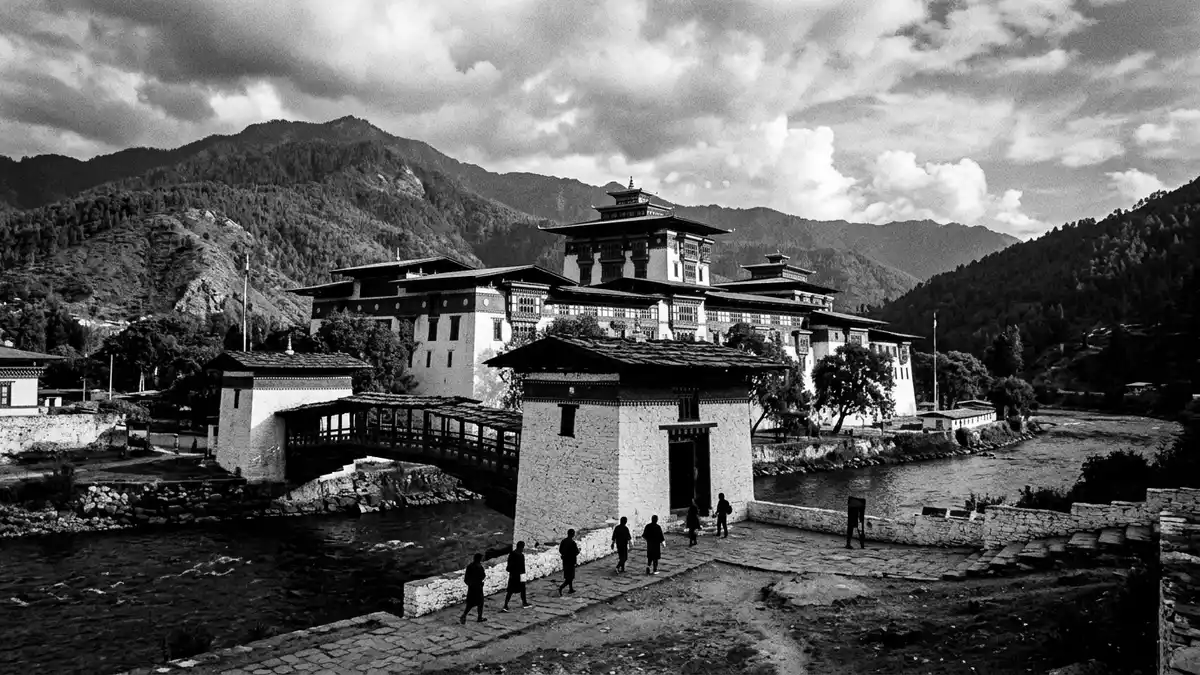
Pungthang Dewachen Phodrang rises where the Pho Chhu and Mo Chhu meet in Punakha, Bhutan. Built in the seventeenth century under Zhabdrung Ngawang Namgyal, it combines monastic space with district administration and a strong riverside setting.
A fortress-monastery at a river junction
The complex occupies a narrow tongue of land between two rivers, so water is part of the setting on more than one side. Its massed walls, white surfaces and dark timber details give it the look of a dzong, the Bhutanese form of fortress-monastery. river junction
The main name means “palace of great happiness”, and the site is also known in English as Punakha Dzong. Its formal identity is tied to Zhabdrung Ngawang Namgyal and the seventeenth century, both central to Bhutanese state and religious history. Zhabdrung Ngawang Namgyal
Stone, timber and layered courtyards
Dzong architecture is marked by heavy masonry, timber galleries and enclosed courtyards, and Pungthang Dewachen Phodrang follows that pattern. The long, layered plan gives the complex a horizontal spread rather than a compact silhouette.
Inside the walls, religious and administrative functions sit close together. That dual use remains one of the clearest features of the place, alongside its riverfront position and fortress-like scale. dual use remains
Bhutanese history in one complex
Pungthang Dewachen Phodrang belongs to the seventeenth century, when dzongs served as centres of authority as well as places of worship. The complex is tied to Bhutan’s political and religious formation, especially the period associated with Zhabdrung Ngawang Namgyal.
Its setting in Punakha valley places it among the best-known examples of Bhutanese monastic fortification. The combination of rivers, walls and internal courts gives the site a clear identity that is visible before any historical detail is added. Punakha valley
Visiting Pungthang Dewachen Phodrang: what travellers from Western Europe should know
- The complex lies in Punakha, between the Pho Chhu and Mo Chhu rivers. Road access from other Bhutanese towns leads into the valley before the bridge approach to the dzong.
- Entry involves a bridge and an ascent through gateways, with steps and internal passages inside the complex. The terrain is shaped by the riverside position and the layered courtyards.
- The official language is Dzongkha and the currency is the Bhutanese ngultrum.
- Entry requirements depend on your nationality; UK travellers can check the FCDO travel advice at gov.uk/foreign-travel-advice, Irish travellers the Department of Foreign Affairs at ireland.ie.
Searching for Pungthang Dewachen Phodrang on social platforms
These links open searches for Pungthang Dewachen Phodrang on each platform.
Frequently asked questions about Pungthang Dewachen Phodrang
Where is Pungthang Dewachen Phodrang?
It stands in Punakha, Bhutan, at the meeting point of the Pho Chhu and Mo Chhu rivers. The setting is central to its identity and to the way the complex is approached.
What does a visit involve?
The approach crosses a bridge and continues through gateways and stepped spaces. Inside, the complex combines monastic areas with administrative functions.
What makes it distinctive?
Its riverside siting and dzong form are inseparable, and the association with Zhabdrung Ngawang Namgyal gives it historical weight. The result is a fortress-monastery with a clear architectural and cultural profile.


