
Naqsh-e Jahan: Safavid space framed by stone and tile
Published on 09/17/2026 at 13:49 | Editorial responsibility: Rafael Müller, Editor-in-Chief AD HOC NEWS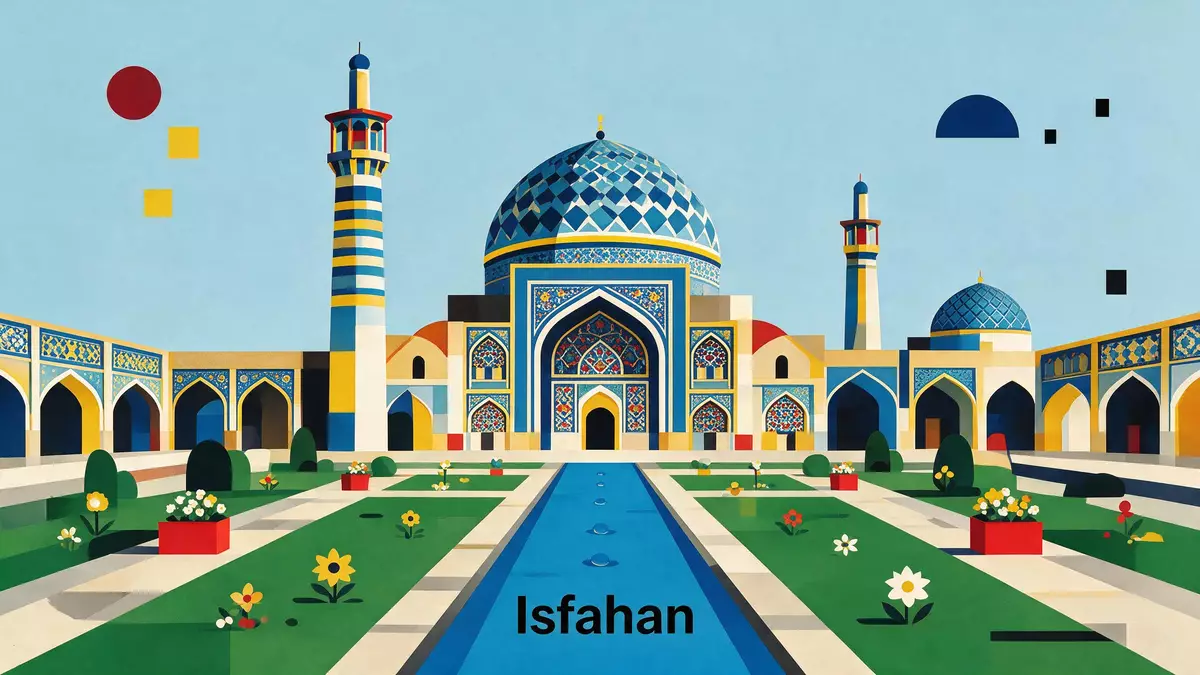
Naqsh-e Jahan in Isfahan is a monumental Safavid-era square laid out as an elongated rectangle framed by arcades and imperial buildings at the heart of the city. Conceived under Shah Abbas I in the late sixteenth and early seventeenth century, it brought palace, mosques and bazaar into a single urban composition across a paved open space.
An imperial square on a grand scale
Naqsh-e Jahan is a large historic city square in central Isfahan, set out as a long rectangle with its shorter sides to the north and south.large historic city square The space measures about 560 m (1,840 ft) in length and 160 m (520 ft) in width, giving it an area of close to 90,000 square metres.area of 89,600 square metres For a visitor standing on its stone paving, the dimensions read as a broad horizontal plane edged by continuous façades rather than as a conventional city square.
The square belongs to the Safavid period, with its construction traditionally dated to the years between 1598 and 1629 under Shah Abbas I, when Isfahan became the capital of the Safavid empire.construction traditionally dated to 1598–1629 In this era Safavid rulers reshaped Isfahan’s urban form, and Naqsh-e Jahan emerged as a ceremonial and commercial centre on routes that linked the Iranian plateau from north to south and east to west.commercial, religious and ceremonial centre The square is known by several names: Naqsh-e Jahan, meaning “Image of the World”, Meidan Emam, and earlier Meidan-e Shah.Meidan Emam, also known as Naghsh-e Jahan
Arcades, mosques and palace around the rectangle
Naqsh-e Jahan is enclosed by continuous arcades of two storeys, with a covered bazaar formed by rows of shops running around the perimeter.covered bazaar with double-storeyed shops Above the shopfronts rises a regular façade of arches and niches, giving the long sides of the rectangle a rhythmic sequence that ties its different structures together.
On each side of the square stands a major Safavid monument. To the west, the Ali Qapu Palace overlooks the paving and provided elevated views over Naqsh-e Jahan.Ali Qapu Palace on the west To the south, the Royal Mosque, also known as the Shah Mosque and today as the Imam Mosque, presents a monumental tiled portal and dome. On the east side, the smaller Sheikh Lotfollah Mosque faces into the square with a finely proportioned façade and a single dome. The northern edge is marked by the Qeysarieh Portal, the gate of the Isfahan Grand Bazaar, linking the square to longer commercial streets.Royal Mosque, Sheikh Lotfollah, Ali Qapu and Qeysarieh
Safavid urban planning and UNESCO status
Naqsh-e Jahan Square is recognised as an outstanding example of Iranian and Islamic architecture and of Safavid urban planning at city scale.outstanding example of Iranian and Islamic architecture Shah Abbas I moved the Safavid capital to Isfahan in 1598 and commissioned Naqsh-e Jahan as its centre, bringing religious, political and commercial buildings into one planned ensemble rather than scattering them across different quarters.commissioned by Shah Abbas I after 1598
Meidan Emam in Esfahan, encompassing Naqsh-e Jahan and its surrounding monuments, is inscribed on the UNESCO World Heritage List.UNESCO World Heritage listing for Meidan Emam The listing highlights the square’s integrated composition of palace, mosques, bazaar and public space as an example of Safavid civilisation and its architectural expression.inscribed on the UNESCO World Heritage List in 1979 For travellers, this status underlines both the historical importance of Naqsh-e Jahan and the care taken in preserving its ensemble of stone paving, arcades, tiled façades and domes.
Visiting Naqsh-e Jahan: what travellers from Western Europe should know
- Naqsh-e Jahan lies in the centre of Isfahan in central Iran, with the Isfahan Grand Bazaar connected to its northern side and major streets leading into the surrounding city.
- The square itself is level and paved, but reaching the upper levels of Ali Qapu Palace involves climbing staircases, and the mosques around the square have thresholds and internal steps.
- The official language is Persian and the currency is the Iranian rial.
- Entry requirements depend on your nationality; UK travellers can check the FCDO travel advice at gov.uk/foreign-travel-advice, Irish travellers the Department of Foreign Affairs at ireland.ie.
Searching for Naqsh-e Jahan on social platforms
These links open searches for Naqsh-e Jahan on each platform.
Frequently asked questions about Naqsh-e Jahan
Where is Naqsh-e Jahan and what kind of place is it?
Naqsh-e Jahan is a large rectangular city square in the centre of Isfahan in Iran, framed by arcades, mosques, a palace and the gate to the Grand Bazaar.
What should a visitor expect when entering the square?
A visitor steps onto extensive stone paving bounded by long two-storey arcades, with major Safavid monuments facing into the open space on all four sides.
What makes Naqsh-e Jahan distinctive among historic squares?
Naqsh-e Jahan brings royal, religious and commercial buildings together around a single planned Safavid-era square, on a scale that turns the space into an urban composition in its own right.


