
Naqsh-e Jahan: Safavid space on an imperial scale
Published on 09/08/2026 at 10:53 | Editorial responsibility: Rafael Müller, Editor-in-Chief AD HOC NEWS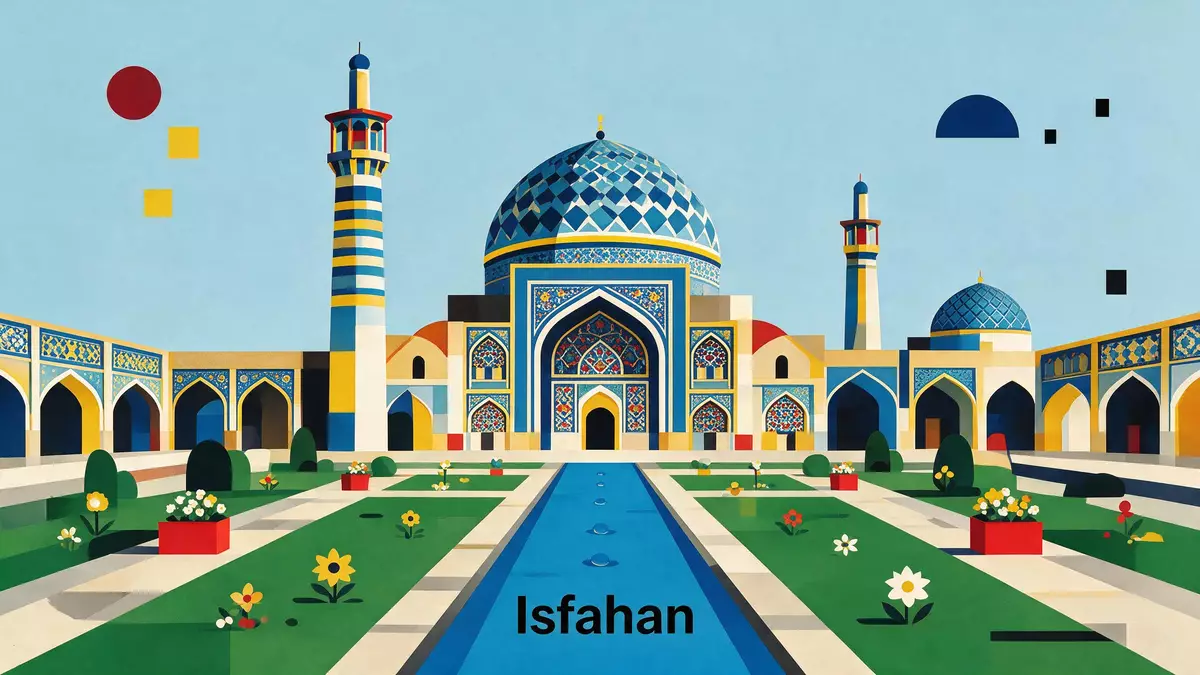
Naqsh-e Jahan in Isfahan is a monumental city square from the Safavid period, laid out as an elongated rectangle enclosed by arcades and imperial buildings. In the early seventeenth century it became the formal centre of Safavid Isfahan under Shah Abbas I, a space where royal, religious and commercial life were set side by side.
The Safavid square at the heart of Isfahan
Naqsh-e Jahan Square occupies the centre of Isfahan in central Iran, on routes that historically linked north to south and east to west across the Iranian plateau.Meidan Emam in Esfahan The square belongs to the Safavid era, with its construction traditionally dated to the years between 1598 and 1629 under Shah Abbas I.construction between 1598 and 1629
In plan Naqsh-e Jahan is an oblong rectangle, measuring about 560 m (1,837 ft) in length and 160 m (525 ft) in width, giving close to 89,600 m² (964,000 sq ft) of open space framed by continuous arcades.dimensions of Naqsh-e Jahan Square The Pashto name “Naqsh-e Jahan” is commonly rendered in English as “Image of the World”, and the square is also known as Shah Square and Imam Square under later official usages.names of the square
Mosques, palace and bazaar gate around the rectangle
The built ensemble around Naqsh-e Jahan is organised around four principal monuments, each occupying one side of the rectangle and joined by two-storey arcades that house bazaar shops.four monumental structures On the south side stands the Imam Mosque, also known historically as the Shah Mosque, with a grand entrance portal leading towards a domed prayer hall covered in turquoise and deep blue tilework.Imam Mosque on the south side
Opposite, on the north side of the square, the Qeysarieh Portal marks the entrance to the main bazaar of Isfahan, a historic covered market extending into the older urban fabric.Qeysarieh Gate to the bazaar The east side is occupied by the Sheikh Lotfollah Mosque, a smaller, more inward-facing mosque distinguished by its single dome and richly patterned faience, while the west side carries the Ali Qapu Palace, a multi-storey royal pavilion whose elevated terrace looks across the entire square.Sheikh Lotfollah Mosque and Ali Qapu Palace
World Heritage status and the experience of the space
Naqsh-e Jahan, under the designation “Meidan Emam, Esfahan”, was inscribed on the UNESCO World Heritage List as a cultural site in 1979.World Heritage inscription in 1979 The listing recognises the square as a major example of Iranian and Islamic urban design from the Safavid period, where royal residence, religious buildings and commercial arcades form a coherent ensemble around a single open space.Safavid urban ensemble
Visitors crossing the square encounter long perspectives framed by arcades, the coloured tilework of the mosque portals, carved timber ceilings in the palace and the brick vaults of the bazaar corridors. The open rectangle is large enough to hold polo grounds in Safavid times, and its scale continues to define the skyline of central Isfahan, with the domes and minarets of the mosques rising above the continuous two-storey facades.
Visiting Naqsh-e Jahan: what travellers from Western Europe should know
- Naqsh-e Jahan lies in the historic centre of Isfahan in central Iran, with streets and the Qeysarieh bazaar converging on the square from the surrounding districts.
- The square itself is level and paved, but reaching mosque interiors or the Ali Qapu Palace involves staircases and passages that may be narrow in places.
- The official language is Persian and the currency is the Iranian rial.
- Entry requirements depend on your nationality; UK travellers can check the FCDO travel advice at gov.uk/foreign-travel-advice, Irish travellers the Department of Foreign Affairs at ireland.ie.
Searching for Naqsh-e Jahan on social platforms
These links open searches for Naqsh-e Jahan on each platform.
Frequently asked questions about Naqsh-e Jahan
Where is Naqsh-e Jahan Square located?
Naqsh-e Jahan Square is located in the centre of Isfahan in central Iran, where major historic streets and the Qeysarieh bazaar meet.
What should visitors expect when exploring Naqsh-e Jahan?
Visitors can walk across a large paved square, enter Safavid mosques and the Ali Qapu Palace, and move into the covered bazaar through the northern gate.
What makes Naqsh-e Jahan distinctive among city squares?
Its Safavid-era layout combines an elongated rectangular space with mosques, a royal pavilion and bazaar arcades, all built around a single urban square.


