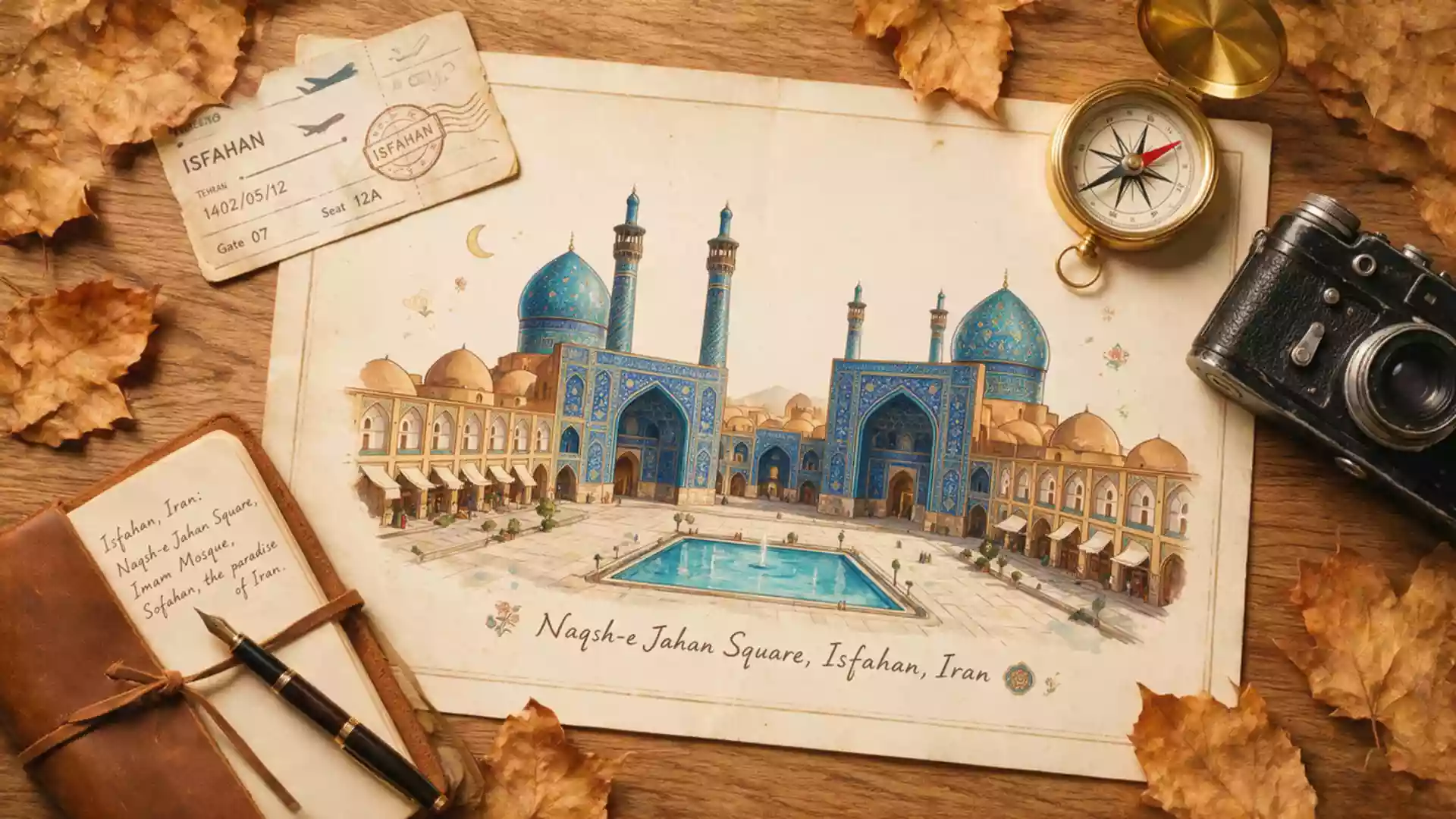
Naqsh-e Jahan, the tiled epicentre of Safavid Isfahan
Published on 09/03/2026 at 15:57 | Editorial responsibility: Rafael Müller, Editor-in-Chief AD HOC NEWS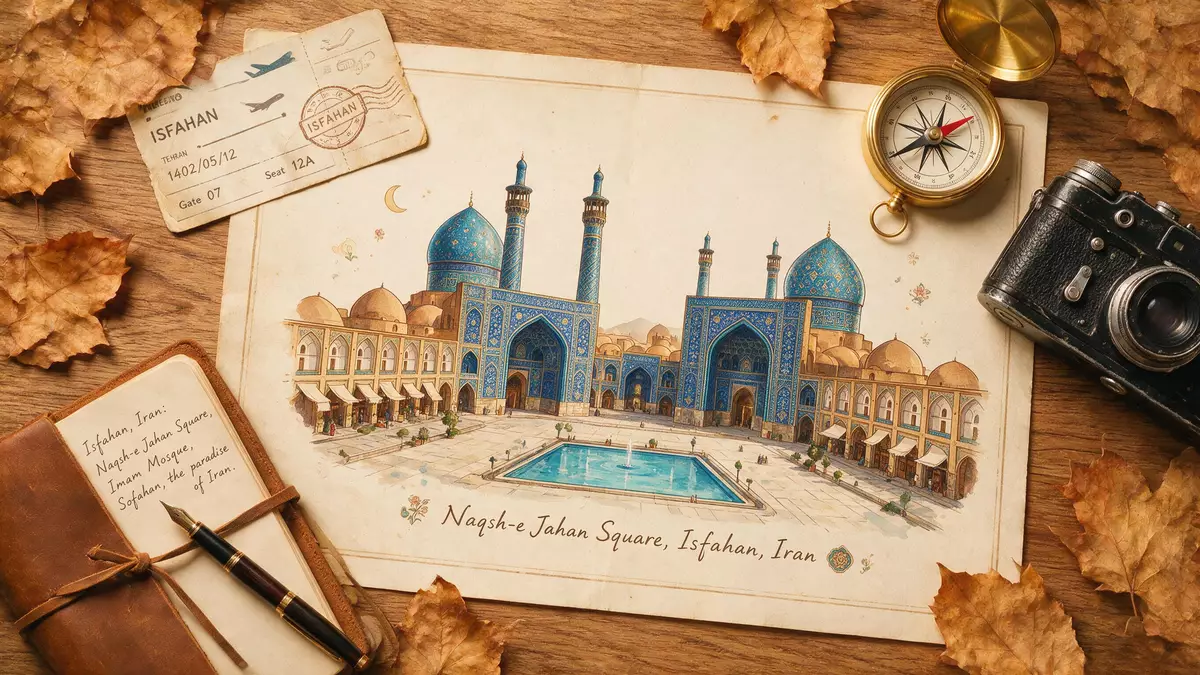
Naqsh-e Jahan in Isfahan is a vast Safavid square where mosques, a palace and bazaars face one another across an open rectangle of stone and sky. Laid out under Shah Abbas I in the early seventeenth century, it forms the ceremonial core of Meidan Emam, Esfahan, a UNESCO World Heritage Site inscribed in 1979.
A single square framed by Safavid power
Naqsh-e Jahan, also officially known as Meidan Emam, Esfahan, stretches as a long rectangle at the centre of Isfahan, with arcaded buildings lining every side.Meidan Emam, Esfahan Its layout dates to the reign of Shah Abbas I, who moved the Safavid capital to Isfahan in 1598 and began constructing the square soon after as a showcase of imperial architecture.moved his capital to Isfahan in 1598
The space is monumental in scale, extending several hundred metres in length and giving clear views to the landmark buildings at each side. The ground is largely level, forming a broad esplanade that once accommodated processions and equestrian games. Low fountains and pools punctuate the centre, while the surrounding two-storeyed arcades contain rows of chambers used for trade and craft workshops.
Mosques, palace and bazaar around the perimeter
Each side of Naqsh-e Jahan is anchored by a major Safavid monument, turning the square into a concentrated panorama of seventeenth-century Iranian architecture.bordered on all sides by monumental buildings On the south side stands the Royal Mosque, later known as the Imam Mosque, with an ivan and tiled dome that rise above the arcades. The east side is marked by the Sheikh Lotfollah Mosque, a more compact domed structure distinguished by refined tilework.
Opposite the Sheikh Lotfollah Mosque on the west side, the Ali Qapu palace presents a tall, tiered façade with a projecting terrace that looks over the square.the Ali Qapu palace At the northern end, the Qeysarieh (Qaysariyyeh) portico forms the ceremonial gateway into the covered bazaar of Isfahan, linking the open square to a network of vaulted market streets. Taken together, these buildings display the full range of Safavid court, religious and commercial architecture within one continuous urban frame.
UNESCO recognition and Safavid urban vision
In 1979 Meidan Emam, Esfahan, encompassing Naqsh-e Jahan and its surrounding monuments, was inscribed on the UNESCO World Heritage List for its outstanding testimony to Safavid civilisation.inscribed on the UNESCO World Heritage List in 1979 The designation highlights the square’s integrated composition of palace, mosques, bazaar and public space as a deliberate demonstration of Safavid power and urban planning.
The complex belongs to the Safavid period of Iranian history, which ran from the early sixteenth to the early eighteenth century and established Shi’a Islam as the state religion. Shah Abbas I, who reigned from 1588 to 1629, used architecture in Isfahan to express that political and religious identity, and Naqsh-e Jahan crystallises this vision in built form.Naqsh-e Jahan Square was inscribed as a UNESCO World Heritage site in 1979
Visiting Naqsh-e Jahan: what travellers from Western Europe should know
- Naqsh-e Jahan lies in the centre of Isfahan in central Iran, reached by city streets and connecting directly to the historic bazaar network on its northern side.
- The square itself is a level paved expanse with long arcades; access to the mosques and Ali Qapu palace involves staircases and changes in floor level.
- The surrounding city sits on an inland plateau, and the open square is fully exposed to sun, with little shade away from the arcades and interiors.
- The official language is Persian (Farsi) and the currency is the Iranian rial.
- Entry requirements depend on your nationality; UK travellers can check the FCDO travel advice at gov.uk/foreign-travel-advice, Irish travellers the Department of Foreign Affairs at ireland.ie.
Searching for Naqsh-e Jahan on social platforms
These links open searches for Naqsh-e Jahan on each platform.
Frequently asked questions about Naqsh-e Jahan
Where is Naqsh-e Jahan?
Naqsh-e Jahan is a historic Safavid square in the centre of Isfahan, a major city in central Iran.
What should a visitor expect on a first visit?
A visitor encounters a large rectangular square lined with two-storeyed arcades, framing monumental mosques, the Ali Qapu palace and the entrance to the bazaar.
What makes Naqsh-e Jahan distinctive among Iranian squares?
Its combination of palace, two major mosques and a bazaar gateway around one open Safavid square, recognised as Meidan Emam, Esfahan on the UNESCO World Heritage List, gives it a distinctive character.