
Museo Guggenheim Bilbao and its flowing titanium forms
Published on 09/17/2026 at 11:14 | Editorial responsibility: Rafael Müller, Editor-in-Chief AD HOC NEWS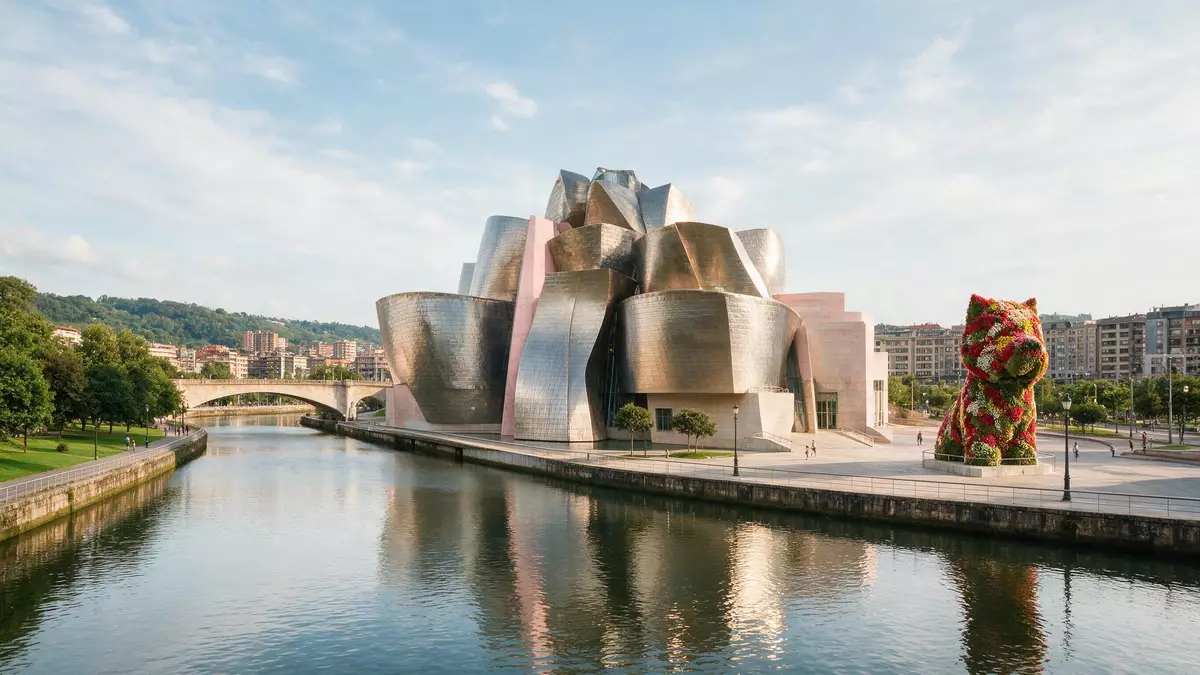
Museo Guggenheim Bilbao is a contemporary art museum on the riverfront in Bilbao, Spain, housed in a flowing building of titanium, limestone and glass designed by Frank Gehry and inaugurated in 1997.
Titanium curves beside the Nervión
The most striking impression of Museo Guggenheim Bilbao is its exterior, where sweeping forms rise beside the Nervión River in Bilbao’s Abandoibarra district.Guggenheim Museum Bilbao From the river promenade, the museum unfolds as a collage of volumes: some are straighter areas clad in pale limestone, while others are free-flowing elements wrapped in thin titanium panels that catch Atlantic light.
The outer skin uses thousands of extremely thin titanium sheets whose textured finish gives the metal a slightly rough, organic quality.titanium sheets Their colour shifts subtly with cloud and sun, so the museum’s appearance changes through the day without altering its underlying forms. Limestone and glass complete the palette, with stone surfaces grounding the more restless metal and wide areas of glazing marking entrances and views.
Frank Gehry’s deconstructivist landmark
Museo Guggenheim Bilbao was designed by Canadian-American architect Frank Gehry for the Solomon R. Guggenheim Foundation and the Basque authorities, with construction taking place between 1993 and 1997.construction 1993 to 1997 The museum opened to the public on 18 October 1997, marking a decisive moment in Bilbao’s late twentieth-century urban transformation.opened 18 October 1997
The building is associated with deconstructivist architecture, a movement that favours fragmented forms and non-orthogonal geometries over regular boxes.deconstructivist architecture To one side, the museum’s forms reach out towards a road bridge that crosses the river, while elsewhere the building steps back to create terraces and walkways. From certain viewpoints the ensemble reads almost like an enormous piece of sculpture placed within the city, its complex surfaces contrasted with the more rectilinear buildings nearby.
Inside the atrium and galleries
Behind the titanium and stone, Museo Guggenheim Bilbao offers a generous interior of around 24,000 m² of floor area, including extensive exhibition space arranged across several levels.24,000 m2 The main organising feature is a high atrium, where glass surfaces and exposed structure come together above the museum’s central space.three levels of the building
Curved walkways, lifts and staircases connect the atrium with the museum’s galleries, many of which are generous enough to house large-scale contemporary installations.largest gallery dimensions Some galleries follow more regular, orthogonal plans and are clad in limestone on the exterior, while others echo the free forms of the outer shell and carry titanium on their outer surfaces.orthogonal and irregular galleries The combination gives visitors alternating experiences of more straightforward exhibition rooms and more enveloping spaces shaped by the curvature of the building.
Visiting Museo Guggenheim Bilbao: what travellers from Western Europe should know
- Museo Guggenheim Bilbao stands on Abandoibarra Etorbidea beside the Nervión River in Bilbao, in Spain’s Basque Country, reachable by urban public transport within the city.
- The museum’s interior is spread across multiple levels linked by staircases, lifts and walkways, so a visit involves moving between floors within a large, multi-storey building.
- The surrounding riverside promenade is level and paved, with open spaces where the museum’s forms can be viewed from different angles along the water.
- The official language in Bilbao is Spanish alongside Basque and the currency is the euro.
Searching for Museo Guggenheim Bilbao on social platforms
These links open searches for Museo Guggenheim Bilbao on each platform.
Frequently asked questions about Museo Guggenheim Bilbao
Where is Museo Guggenheim Bilbao located?
Museo Guggenheim Bilbao stands on Abandoibarra Etorbidea beside the Nervión River in Bilbao, in Spain’s Basque Country.
What can visitors expect inside the museum?
Visitors encounter a large atrium, multi-level circulation and a sequence of galleries for contemporary art, some regular in plan and others shaped by the building’s curved outer forms.
What makes Museo Guggenheim Bilbao distinctive among museums?
The museum is distinctive for its deconstructivist architecture by Frank Gehry, with titanium, limestone and glass surfaces giving the building a sculptural presence along the riverfront.


