
Museo Guggenheim Bilbao and its titanium riverside curves
Published on 09/14/2026 at 20:40 | Editorial responsibility: Rafael Müller, Editor-in-Chief AD HOC NEWS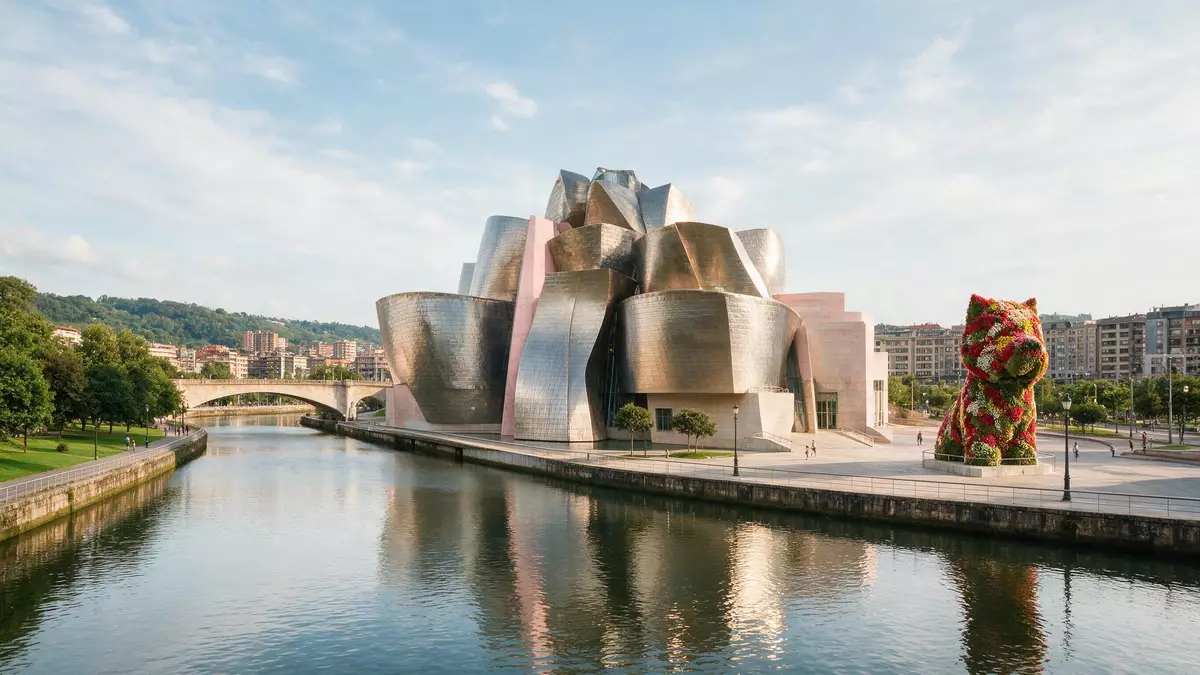
Museo Guggenheim Bilbao is a contemporary art museum on the banks of the river in Bilbao, Spain, housed in a titanium-clad building designed by Frank Gehry and inaugurated in October 1997. The museum stands beside a curve of the Nervión river in the Basque city, where its gleaming surfaces and interlocking forms have become a defining presence in the riverside landscape.
Titanium skin along the Nervión
The most striking aspect of Museo Guggenheim Bilbao is its exterior, where sweeping forms are clad in thin titanium panels that catch the Atlantic light over the Nervión.The building’s exterior is clad in titanium, limestone and glass and rises beside the river at Abandoibarra in Bilbao.The museum’s address places it on Abandoibarra Etorbidea in Bilbao, Bizkaia From the river walk, the museum’s forms unfold in a sequence of curves and angled volumes that appear to lean, twist and overlap, their metallic surfaces shifting in tone with cloud and sun.
The titanium relates directly to the museum’s Basque riverside setting, where humidity, rain and salt-laden air would have challenged more conventional claddings. Gehry and his team adopted extremely thin titanium sheets for their durability and their ability to reflect Bilbao’s soft, grey light in subtle, changing ways.The primary materials include titanium cladding, limestone and glass The metal wraps complex, non-orthogonal volumes and sets up a deliberate contrast with plainer limestone areas, so that the museum reads as a collage of surfaces along the river.
Frank Gehry’s sculptural architecture
Museo Guggenheim Bilbao belongs to a family of sculptural projects by Frank Gehry, whose work in Bilbao established him as one of the key figures of late twentieth-century architecture.The building was designed by Canadian-American architect Frank Gehry Rather than a simple rectangular museum block, Gehry’s design assembles a series of intersecting forms: some are straighter limestone-clad volumes, while others are free-flowing titanium elements swooping out towards the river and the adjacent bridge.Ten of the museum’s galleries are orthogonal and clad in limestone, while irregular galleries are clad in titanium The result is a building that reads almost like an enormous piece of sculpture placed in the city.
Inside, the architecture continues this sense of motion and layering. A central atrium rises to a considerable height, crossed by bridges and edged by glass, so that visitors pass between galleries through a space that feels open to the river and the city beyond.The museum has been widely noted for its sculptural, titanium-clad form since opening in 1997 From some points the view takes in the Nervión, nearby quays and the city slopes beyond, linking the interior back to the waterside setting.
A riverside museum opened in 1997
Museo Guggenheim Bilbao opened to the public in October 1997, after a construction process that began in 1993 and reshaped part of Bilbao’s waterfront.Construction started in October 1993 and was completed in October 1997 The institution forms part of the wider Guggenheim Foundation network of museums and focuses on modern and contemporary art, with permanent works and temporary exhibitions housed in its varied galleries.The museum was inaugurated on 18 October 1997 and exhibits contemporary art linked to the Guggenheim Foundation The date of inauguration, 18 October 1997, has become a touchstone in the recent history of Bilbao’s cultural development.
The building’s position beside the Nervión allows the museum to connect directly with promenades and bridges, and outdoor artworks extend the experience beyond the galleries. Large-scale pieces stand near the river and within courtyards, framed by the building’s metallic forms and by stretches of water and stone. In this way the museum functions both as an indoor institution and as a sequence of outdoor spaces along the former industrial waterfront.
Visiting Museo Guggenheim Bilbao: what travellers from Western Europe should know
- Museo Guggenheim Bilbao stands on the Nervión river in the Abandoibarra area of Bilbao, in northern Spain, reached by city transport links serving Bilbao’s central districts.
- The museum occupies multi-level terrain with internal staircases, lifts and walkways, and its riverfront approaches involve sloping paths and broad exterior steps beside the building.
- Nearby landmarks include the Puente de la Salve road bridge over the Nervión and other riverside walks that connect the museum to central Bilbao neighbourhoods.
- The official language is Spanish and the currency is the euro.
Searching for Museo Guggenheim Bilbao on social platforms
These links open searches for Museo Guggenheim Bilbao on each platform.
Frequently asked questions about Museo Guggenheim Bilbao
Where is Museo Guggenheim Bilbao located?
Museo Guggenheim Bilbao stands in Bilbao, in Spain’s Basque Country, alongside the Nervión river in the Abandoibarra district.
What can visitors expect inside Museo Guggenheim Bilbao?
Visitors encounter modern and contemporary art displayed in a variety of gallery spaces, arranged around a tall central atrium linked to the riverside.
What makes Museo Guggenheim Bilbao distinctive among museums?
The museum is distinctive for Gehry’s titanium-clad, sculptural building on the river, where interlocking forms and contrasting materials frame both art and outdoor spaces.


