
Museo Guggenheim Bilbao and its titanium riverfront curves
Published on 08/27/2026 at 12:31 | Editorial responsibility: Rafael Müller, Editor-in-Chief AD HOC NEWS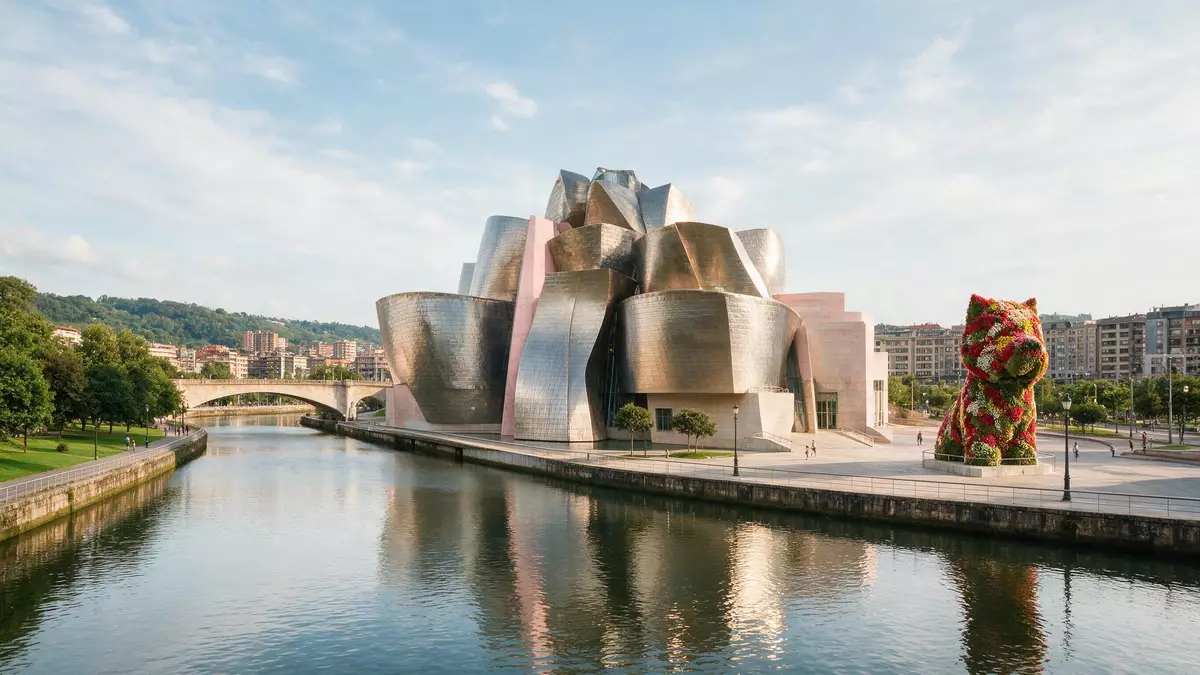
Museo Guggenheim Bilbao is a contemporary art museum on the riverfront in Bilbao, Spain, where Frank Gehry’s titanium, glass and limestone structure turns the city’s former docks into an encounter with sculptural architecture. Opened in 1997, it has become a landmark of late twentieth-century design and a vessel for international and Basque contemporary art.
Titanium, glass and limestone on the Nervión
The museum stands beside the Nervión estuary in the Abandoibarra district, where its irregular volumes spill towards the water and the nearby bridges. Gehry’s building combines rough blocks clad in pale limestone with sweeping forms covered in thin titanium plates, their surfaces catching changes in light and weather across the day.titanium, glass and limestone Large sheets of treated glass enclose the atrium and other circulation spaces, creating tall internal volumes while protecting the artworks inside from direct sunlight.the construction of the building
The museum’s plan follows the curve of the river, with different wings jutting out at angles, some rectilinear, others folded and twisted. Several of the gallery volumes are identifiable on the exterior by their limestone cladding, while others appear as titanium-covered forms that read almost as sculptural objects from the promenade.limestone finish and titanium-clad forms Walkways and terraces run around the building at different levels, bringing visitors close to these surfaces and to outdoor artworks installed near the river.
Frank Gehry’s late twentieth-century museum architecture
Museo Guggenheim Bilbao was designed by the Canadian-American architect Frank Gehry for the Solomon R. Guggenheim Foundation and the Basque authorities, with construction beginning in 1993 and completion in October 1997.constructed between 1993 and 1997 The building is associated with deconstructivist architecture, a movement that embraces fragmented forms, non-orthogonal geometries and an expressive use of materials. Its complex curves were developed with extensive physical modelling and computer-aided design, producing a structure that appears to shift when viewed from different points along the river.
Inside, the organisational focus is a tall atrium with glass walls and sculptural supporting elements, from which galleries branch out in different directions on several levels. Nineteen exhibition spaces occupy these volumes, some long and rectilinear, others unusually shaped, allowing large-scale works to be shown alongside more intimate displays.nineteen galleries and atrium Ramps, staircases and lifts connect the floors, giving visitors changing views back into the atrium and out towards the river and the city.
Collections, commissions and the riverfront setting
Since its opening in 1997, Museo Guggenheim Bilbao has developed a contemporary art collection with works by artists from the second half of the twentieth century and by more recent figures from Europe, America and the Basque Country.contemporary art collection The museum combines pieces from its own holdings with works on loan from the Solomon R. Guggenheim Foundation and other institutions, as well as specially commissioned installations designed for specific galleries and outdoor spaces.programme of permanent and commissioned works
Several works have become closely associated with the site, including Richard Serra’s “The Matter of Time” in one of the largest galleries, and major outdoor sculptures near the entrance and the river. The museum sits within a redeveloped strip of riverfront, with landscaped walks, seating, and sightlines towards bridges and the historic centre of Bilbao. From the promenade, the building’s metal surfaces reflect parts of the city’s skyline and the water, binding the museum visually to the wider urban landscape.
Visiting Museo Guggenheim Bilbao: what travellers from Western Europe should know
- Museo Guggenheim Bilbao stands beside the Nervión estuary in the Abandoibarra area of Bilbao, reachable on foot from central districts and from nearby tram and metro stops.
- The museum’s interior includes several levels linked by stairs, ramps and lifts, and some of the larger galleries involve extended walking distances through spacious halls.
- Outdoor sculpture areas and terraces border the river and adjacent plazas, with changes in level between the street, the promenade and the museum entrances.
- Spain’s official language is Spanish and the currency is the euro, with Basque also widely used on signage and in local institutions.
Searching for Museo Guggenheim Bilbao on social platforms
These links open searches for Museo Guggenheim Bilbao on each platform.
Frequently asked questions about Museo Guggenheim Bilbao
Where is Museo Guggenheim Bilbao located?
Museo Guggenheim Bilbao is in Bilbao in northern Spain, beside the Nervión estuary in the Abandoibarra riverfront district.
What can visitors expect inside the museum?
Visitors encounter a tall central atrium, nineteen galleries spread across several levels, and a programme of contemporary art drawn from international and Basque collections.
What makes Museo Guggenheim Bilbao distinctive among museums?
The museum is distinctive for Frank Gehry’s titanium, glass and limestone building of the late twentieth century and for large-scale works integrated with the riverfront setting.


