
Monasterio de Santa Catalina, Arequipa’s stone cloister city
Published on 09/16/2026 at 09:19 | Editorial responsibility: Rafael Müller, Editor-in-Chief AD HOC NEWS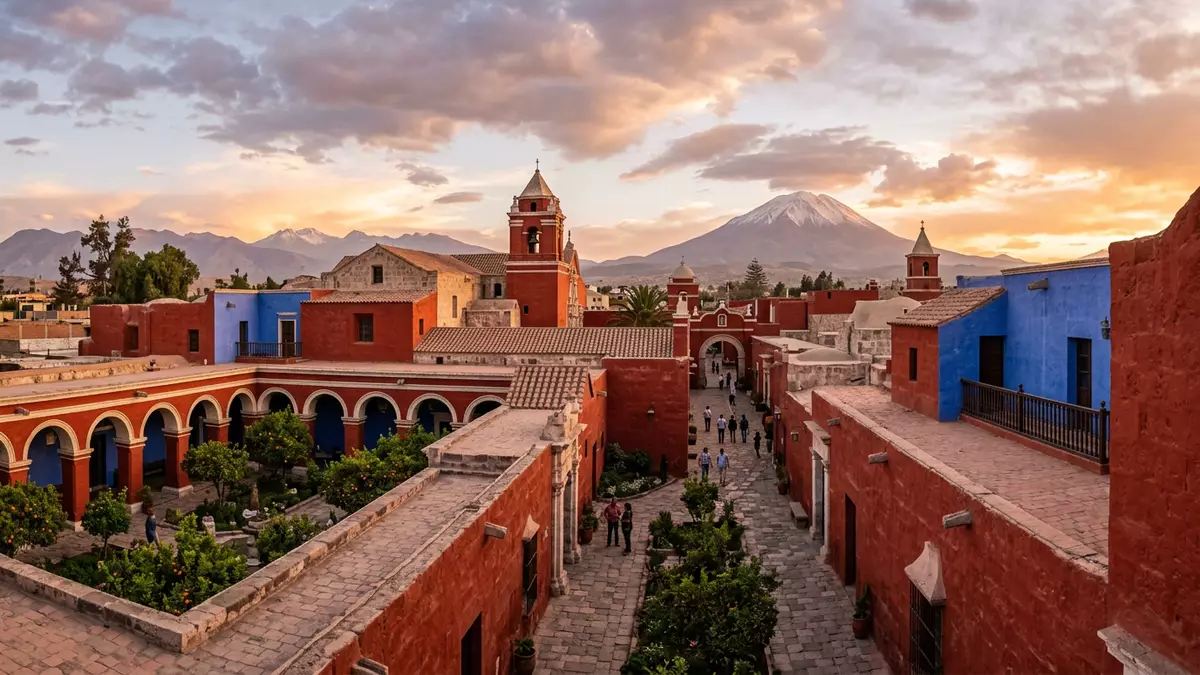
Monasterio de Santa Catalina in Arequipa is a Dominican convent that expanded over centuries into a cloistered quarter of streets, courtyards and chapels enclosed behind high volcanic stone walls. Consecrated in 1579 during the Spanish colonial period, it occupies an entire urban block within Arequipa’s historic centre, a district recognised as a World Heritage Site for its distinctive sillar architecture.
A cloistered city within the White City
The defining experience of Monasterio de Santa Catalina is entering what feels like a miniature city sealed inside the wider White City of Arequipa. Behind the main portal on Santa Catalina Street, a network of narrow lanes, small plazas and residential cloisters unfolds, lined by buildings whose walls are built from pale sillar stone, a porous material formed from volcanic lava and quarried around Arequipa.sillar, a porous stone formed by volcanic lava The convent complex covers a city block in the colonial core and sits within the historic centre whose fusion of European and Indigenous building techniques in sillar earned UNESCO inscription in 2000.UNESCO inscribed Arequipa’s historic centre in 2000
Within the enclosure, cloisters frame courtyards planted with trees and flowerbeds, and simple stone arcades run around these open spaces. Chapels are roofed with barrel vaults or domes, and thick piers support the ceilings, an arrangement associated with the “Arequipa school” of colonial architecture, which adapted Spanish Baroque forms to local conditions such as seismic activity and climate.architecture blends Spanish colonial forms with local craftsmanship Over different centuries additional cloisters, service areas and small houses were added, so the monastery reads as a layered architectural record of Viceroyal Peru, with colonial, mestizo Baroque and neoclassical elements coexisting in one enclosed precinct.important example of Viceroyal architecture
Founding a Dominican convent in the sixteenth century
Santa Catalina was founded in 1579, less than forty years after Arequipa itself was established by the Spanish in 1540, at a time when the city served as an important regional centre of the Viceroyalty of Peru.the monastery was founded in 1579 The convent belongs to the Dominican Second Order, whose houses gathered women into enclosed religious communities, and historical accounts consistently connect its origin with Doña María de Guzmán, a wealthy widow from Arequipa who donated her fortune and properties and became the first prioress.founded in 1579 by María de Guzmán Licences for the foundation were granted under the viceregal administration of Francisco de Toledo, reflecting the close ties between religious institutions and colonial governance.licences granted during Francisco de Toledo’s administration
For centuries the convent functioned as a strictly cloistered community of Dominican nuns whose lives were largely closed to the wider city. Daughters of the colonial elite entered with dowries and brought servants and furnishings, creating cells that in some cases grew into small apartments with private rooms and domestic spaces.accepted daughters of the colonial elite Historical summaries describe the monastery as a cloistered convent for about 390 to 400 years, with outsiders excluded and contact with Arequipa beyond the walls extremely limited until the twentieth century.cloistered convent for about 390 years In 1970 most of the complex was opened to visitors while a smaller religious community continues to reside in a separate cloistered area, so Santa Catalina now combines living convent with museum-like historic precinct.opened to the public in 1970
Stone, colour and everyday life inside the enclosure
Architecturally, Monasterio de Santa Catalina is built almost entirely from sillar, the light-coloured volcanic stone that defines much of Arequipa’s colonial centre.almost entirely built with ashlar This material allows thick walls, carved details and robust structural elements that respond to an earthquake-prone region, and its pale tone contrasts with painted façades in deep reds and blues that lend many alleys and cloisters a strong visual identity. Art historians describe the complex as a blend of Spanish colonial and Mudéjar forms with local vernacular influences, visible in its arches, vaults and decorative programmes.blend of Spanish colonial, Mudéjar and local styles
Within its streets and cloisters, Santa Catalina once operated as a largely self-sufficient world. Historical descriptions refer to bakeries, laundries and communal kitchens that served the enclosed community, as well as chapels and devotional spaces where religious life unfolded. Over generations, the convent housed hundreds of women, and many cells preserved furnishings, artworks and textiles that reflect the wealth some families invested in cloistered life.served as a cloister for Dominican nuns Earthquakes in the region repeatedly damaged parts of the complex, notably in 1600 and 1604, and reconstructions in the seventeenth and eighteenth centuries contributed to the layered architectural character visitors see across its courtyards and cloisters.earthquakes in 1600 and 1604 and later rebuilding
Visiting Monasterio de Santa Catalina: what travellers from Western Europe should know
- Monasterio de Santa Catalina stands in the historic centre of Arequipa, a short walk north of the Plaza de Armas along Santa Catalina Street in the colonial grid.
- The complex occupies an entire city block enclosed by high sillar walls; visiting involves walking along cobbled lanes and climbing short flights of stone steps between cloisters and courtyards.
- Arequipa lies in southern Peru, and the official language is Spanish and the currency is the Peruvian sol.
- The convent still houses a small Dominican community in a restricted cloistered area, so some parts of the enclosure remain reserved for religious life.
Searching for Monasterio de Santa Catalina on social platforms
These links open searches for Monasterio de Santa Catalina on each platform.
Frequently asked questions about Monasterio de Santa Catalina
Where is Monasterio de Santa Catalina located?
Monasterio de Santa Catalina stands in the historic centre of Arequipa in southern Peru, occupying a full block just north of the Plaza de Armas.
What can visitors expect inside the monastery?
Visitors walk through enclosed streets, cloisters and courtyards built of sillar stone, with chapels, cells and service areas that once sustained a cloistered Dominican community.
What makes Monasterio de Santa Catalina distinctive among colonial sites?
Its character as a self-contained cloistered quarter, its extensive use of volcanic sillar stone and its layered blend of colonial and local architectural styles give the complex a distinctive identity.


