Monasterio de Santa Catalina: a city within the city in Arequipa
Published on 08/27/2026 at 14:38 | Editorial responsibility: Rafael Müller, Editor-in-Chief AD HOC NEWS
Monasterio de Santa Catalina in Arequipa is a Dominican convent whose enclosed streets, courtyards and cloisters form a self-contained miniature city inside the colonial centre. Opened as a private monastery in 1579, it still houses a small religious community behind walls of pale volcanic stone.
A walled monastic city of streets and cloisters
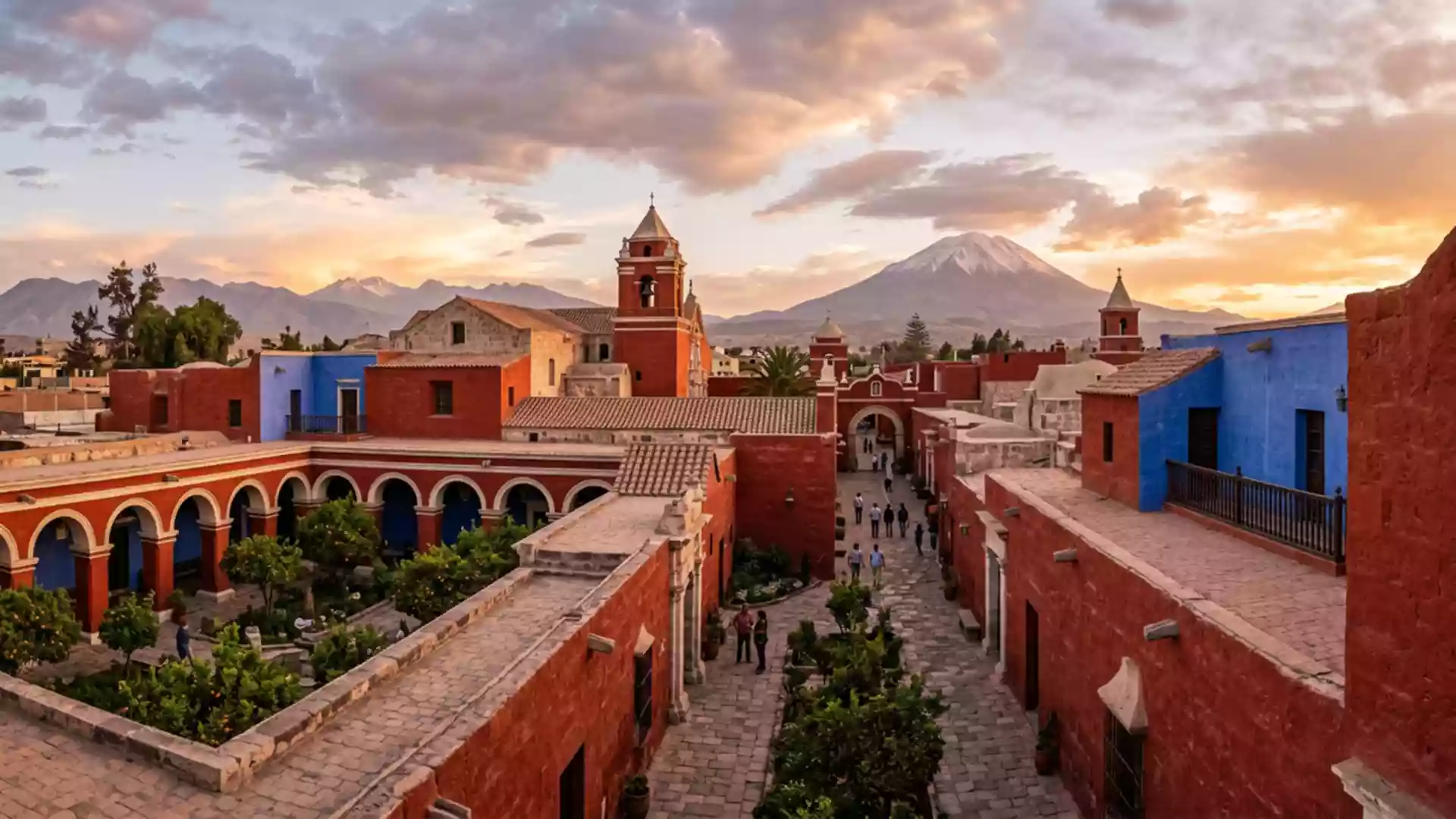
The Monasterio de Santa Catalina occupies a substantial block within the historic centre of Arequipa, with its entrance on Calle Santa Catalina a short walk from the Plaza de Armas.historic centre of Arequipa Inside the gateway the convent unfolds as a dense network of internal streets, small squares and cloistered passageways, laid out in a way that resembles a compact town.
Rather than a single large courtyard, visitors encounter successive environments: painted alleyways lined with cells, open patios centred on fountains, and cloisters framing chapels and communal rooms.occupies a territory of 20,426 m2 The internal streets carry names and are edged by buildings with doors and windows facing the walkway, reinforcing the impression of a small urban quarter sealed off from the surrounding city.
Founding, enclosure and gradual opening
The Monasterio de Santa Catalina was founded under the Dominican order in 1579, with licences granted during the viceregal administration of Francisco de Toledo.foundation of the monastery in 1579 A wealthy widow from Arequipa, Doña María de Guzmán, donated her properties and became the first prioress, and she is recognised as a key founder of the convent.Doña María de Guzmán as founder
For centuries the monastery functioned as a cloistered community of nuns, largely closed to lay visitors and sustained by the families who sent their daughters to live within its walls.cloistered convent for about 390 years In the twentieth century the convent began to open part of its complex to the outside world, and since 1970 its streets, cloisters and chapels have been accessible to visitors while a smaller religious community continues to live in a separate area of the enclosure.opened to visitors in 1970
Volcanic ashlar, colour and colonial architecture
Like many of Arequipa’s colonial buildings, Monasterio de Santa Catalina is built predominantly from sillar, a porous volcanic stone quarried in the region that can appear white, cream or slightly pink.built predominantly from sillar Walls, arcades and arches rise from this material, giving the complex a consistent structural texture even where the surfaces are covered with lime-based plaster and pigment.
The architecture blends Spanish colonial forms with elements developed by local craftsmen, a mixture sometimes described as mestizo Baroque.baroque, neoclassical and neocolonial styles Chapels are roofed with barrel vaults or domes, cloisters carry rhythmic sequences of arches, and thick stone piers support the ceilings. Many external walls in the streets and patios are painted in deep reds and blues that contrast with the pale stone of door surrounds and the bright Andean light, while interior rooms retain more subdued finishes around altarpieces, carved wood and religious artworks.
Visiting Monasterio de Santa Catalina: what travellers from Western Europe should know
- Monasterio de Santa Catalina stands in the colonial core of Arequipa, with its main entrance on Calle Santa Catalina close to the Plaza de Armas and other historic buildings.
- Inside the monastery the terrain is largely paved, but movement between levels involves staircases and uneven stone steps, and many cloisters and patios are reached through narrow passages.
- The monastery forms part of the UNESCO-listed historic centre of Arequipa, so nearby streets carry other colonial houses, churches and civic buildings in similar volcanic ashlar stone.
- The official language is Spanish and the currency is the Peruvian sol.
- Entry requirements depend on your nationality; UK travellers can check the FCDO travel advice at gov.uk/foreign-travel-advice, Irish travellers the Department of Foreign Affairs at ireland.ie.
Searching for Monasterio de Santa Catalina on social platforms
These links open searches for Monasterio de Santa Catalina on each platform.
Frequently asked questions about Monasterio de Santa Catalina
Where is Monasterio de Santa Catalina and what kind of place is it?
Monasterio de Santa Catalina is a Dominican convent complex in the historic centre of Arequipa in southern Peru, occupying a walled block of streets, courtyards and chapels.
What can visitors expect when walking through the monastery?
Visitors move through a sequence of internal streets, cloisters and patios built in volcanic ashlar stone, with vivid red and blue painted walls, chapels and former living quarters.
What makes Monasterio de Santa Catalina distinctive among colonial sites?
Its scale as an enclosed miniature city, its fusion of Spanish and local architectural styles, and its long history as a cloistered community give the monastery a distinctive character within Arequipa’s colonial landscape.