
Monasterio de Santa Catalina, Arequipa’s painted cloister city
Published on 09/08/2026 at 06:28 | Editorial responsibility: Rafael Müller, Editor-in-Chief AD HOC NEWS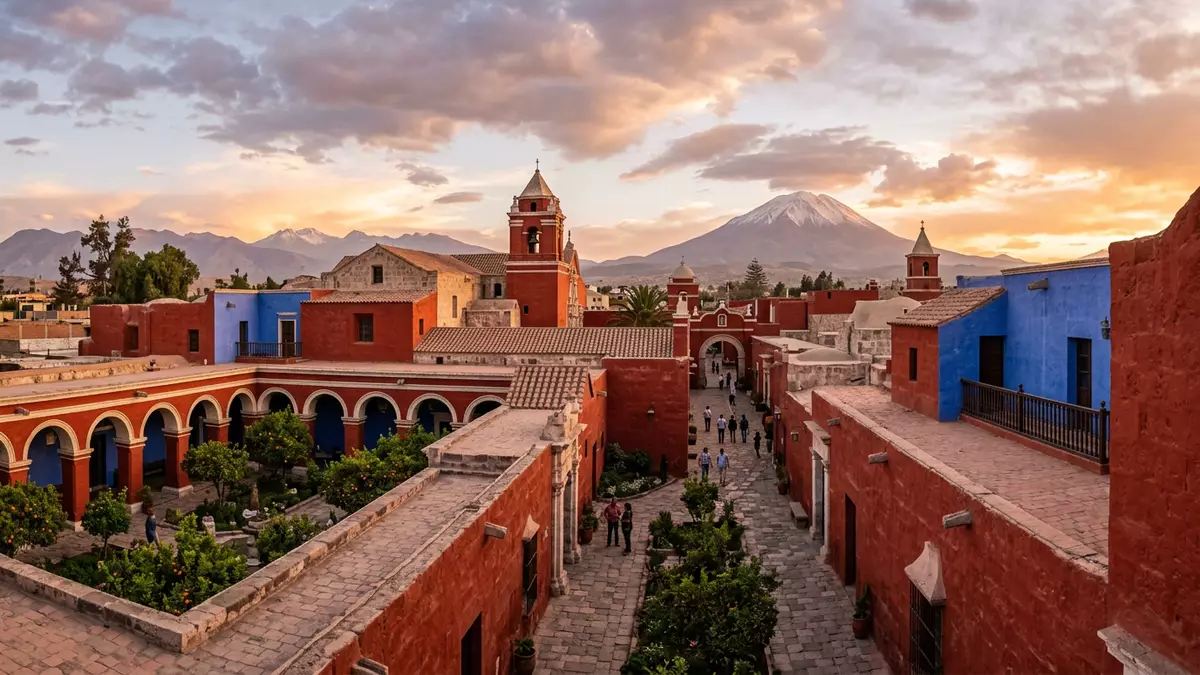
Monasterio de Santa Catalina in Arequipa is a Dominican convent that expanded over centuries into a self-contained cloistered quarter, with streets, courtyards and chapels enclosed behind high stone walls. Consecrated in 1579 in the Spanish colonial period, it forms part of the historic centre of Arequipa recognised as a UNESCO World Heritage Site and remains one of the most distinctive ensembles of sillar stone architecture in southern Peru.
A city within the city in sillar stone
Santa Catalina occupies a large block along Calle Santa Catalina in the historic centre of Arequipa, a short walk north of the Plaza de Armas, and is laid out as an internal network of alleys, small plazas and cloisters rather than a single monolithic building.Calle Santa Catalina 301 marks the main entrance on a street lined with other colonial structures built from the same pale volcanic stone.Arequipa’s historic centre gives the monastery an urban frame that contrasts with the inward-facing life it was designed to host.
Within the walls the convent covers around 20,000 m², organised as a series of zones named like streets and neighbourhoods in a town, each with its own atmosphere.cobblestone streets, plazas and gardens run between rows of low buildings where nuns once lived in individual apartments. The construction uses Arequipa’s characteristic sillar, a workable stone quarried from local volcanic deposits, and many facades are finished with vividly coloured limewash in reds and blues that stand out against the highland light.
Colonial foundation and cloistered life
The monastery was founded in 1579, less than four decades after Arequipa itself was established by the Spanish, and belongs to the Dominican Second Order, whose convents housed women in enclosed religious communities.consecrated in 1579 The foundation is connected with Doña María de Guzmán, a wealthy widow whose name appears in historical accounts as the original patron.Founded 1579 by Doña María de Guzmán For centuries the convent was completely enclosed; for 391 years no outsider entered, and the community lived with extremely limited contact with the city beyond the walls.
In its early centuries Santa Catalina drew women from prominent families into a cloistered environment whose architecture grew as successive generations added new cloisters, chapels and domestic spaces. The layout reflects this long, incremental development, with seventeenth and eighteenth-century sections layered across the site.built in the 17th and 18th centuries In 1970 the convent opened part of its precinct to visitors while other areas remained reserved for the religious community, turning Santa Catalina into both a living monastery and a place where the spatial traces of cloistered life can be observed.
Painted streets, cloisters and everyday spaces
Walking inside Monasterio de Santa Catalina reveals a sequence of named streets such as Calle Sevilla, Calle Granada and Calle Córdoba, each running between painted walls and opening into small squares.Calle Sevilla, Calle Granada, Calle Córdoba Some sections are known for bright crimson walls, others for orange tones, and many passages are framed by arches that soften the transitions between outdoor rooms. Courtyards often hold potted plants or citrus trees, and the Zocodover Cloister is particularly associated with orange trees set around its central space.
The complex preserves a range of everyday convent spaces alongside chapels and cloisters. A historic kitchen from the eighteenth century still stands with its heavy masonry forms and hearths.The kitchen is from the 18th century The lavandería, or washing area, incorporates large clay basins built into a stone water channel, forming a line of vessels used for laundry within one of the outdoor service zones.20 large clay pots used for laundry Chapels and oratories sit among these domestic elements, making Santa Catalina a place where religious, communal and practical spaces visibly intertwine.
Visiting Monasterio de Santa Catalina: what travellers from Western Europe should know
- Monasterio de Santa Catalina stands in Arequipa’s historic centre along Calle Santa Catalina, a short walk from the Plaza de Armas and reachable on foot from many central hotels.
- Inside the monastery the terrain consists of cobbled alleys, stone steps and uneven surfaces between cloisters and courtyards, so moving through the complex involves frequent short climbs and descents.
- The official language is Spanish and the currency is the Peruvian sol.
- Entry requirements depend on your nationality; UK travellers can check the FCDO travel advice at gov.uk/foreign-travel-advice, Irish travellers the Department of Foreign Affairs at ireland.ie.
Searching for Monasterio de Santa Catalina on social platforms
These links open searches for Monasterio de Santa Catalina on each platform.
Frequently asked questions about Monasterio de Santa Catalina
Where is Monasterio de Santa Catalina located?
Monasterio de Santa Catalina stands in the historic centre of Arequipa in southern Peru, occupying a full block along Calle Santa Catalina near the Plaza de Armas.
What can visitors expect inside the monastery complex?
Visitors encounter a network of painted alleys, cloisters, chapels and domestic rooms built from local sillar stone, including historic kitchens, laundry areas and gardens within the walled precinct.
What makes Monasterio de Santa Catalina distinctive among Andean convents?
Santa Catalina is distinctive for its scale as a “city within the city”, its long cloistered history from 1579 and its vivid sillar architecture with streets and cloisters named and arranged like an enclosed urban quarter.


