
Minar-e Pakistan in Lahore: concrete memory of a political turning point
Published on 09/08/2026 at 19:42 | Editorial responsibility: Rafael Müller, Editor-in-Chief AD HOC NEWS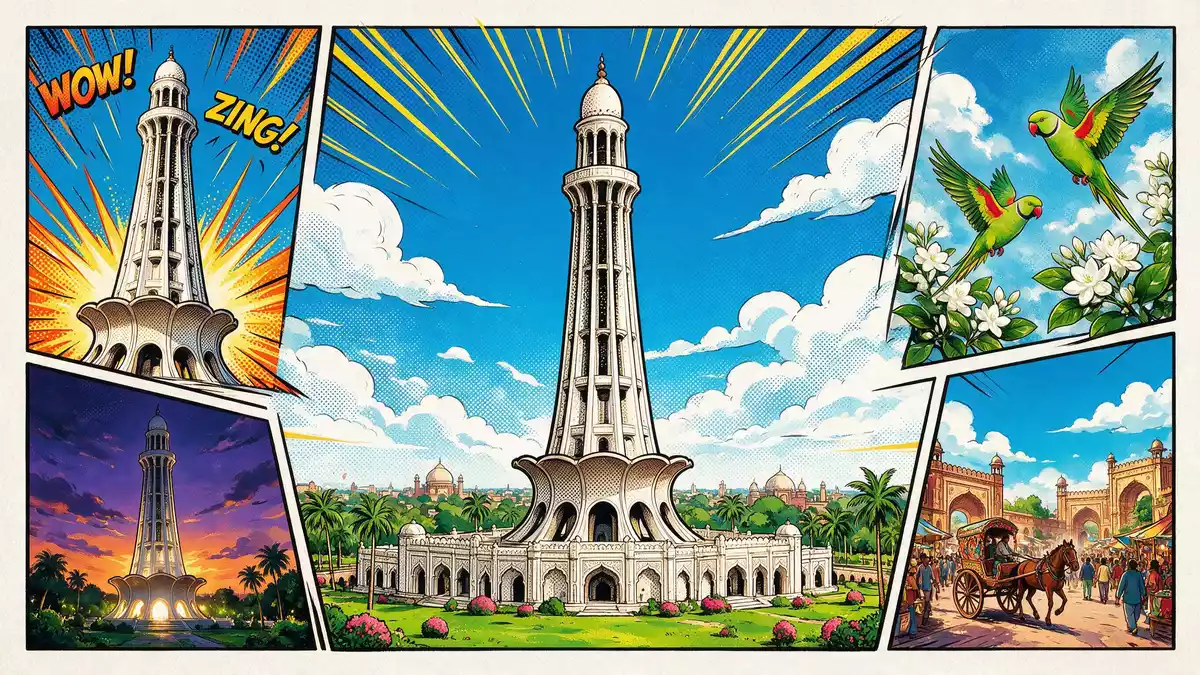
Minar-e Pakistan in Lahore is a national monument that turns a pivotal political moment from 1940 into a permanent concrete presence on the city’s skyline. Standing in Greater Iqbal Park on the ground where the Lahore Resolution was adopted by the All-India Muslim League, the tower connects Pakistan’s constitutional origins directly to a specific patch of grass and stone in Lahore.
The tower where the Lahore Resolution took form
Minar-e Pakistan stands in Greater Iqbal Park, a broad expanse of lawns and water immediately west of Lahore’s old core, on the site of the Muslim League’s 27th annual session in March 1940. During that gathering, delegates adopted the Lahore Resolution, later widely known as the Pakistan Resolution, which called for separate states in Muslim-majority regions of British India and fed into the creation of Pakistan in 1947.Lahore Resolution in 1940 The tower fixes that moment in the landscape, marking the exact ground where Muhammad Ali Jinnah addressed the session and tied abstract constitutional demands to a piece of urban space.
The decision to monumentalise that political turning point produced a project in the early 1960s that would bring a tall concrete structure into what was then known as Minto Park. Construction began after a foundation stone was laid on 23 March 1960 and continued through the decade until completion in 1968, placing the tower in the context of Pakistan’s early post-independence period.foundation stone in 1960 and completion in 1968 The monument is formally recognised as a national symbol, and its association with the Lahore Resolution makes it a reference point in narratives about the country’s formation.national monument marking the Lahore Resolution
Concrete, stone and a layered base
Architecturally, Minar-e Pakistan combines reinforced concrete with stone and draws on Mughal references alongside modern structural forms.blend of Mughal and modern architecture The tower rises from a broad platform whose successive terraces step up from the surrounding park, forming a pronounced base before the shaft begins its climb. The composition links vertical and horizontal elements, with the minaret-like shaft rising from a plinth that can be approached from different sides by staircases set into the platform.layered base and tapering shaft
The tower’s height is recorded at around 70 m (230 ft), giving it a strong presence above the trees and paths of Greater Iqbal Park.around 70 m (230 ft) above the ground Its tapering shaft takes the familiar language of a minaret and translates it into reinforced concrete, while the stone at the base grounds the design in a material closely associated with historic construction in Lahore. At the centre of the lower composition, a marked point in the paving indicates where Jinnah spoke in March 1940, and a memorial rostrum aligns the visitor with that position when standing on the platform.memorial rostrum for Muhammad Ali Jinnah
Greater Iqbal Park and Lahore’s wider setting
Greater Iqbal Park spreads around Minar-e Pakistan with lawns, paved walks and water features, offering clear views of the tower from different angles across the grounds.Greater Iqbal Park in Lahore Within sight of the monument lie other historic elements of Lahore’s inner urban fabric, and the park creates a buffer of open space between the tower and the surrounding streets. The minaret form, rising from its layered base in the middle of this parkland, reads both as a freestanding structure and as part of a larger ensemble of built and planted elements.
The monument’s location means that a visit to Minar-e Pakistan can easily connect with a wider exploration of central Lahore, from nearby parkland to historic districts beyond. The combination of concrete shaft, stone terraces and surrounding greenery makes the site a point where large-scale national history and local urban space intersect, with the tower acting as a vertical marker for the events of 23 March 1940 that shaped Pakistan’s subsequent constitutional path.tower commemorating the Pakistan Resolution
Visiting Minar-e Pakistan: what travellers from Western Europe should know
- Minar-e Pakistan stands in Greater Iqbal Park in Lahore, east of the Ravi River, and is reached by city roads that connect the park with the wider urban area.
- The monument’s base is formed by terraces reached via staircases from the surrounding park, so visiting the platform involves climbing steps rather than walking on a single level.
- The monument lies in Pakistan, where the official language is Urdu and the currency is the Pakistani rupee.
- Entry requirements depend on your nationality; UK travellers can check the FCDO travel advice at gov.uk/foreign-travel-advice, Irish travellers the Department of Foreign Affairs at ireland.ie.
Searching for Minar-e Pakistan on social platforms
These links open searches for Minar-e Pakistan on each platform.
Frequently asked questions about Minar-e Pakistan
Where is Minar-e Pakistan located in Lahore?
Minar-e Pakistan stands in Greater Iqbal Park in Lahore, on the former Minto Park grounds west of the historic city centre.
What should visitors expect when they reach the monument?
Visitors find a tall concrete and stone tower rising from a multi-level platform in a large park, with paths, lawns and water nearby.
What makes Minar-e Pakistan distinctive among Lahore’s monuments?
Its distinctive character comes from its role as a marker of the 1940 Lahore Resolution, built between 1960 and 1968 as a national monument.


