
Minar-e Pakistan and the layered stone of Lahore’s national tower
Published on 08/27/2026 at 19:10 | Editorial responsibility: Rafael Müller, Editor-in-Chief AD HOC NEWS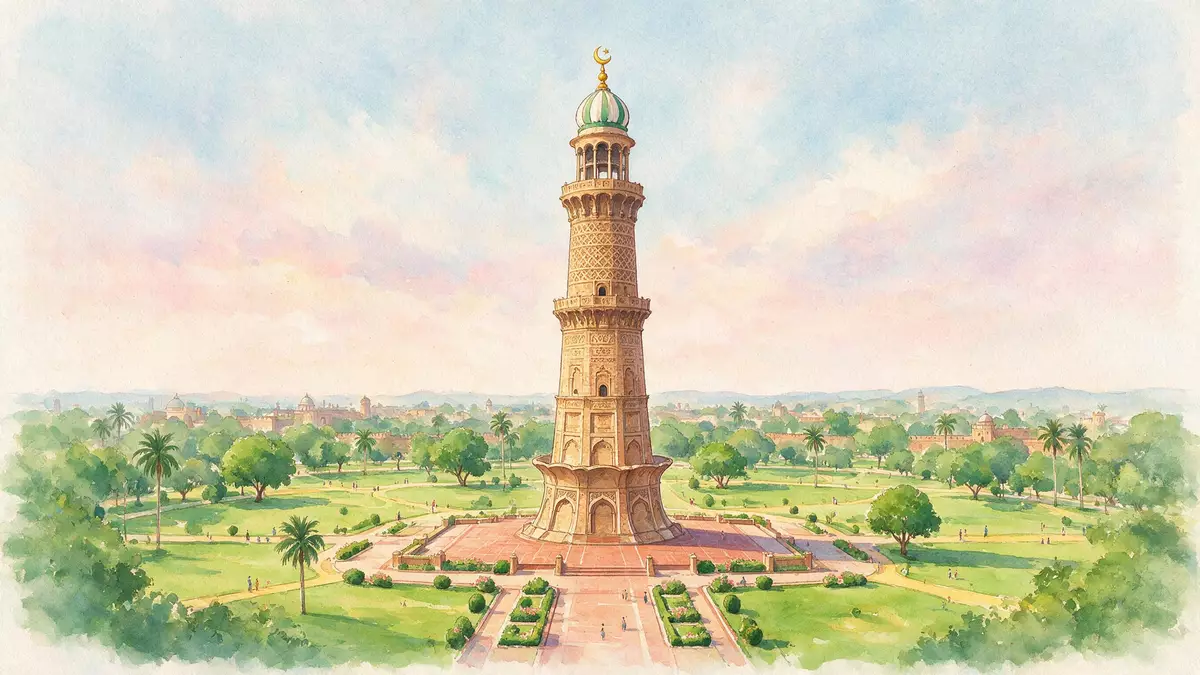
Minar-e Pakistan stands in Lahore’s Greater Iqbal Park as a national monument that turns a political turning point from 23 March 1940 into a tower of stone and steel. Its layered base and tapering shaft mark the ground where the All-India Muslim League adopted the Lahore Resolution, a demand that shaped the creation of Pakistan in 1947.
A tower built on the Lahore Resolution
The core of Minar-e Pakistan is its role as a built reminder of the Lahore Resolution, passed in Minto Park during the All-India Muslim League’s 27th annual session on 23 March 1940. The text adopted at that gathering called for separate, autonomous homelands for Muslims in the Muslim-majority regions of British India, a demand that fed directly into the creation of Pakistan in 1947 and is remembered as the Pakistan Resolution.Lahore Resolution in 1940
The decision to fix that moment in architecture took shape two decades later, when the government of Pakistan commissioned a monument on the same open ground in Lahore. Construction began in 1960 and continued for several years, bringing a concrete and stone minaret into a park landscape that also carries lawns, water and trees.construction began in 1960 The result is a memorial that binds political history and physical place in a single vertical line.
Architecture in layers of stone and marble
Minar-e Pakistan rises to about 70 m (230 ft), with a base shaped as a star plan that spreads outwards before the tower shaft begins.about 70 m tall The structure combines reinforced concrete with stone cladding and marble, giving the monument both mass and a carefully finished surface. From a distance the tower reads as a slender minaret, but close up its surfaces show distinct bands of texture.
The architect was Nasreddin Murat-Khan, a Russian-born Pakistani of Dagestani origin who settled in Pakistan after the Second World War.Nasreddin Murat-Khan as architect He worked with structural engineer Abdur Rahman Khan Niazi, creating a design described as a blend of Mughal, Islamic and modern architecture.blend of Mughal and modern The lower portion is faced with rough Taxila stone, above which the masonry becomes progressively more finely dressed before giving way to polished white marble higher up the shaft. The change in surface treatment turns the tower into a vertical sequence of textures.
A monument in Greater Iqbal Park
Minar-e Pakistan stands within Greater Iqbal Park, the name now given to the former Minto Park in Lahore’s historic core. The grounds lie close to other landmarks including Badshahi Mosque and Lahore Fort, so that the tower forms part of a wider ensemble of Mughal and colonial-era structures in the city.located in Iqbal Park From the lawns the tower is visible behind planted areas and water features, while at its base a raised platform frames the start of the climb.
The structure includes internal stairs that spiral up to viewing levels, and lifts that run inside the shaft, giving visitors a way to reach platforms above the park. From those heights the view extends across the green of Greater Iqbal Park and into the older districts of Lahore, linking the twentieth-century monument visually to earlier layers of the city.
Visiting Minar-e Pakistan: what travellers from Western Europe should know
- Minar-e Pakistan stands in Greater Iqbal Park, north-west of Lahore’s Walled City, and is reached along Circular Road near Badshahi Mosque and Lahore Fort.
- The monument stands on a stepped plinth and the interior climb follows a narrow staircase, so a visit to the upper levels involves a sustained ascent on foot.
- Lahore lies in the Punjab province of Pakistan, where the official language is Urdu and the currency is the Pakistani rupee.
- Entry requirements depend on your nationality; UK travellers can check the FCDO travel advice at gov.uk/foreign-travel-advice, Irish travellers the Department of Foreign Affairs at ireland.ie.
Searching for Minar-e Pakistan on social platforms
These links open searches for Minar-e Pakistan on each platform.
Frequently asked questions about Minar-e Pakistan
Where is Minar-e Pakistan and what surrounds it?
Minar-e Pakistan stands in Greater Iqbal Park in Lahore, close to landmarks such as Badshahi Mosque and Lahore Fort in the historic core of the city.
What can visitors expect during a visit?
Visitors encounter a tall concrete and stone tower on a raised plinth, with internal stairs and lifts leading to viewing platforms above the lawns and water of Greater Iqbal Park.
What makes Minar-e Pakistan distinctive among monuments in Lahore?
Minar-e Pakistan combines a star-plan base, a 70 m (230 ft) tower and a deliberate layering of rough stone, dressed masonry and marble to mark the exact ground of the 1940 Lahore Resolution.


