
Minar-e Pakistan: Lahore’s concrete marker of the 1940 resolution
Published on 08/28/2026 at 12:20 | Editorial responsibility: Rafael Müller, Editor-in-Chief AD HOC NEWS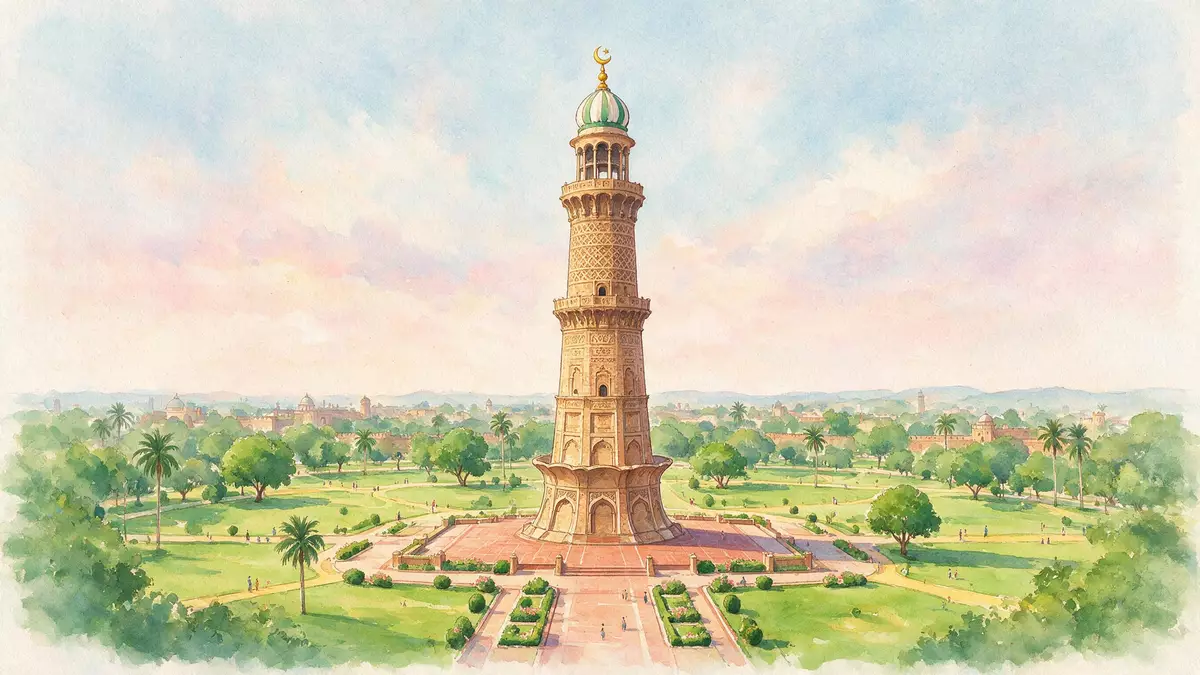
Minar-e Pakistan in Lahore is a reinforced-concrete tower standing in Greater Iqbal Park on the site where the Lahore Resolution was passed on 23 March 1940, calling for a separate homeland for Muslims in British India.Greater Iqbal Park in Lahore The monument’s tall profile and layered base make the resolution’s abstract political demand into a permanent physical landmark in the city.
A tower built over a pivotal political moment
Minar-e Pakistan is officially recognised as a national monument marking the Lahore Resolution, passed by the All-India Muslim League during its session in Minto Park, the area that is now incorporated into Greater Iqbal Park.Lahore Resolution commemoration The resolution set out the demand for separate states in Muslim-majority areas of the Indian subcontinent and later became closely associated with the eventual creation of Pakistan.marks the passing of Lahore Resolution
The tower’s construction began with a foundation stone laid on 23 March 1960, two decades after the original political gathering, and was completed in 1968.foundation stone laid on 23 March 1960 The architect was Nasreddin Murat-Khan, a Pakistani-Russian designer whose work on the project was carried out under direct commission from the government and who also oversaw construction with Mian Abdul Khaliq and Company.designed by Nasreddin Murat-Khan The tower is recorded as reaching around 70 m (230 ft) above the ground, rising from a multi-level platform.70-metre tall tower
Concrete, stone and a layered base in Greater Iqbal Park
Architecturally, Minar-e Pakistan blends reinforced concrete with stone, combining references to Mughal forms with modern structural techniques.blend of Mughal and modern architecture The shaft of the tower rises from a broad plinth whose successive terraces form a base that visitors can approach by staircases from the surrounding park.star-shaped platform and staircases At the very centre of this composition lies the spot where Muhammad Ali Jinnah is recorded as having addressed the Muslim League session in March 1940, with a memorial rostrum marking his position.memorial rostrum for Muhammad Ali Jinnah
The surrounding Greater Iqbal Park is an extensive urban green space in central Lahore, enclosed by lawns and walkways and bordered by major roads such as Circular Road.Greater Iqbal Park in central Lahore Minar-e Pakistan stands just north of the Mughal-era Lahore Fort and Badshahi Mosque, placing the twentieth-century political monument within sight of earlier imperial architecture that shaped the city’s historic core.beside Badshahi Mosque and Lahore Fort
Climbing the tower and reading the movement’s history
Visitors approaching Minar-e Pakistan encounter the broad platform before the tower itself, with long flights of steps leading up from the park towards the base.two flights of staircases Inside the base, a museum presents exhibits on the Pakistan Movement, showing documents and images related to the Lahore Resolution and the political path that led to independence.museum on the Pakistan Movement From higher levels, the tower’s viewing areas offer long views over Lahore’s dense urban fabric, including the fort, the mosque and the surrounding districts.
The monument’s management has installed both stair access and an elevator within the structure, enabling visitors to reach the upper viewing sections without relying solely on hundreds of steps.324 steps and a lift Around the monument, Greater Iqbal Park’s open lawns and paved paths provide space for large political gatherings, rallies and commemorative events that make direct use of the tower’s symbolic position.tower used for political gatherings
Visiting Minar-e Pakistan: what travellers from Western Europe should know
- Minar-e Pakistan stands inside Greater Iqbal Park in central Lahore, close to Circular Road and a short walk north of Lahore Fort and Badshahi Mosque.
- The monument rises from a high multi-terraced platform reached by staircases, and climbing inside the tower involves a considerable number of steps in addition to the elevator.
- The Lahore Metrobus network serves the area around Greater Iqbal Park, with Azadi Chowk Station lying within walking distance of the park’s entrances.
- The official language is Urdu and the currency is the Pakistani rupee.
- Entry requirements depend on your nationality; UK travellers can check the FCDO travel advice at gov.uk/foreign-travel-advice, Irish travellers the Department of Foreign Affairs at ireland.ie.
Searching for Minar-e Pakistan on social platforms
These links open searches for Minar-e Pakistan on each platform.
Frequently asked questions about Minar-e Pakistan
Where is Minar-e Pakistan located in Lahore?
Minar-e Pakistan stands in Greater Iqbal Park in central Lahore, near Circular Road and within walking distance of Lahore Fort and Badshahi Mosque.
What can visitors expect when exploring the monument?
Visitors find a multi-level platform, staircases, an internal elevator and a museum in the tower’s base presenting material on the Pakistan Movement and the Lahore Resolution.
What makes Minar-e Pakistan distinctive among Lahore’s landmarks?
The monument combines a 1960s reinforced-concrete tower by Nasreddin Murat-Khan with stone terraces and a precise location on the ground where the Lahore Resolution was passed.


