
Masjed-e Nasir ol-Molk and the geometry of coloured light
Published on 09/16/2026 at 07:26 | Editorial responsibility: Rafael Müller, Editor-in-Chief AD HOC NEWS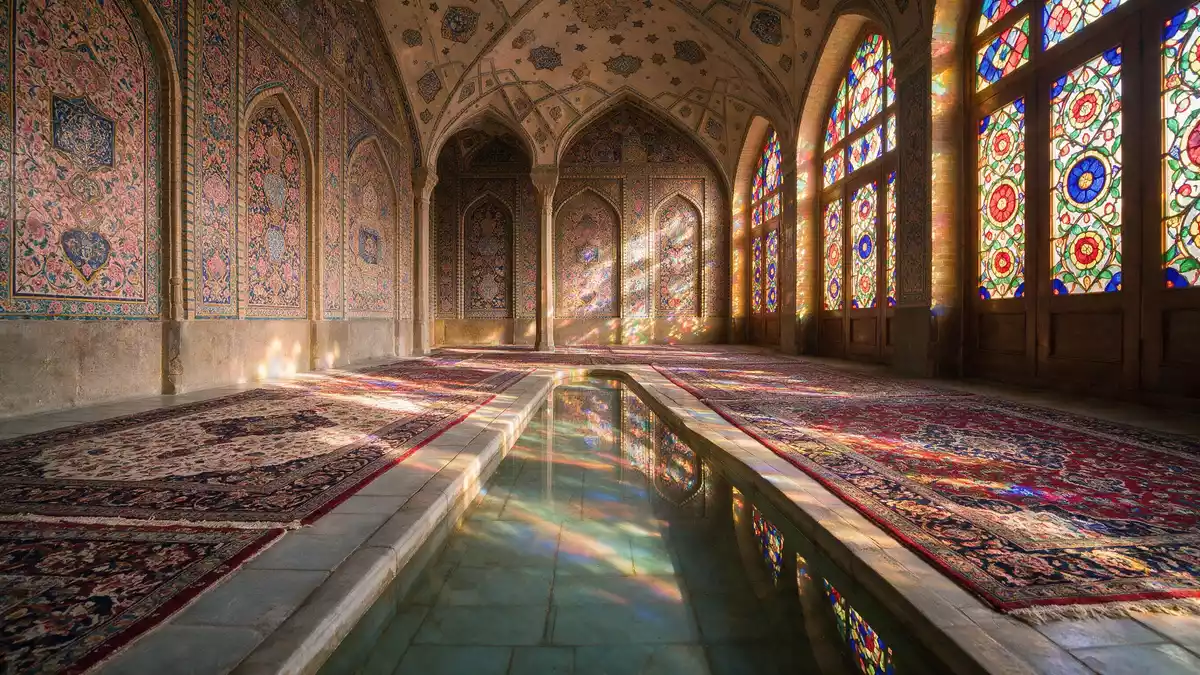
Masjed-e Nasir ol-Molk in Shiraz is a Qajar-era mosque completed in 1888 whose interior is shaped as much by coloured light as by stone and tile. Built under the patronage of Mirza Hasan Ali Nasir al-Mulk, it stands in a historic neighbourhood south of Lotfali Khan Zand Street where façades of carved stone and pink-hued tiles conceal prayer halls lined with stained glass.
The Pink Mosque in the Qajar cityscape
Masjed-e Nasir ol-Molk belongs to the Qajar period of Iranian history, a dynasty that ruled Iran from 1785 to 1925 and left Shiraz with mansions, gardens and religious buildings characterised by elaborate ornament and vivid colour.Qajar dynasty The mosque’s construction began in 1876 and continued for around twelve years, finishing in 1888, so its layout and decoration reflect late nineteenth-century taste.completed in 1888
The building occupies a plot in the Gowd-e Araban district, just south of Lotfali Khan Zand Street and near the shrine complex of Shah Cheragh, so visitors encounter it within a dense urban fabric of narrow streets and other religious sites.Gowd-e Araban district From the street, Masjed-e Nasir ol-Molk presents an entrance portal and outer walls whose surfaces are lined with seven-colour tiles in shades of rose, magenta, blue and yellow, giving rise to its widely used nickname “Pink Mosque”.pink-coloured tiles
Court, iwans and carved stone
Beyond the entrance, Masjed-e Nasir ol-Molk is organised around a central courtyard, or sahn, framed by arcades and iwans that follow established patterns of Iranian mosque design. Stone pavements define the central space, with water set into the middle and façades of arcades facing it on several sides, while the main prayer halls lie to the east and west.
The courtyard elevations show another aspect of Qajar craftsmanship: carved stone, polychrome tiles and muqarnas vaulting used together to articulate arches and wall surfaces.muqarnas vaulting and tilework Columns and arches carry vaults lined with tiles bearing floral sprays, arabesques and calligraphic bands, while carved stone appears particularly in the bases and capitals of the interior columns, giving the structural elements a sculptural presence.
Timber, glass and the winter prayer hall
The western shabestan, often described as a winter prayer hall, is the part of Masjed-e Nasir ol-Molk most closely associated with coloured light. Along its outer wall facing the courtyard, large timber frames hold panels of stained glass set into wooden doors and windows, known in Persian architecture as orsi. These frames combine carpentry with coloured glass, using geometric and floral patterns to divide panels of red, blue, yellow, green and other hues.orsi windows with coloured glass
Inside the hall, rows of stone columns with carved capitals support low vaults lined with tiles, and carpets cover the floor so that the coloured light plays across both textile and stone surfaces.columns and stained glass panels The passage of daylight through the coloured glass turns these structural and decorative elements into part of a shifting field of colour in which the hall’s geometry, ornament and light interact.
Patterns, colour and craftsmanship
Masjed-e Nasir ol-Molk is often used to illustrate how late Qajar craftsmen combined older Iranian forms with influences from European tile production. The tiles lining its walls and vaults are an example of haft-rangi, or seven-colour tiles, which allow complex figurative and floral patterns to be fired as a single panel rather than assembled from individual pieces.seven-colour tiles with floral motifs On some surfaces, small figurative details appear within larger arabesque and floral compositions, reflecting Qajar interest in narrative scenes and European-inspired motifs.
The mosque’s designers are named as Muhammad Hasan the architect and Muhammad Reza Kashi Paz-e-Shirazi, craftsmen who worked with stone, tile and glass to produce a building where structural forms and ornament are closely intertwined.Muhammad Hasan Memar and Mohammad Reza Kashi Paz In the stained glass, later work by masters such as Haj Mirza Ayat in the twentieth century continued this tradition, introducing and restoring coloured panels so that the interplay of light and pattern in the winter hall remains one of the mosque’s characteristic features.restoration of stained glass
Visiting Masjed-e Nasir ol-Molk: what travellers from Western Europe should know
- Masjed-e Nasir ol-Molk stands in the Gowd-e Araban neighbourhood of Shiraz, south of Lotfali Khan Zand Street and close to the Shah Cheragh shrine complex.
- The approach from the surrounding streets leads through an entrance portal into a stone-paved courtyard, with steps and uneven surfaces between the outdoor sahn and the interior prayer halls.
- The mosque lies within an historic district that also contains other Qajar-era houses and religious buildings, so it can be combined with walks through nearby streets and sites such as Shah Cheragh.
- The official language is Persian and the currency is the Iranian rial.
- Entry requirements depend on your nationality; UK travellers can check the FCDO travel advice at gov.uk/foreign-travel-advice, Irish travellers the Department of Foreign Affairs at ireland.ie.
Searching for Masjed-e Nasir ol-Molk on social platforms
These links open searches for Masjed-e Nasir ol-Molk on each platform.
Frequently asked questions about Masjed-e Nasir ol-Molk
Where is Masjed-e Nasir ol-Molk located?
Masjed-e Nasir ol-Molk is in Shiraz in southern Iran, in the Gowd-e Araban neighbourhood south of Lotfali Khan Zand Street near the Shah Cheragh shrine.
What should visitors expect on a visit?
Visitors pass from a street-front entrance into a stone courtyard and then into prayer halls where carved columns, tiled vaults and stained-glass windows create intricate patterns of colour.
What makes Masjed-e Nasir ol-Molk distinctive among mosques?
Its combination of pink-hued seven-colour tiles, carved stone, muqarnas vaulting and extensive stained glass in timber orsi frames makes coloured light a central feature of the architecture.


