
Everglades National Park’s river of grass near Homestead
Published on 09/07/2026 at 13:11 | Editorial responsibility: Rafael Müller, Editor-in-Chief AD HOC NEWS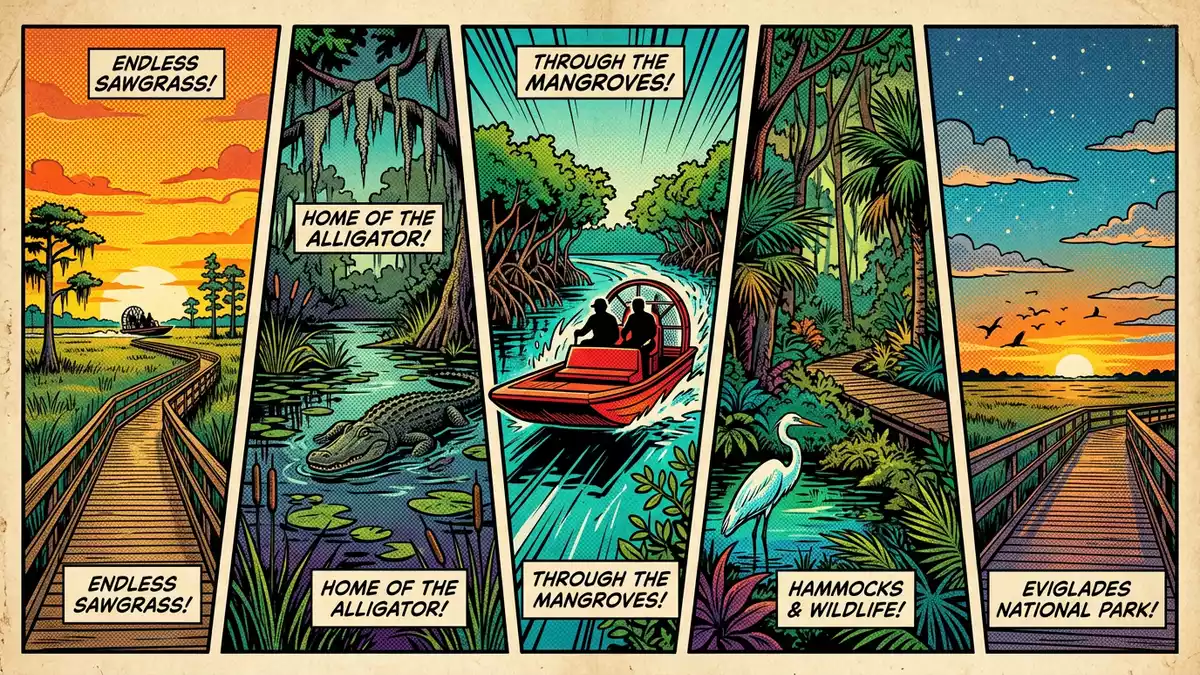
Everglades National Park, south-west of Homestead in southern Florida, protects the southern portion of the wider Everglades wetland as a vast subtropical “river of grass”. Established as a United States national park on 6 December 1947, following Congressional authorisation in 1934, it preserves a mosaic of marshes, forests and shallow bays that together form one of North America’s largest subtropical wilderness areas.authorised in 1934 and dedicated in 1947
Everglades National Park as a protected subtropical wetland
Everglades National Park lies at the southern tip of the Florida peninsula, extending across Miami-Dade, Monroe and Collier counties in a broad arc of wetlands and coastal shallows.within Miami-Dade, Monroe and Collier counties The park boundary encloses more than 1.5 million acres of largely flat terrain, where surface water spreads thinly over limestone and marl to create extensive wet prairies.1.5 million acres of habitat Within this area, the national park protects the southern portion of the Everglades ecosystem, a landscape shaped not by mountains or deep valleys but by the slow movement of water across a barely perceptible gradient.
The Everglades has been recognised internationally for its ecological significance. In the 1970s it was designated both a UNESCO Biosphere Reserve and, slightly later, a World Heritage Site, acknowledging the global importance of its subtropical wetlands and the biological communities they support.biosphere reserve and World Heritage Site These recognitions sit alongside its status as a United States national park and underline the park’s role in safeguarding a large tract of natural landscape within a wider region of intensive development and water management.
The “river of grass”: sawgrass prairies and freshwater sloughs
The phrase “river of grass”, coined for the Everglades, reflects the way surface water and vegetation combine to form the park’s defining habitats. Much of Everglades National Park consists of open, shallow wetlands dominated by sawgrass, the sedge Cladium, whose dense stands create a regular pattern of green blades across the marsh.sawgrass marshes described as a river of grass During wetter periods, water flowing south from the interior forms broad freshwater sloughs, shallow channels and ponds that thread through these prairies and give the landscape its river-like character despite the almost level ground.
Within the wetlands, small rises in the limestone bedrock or accumulated soil support distinct habitats. Tropical hardwood hammocks stand slightly above the surrounding marsh, bearing dense woodland with broad-leaved trees and providing higher, drier refuges for plants and animals.tropical hardwood hammocks in the park Pine rocklands occupy other elevated patches of limestone, with open stands of pine and a fire-adapted understorey, while cypress stands mark areas where the trees' buttressed trunks rise from standing water. This pattern of prairies, hammocks, pine forests and cypress swamps creates a varied terrain that is still largely governed by the seasonal presence and depth of surface water.
From inland marsh to mangrove coast and Florida Bay
Towards its southern and western edges, Everglades National Park follows the gradual transition from freshwater wetlands to coastal and marine environments. At the margin where inland water meets the saltwater of the Gulf of Mexico and the Atlantic, extensive mangrove forests occupy tidal creeks, estuaries and sheltered shorelines.mangrove forest and shallow marine shallows Here, mangrove trees grow directly in brackish channels, their roots arching into the water, while patches of slightly higher ground carry additional coastal vegetation and provide roosting sites for birds.
Beyond the line of mangroves, the park boundary encloses a large portion of Florida Bay, a broad embayment between mainland Florida and the Florida Keys. More than 800 square miles, around 2,100 km², of this bay lie within the protected area, making it the largest single body of water under the park’s care.over 800 square miles of Florida Bay Within Florida Bay, extensive seagrass beds occupy shallow basins, and labyrinths of channels link interior lagoons to the open gulf. The combination of inland freshwater wetlands, tidal mangrove forests and shallow marine bays makes Everglades National Park an example of a single protected area spanning an entire ecological gradient from land to sea.
Visiting Everglades National Park: what travellers from Western Europe should know
- Everglades National Park lies south-west of Homestead in southern Florida, with a main eastern road approach reached from the Ernest F. Coe Visitor Center near the city.Ernest F. Coe Visitor Center near Homestead
- The terrain consists largely of low-lying wetlands, boardwalks and unpaved tracks; some areas involve walking on flat but uneven ground and exposed paths without substantial shade from buildings.
- Approaches from the north and north-west reach different sectors of the park, including the Shark Valley area off the Tamiami Trail and the Gulf Coast access near Everglades City, each providing contrasting views of wetlands and coastal waters.three main entry points
- The official language is English and the currency is the United States dollar.
- Entry requirements depend on your nationality; UK travellers can check the FCDO travel advice at gov.uk/foreign-travel-advice, Irish travellers the Department of Foreign Affairs at ireland.ie.
Searching for Everglades National Park on social platforms
These links open searches for Everglades National Park on each platform.
Frequently asked questions about Everglades National Park
Where is Everglades National Park in relation to Homestead?
Everglades National Park occupies the southern tip of Florida, with one of its principal eastern entrances and visitor facilities reached from the Ernest F. Coe Visitor Center near Homestead.
What should visitors expect on a visit to Everglades National Park?
Visitors can expect broad sawgrass marshes, scattered tree islands, tropical hardwood hammocks and mangrove-lined creeks, with shallow coastal waters in Florida Bay forming part of the protected area.
What makes Everglades National Park distinctive among protected areas?
Everglades National Park is distinctive for its large subtropical wetland, recognised as both a United States national park and an international biosphere reserve and World Heritage Site, spanning habitats from inland marsh to marine bay.


