
Everglades National Park’s river of grass near Homestead
Published on 08/31/2026 at 20:25 | Editorial responsibility: Rafael Müller, Editor-in-Chief AD HOC NEWS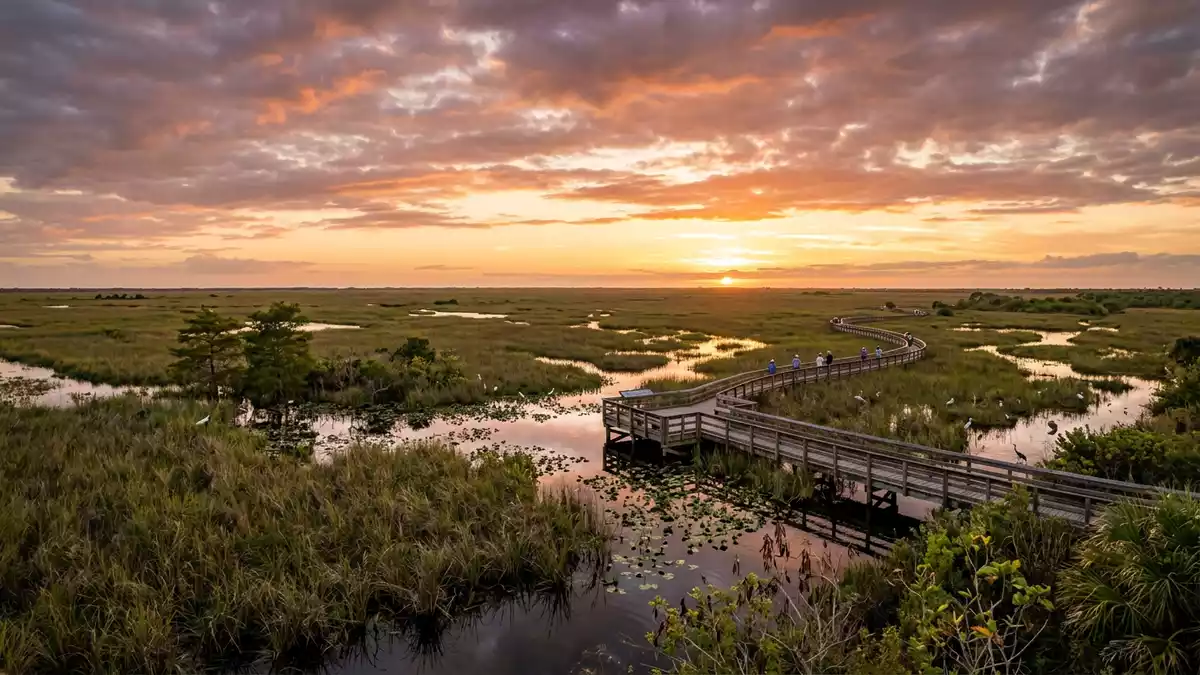
Everglades National Park spreads across the southern tip of Florida as a low, water-shaped wilderness, with Homestead marking one of its main eastern gateways. Designated by the United States Congress in 1934 and formally established on 6 December 1947, it preserves a mosaic of wetlands, forests and shallow bays that together form an immense subtropical landscape.authorised in 1934 and established in 1947 The park lies within Miami-Dade, Monroe and Collier counties and has become one of the key protected areas at the southern end of the Florida peninsula.Miami-Dade, Monroe and Collier counties
A subtropical wilderness shaped by slow water
The defining feature of Everglades National Park is a broad sheet of shallow, slow-moving freshwater that once flowed unbroken from Lake Okeechobee towards Florida Bay. This landscape of marsh and wet prairie is dominated by sawgrass, the sedge *Cladium*, whose dense stands gave rise to the phrase “River of Grass” and still cover much of the park’s interior.sawgrass marshes described as a river of grass The fresh water spreads across an almost level limestone base, creating broad, open prairies punctuated by tree islands and channels.
Alongside these prairies, Everglades National Park contains tropical hardwood hammocks, pinelands, cypress stands and extensive mangrove forest. These ecosystems reflect the park’s position between temperate and tropical zones, and between freshwater and marine environments.freshwater sloughs, hammocks, pineland, cypress and mangrove The result is a varied terrain in which low rock ridges rise above marsh, dense woodland occupies slightly higher ground and tidal creeks thread towards the sea.
From the river of grass to Florida Bay
At the southern edge of Everglades National Park the freshwater flow meets the saltwater of the Gulf of Mexico and the Atlantic, creating a wide transition zone of mangrove forest and shallow marine shallows. More than 800 square miles, around 2,100 km², of Florida Bay lie within the park boundary, forming its largest single body of water.over 800 square miles of Florida Bay protected Here, mangrove trees grow directly in brackish channels while extensive seagrass beds occupy the bay’s interior basins.
Florida Bay and the coastal mangroves give Everglades National Park a strong marine character as well as its inland wetlands. The bay’s shallow waters, seagrasses and tidal flats support rich aquatic life, while the mangroves form a dense, water-bound forest edge. Together with inland marshes and sloughs, these coastal environments mean that the park covers both terrestrial and marine habitats within one continuous protected area.encompasses 2,357 square miles including most of Florida Bay
Protection, recognition and wildlife
Everglades National Park extends over roughly 1.5 million acres, or about 6,100 km², making it one of the largest national parks in the eastern United States.around 1.5 million acres of habitat In 1976 it was recognised as part of a Biosphere Reserve under UNESCO’s Man and the Biosphere Programme, together with Dry Tortugas National Park, and in 1979 it was inscribed on the World Heritage List.UNESCO Biosphere Reserve in 1976 and World Heritage site in 1979 These designations reflect the global significance of its ecosystems and species.
The park’s habitats support hundreds of bird species and many rare or threatened animals. Among those recorded are the Florida panther, West Indian manatee, American alligator, American crocodile and wood stork, which share the landscape with a wide range of fish, reptiles and wetland plants.rare species including Florida panther and American crocodile The mixture of wetlands, mangrove estuaries, pine rocklands and seagrass meadows makes Everglades National Park a major refuge for wildlife at the southern end of mainland Florida.
Visiting Everglades National Park: what travellers from Western Europe should know
- Everglades National Park lies south-west of Homestead in southern Florida, with a main eastern approach reached from the Ernest F. Coe Visitor Center near the city.
- The terrain within the park includes long, level boardwalks and natural trails across marshland, along with access routes beside water channels and coastal bays.
- Everglades National Park is in the United States, where the official language is English and the currency is the US dollar.
- Entry requirements depend on your nationality; UK travellers can check the FCDO travel advice at gov.uk/foreign-travel-advice, Irish travellers the Department of Foreign Affairs at ireland.ie.
Searching for Everglades National Park on social platforms
These links open searches for Everglades National Park on each platform.
Frequently asked questions about Everglades National Park
Where is Everglades National Park located?
Everglades National Park occupies the southern tip of mainland Florida in the United States, spanning parts of Miami-Dade, Monroe and Collier counties.
What kind of landscape should visitors expect?
Visitors encounter broad sawgrass marshes, tree islands, mangrove-lined creeks and the shallow waters of Florida Bay, forming a wide subtropical wetland and coastal environment.
What makes Everglades National Park distinctive among protected areas?
The park’s combination of vast wetlands, mangrove forest, marine shallows and rare species, recognised through UNESCO Biosphere Reserve and World Heritage status, sets it apart within southern Florida.


