
Everglades National Park’s living “river of grass” near Homestead
Published on 09/01/2026 at 08:56 | Editorial responsibility: Rafael Müller, Editor-in-Chief AD HOC NEWS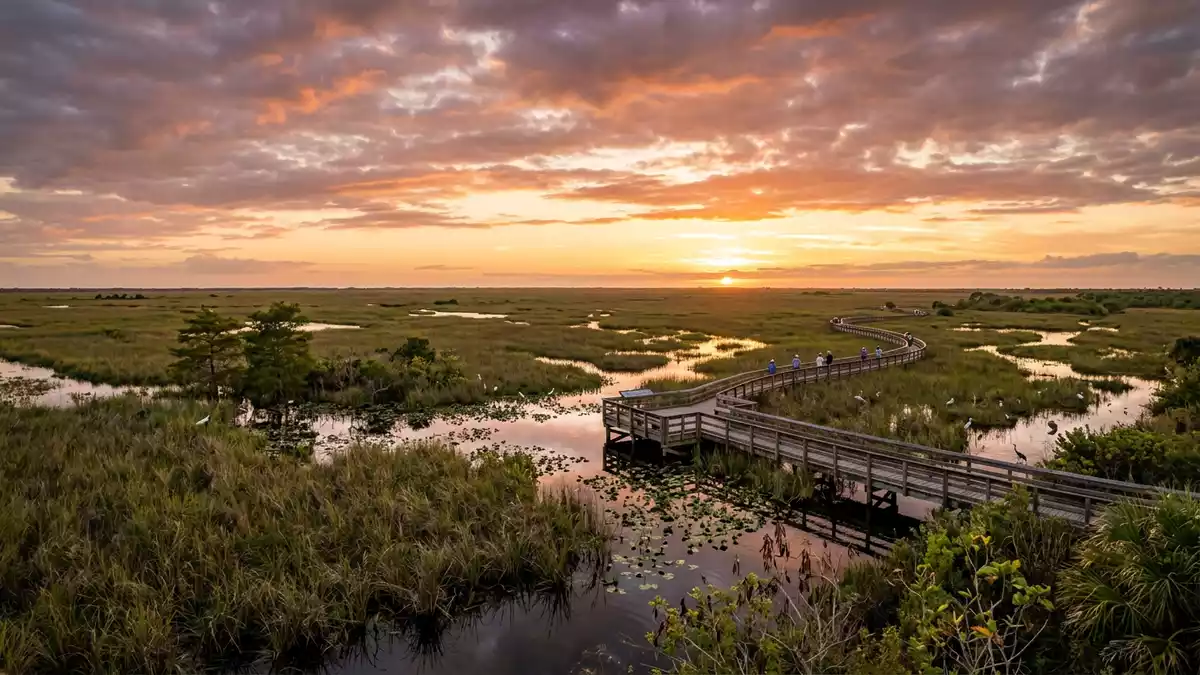
Everglades National Park, south of Homestead in Florida, protects a vast subtropical wetland where slow-moving water, open marsh and coastal mangroves form one continuous landscape. Established as a United States national park in 1947, it safeguards the southern portion of the wider Everglades ecosystem and has earned international recognition for its extraordinary mix of freshwater and marine habitats.Everglades National Park was authorised in 1934 and established in 1947 This is a place defined more by the quiet movement of water than by mountains or cliffs, and that slow flow is the lead thread running through every visit.
The river of grass and the scale of the wetlands
The core experience of Everglades National Park is the sight of broad, shallow wetlands stretching to the horizon, dominated by sawgrass and punctuated by tree islands and open channels of water.The Everglades is a subtropical wetland ecosystem spanning central and south Florida During the wet season, water from Lake Okeechobee forms a slow river moving south through these marshes, giving rise to the description “river of grass”. The park encompasses more than 6,100 square kilometres (2,357 square miles) of protected land and water, including much of Florida Bay, and it preserves the southern part of this larger system.The park covers over 6,100 square kilometres
Within this expanse lie distinct ecosystems that are easy to recognise on the ground. Sawgrass prairies form open, grassy plains broken by narrow channels and small ponds. Tropical hardwood hammocks rise slightly above the marsh on natural ground, carrying dense woodland and providing higher, drier refuges for wildlife.The park features open sawgrass prairies, tropical hardwood hammocks and mangrove estuaries Pine rocklands stand on limestone, with scattered pines and a fire-adapted understorey. Towards the coast, freshwater gives way to estuarine waters and extensive mangrove forests, before the wetlands open into the shallow bays of the Gulf of Mexico and Florida Bay.
International recognition and protected status
Everglades National Park is part of a cluster of protected areas in southern Florida, which together safeguard a large region of wetlands, coastal waters and islands. The national park itself extends across Miami-Dade, Monroe and Collier counties and has been measured at over 610,000 hectares of land and water within its boundaries.Everglades National Park covers more than 610,000 hectares and sits at the centre of a wider protected complex It forms part of a broader network that includes Big Cypress National Preserve, Biscayne National Park, Dry Tortugas National Park, several wildlife refuges and the Florida Keys National Marine Sanctuary, all linked by shared water and habitats.
The park’s importance has been recognised through several international designations. In 1976, the Everglades and Dry Tortugas area gained status as a Biosphere Reserve under UNESCO’s Man and the Biosphere Programme, reflecting its role as a large protected landscape with active human use around it.The Everglades and Dry Tortugas were designated a Biosphere Reserve in 1976 In 1979, parts of Everglades National Park were inscribed on the World Heritage List, emphasising the global significance of its wetlands and mangrove coasts.The park was inscribed as a World Heritage site in 1979 These layers of recognition mark Everglades National Park as more than a regional attraction; it is a landscape of international reference for wetland conservation.
Wildlife encounters in a subtropical mosaic
One of the reasons travellers come to Everglades National Park is the density and variety of wildlife supported by its mosaic of habitats. The national park protects tropical and subtropical environments where temperate and tropical species meet, and it contains hundreds of plant and animal species, including many that are rare or threatened.Everglades National Park is home to rare or threatened species such as the Florida panther and West Indian manatee Birds are a major presence: wading species such as herons, egrets, ibises and roseate spoonbills feed in the shallows, while birds of prey and smaller songbirds use the hammocks and pine islands.More than 360 bird species have been recorded in the park
Large reptiles and mammals are especially associated with the Everglades. American alligators inhabit freshwater sloughs and wet prairies, where they maintain ponds and nesting sites, while American crocodiles occupy coastal mangroves and the bay, an unusual overlap of two large reptile species.Both American alligators and American crocodiles occur within the Everglades Among mammals, the Florida panther is one of the most endangered species in the region, using upland habitats at the margins of the wetlands, and West Indian manatees and bottlenose dolphins move through coastal and estuarine waters. The mixture of sawgrass, cypress domes, hammocks and mangroves gives travellers a chance to see wildlife adapted to sharply different conditions within a single day, as long as they spend time looking rather than moving quickly through the landscape.
Visiting Everglades National Park: what travellers from Western Europe should know
- Everglades National Park lies in southern Florida, with one of its principal visitor centres near Homestead; the protected area extends across Miami-Dade, Monroe and Collier counties.
- Much of the park consists of flat, waterlogged terrain and open marsh; boardwalks, raised trails and boat routes provide access, and some paths cross uneven, natural ground where waterproof footwear is practical.
- Towards the coast the wetlands grade into mangrove estuaries and shallow bays, so some viewpoints and shorelines are reached by water-based transport rather than by extended walks on foot.
- The official language is English and the currency is the United States dollar.
- Entry requirements depend on your nationality; UK travellers can check the FCDO travel advice at gov.uk/foreign-travel-advice, Irish travellers the Department of Foreign Affairs at ireland.ie.
Searching for Everglades National Park on social platforms
These links open searches for Everglades National Park on each platform.
Frequently asked questions about Everglades National Park
Where is Everglades National Park and how does Homestead relate to it?
Everglades National Park occupies a large area of southern Florida, and Homestead lies close to one of its main eastern entrances and visitor facilities.
What should visitors expect when exploring the park?
Visitors encounter wide, shallow wetlands with sawgrass prairies, hammocks, pine rocklands and mangrove shores, accessed by roads, boardwalks and water routes rather than steep mountain paths.
What makes Everglades National Park distinctive among national parks?
Its character comes from the slow river of grass flowing through a subtropical mosaic of freshwater and coastal habitats, supporting alligators, crocodiles, manatees, wading birds and endangered species such as the Florida panther.


