
Centro Historico de Cuenca, an Andean grid of rivers and domes
Published on 09/15/2026 at 12:27 | Editorial responsibility: Rafael Müller, Editor-in-Chief AD HOC NEWS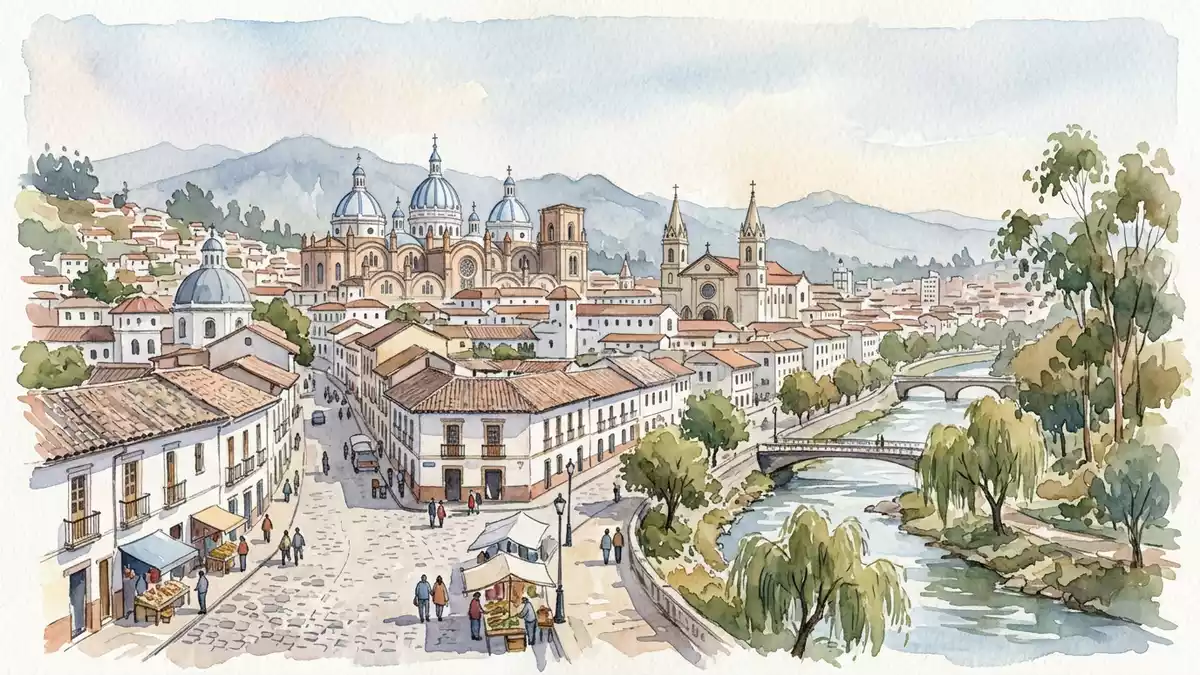
Centro Historico de Cuenca is the historic core of Santa Ana de los Ríos de Cuenca in southern Ecuador, set on an Andean plateau bordered by several rivers and crowned by church domes. Recognised as the Historic Centre of Santa Ana de los Ríos de Cuenca on the UNESCO World Heritage List as a cultural site from 1999, it concentrates centuries of urban life into a compact grid of streets, plazas and low-rise buildings.Historic Centre of Santa Ana de los Ríos de Cuenca
An Andean plateau shaped by rivers and a planned grid
The Centro Historico de Cuenca occupies the territory that was taken up by the town until the first half of the twentieth century, covering more than 200 ha of urban fabric and archaeological zones on a highland plateau.territory occupied by the town The grid is bordered by rivers such as the Río Tomebamba, Yanuncay, Tarqui and Machángara, which cross the valley and mark natural edges to the historic centre.highland plateau bordered by rivers such as the Río Tomebamba
Cuenca, formally named Santa Ana de los Ríos de Cuenca, was founded on 12 April 1557 in the Azuay province, and the historic centre reflects that colonial origin in its planned street pattern.foundation of Santa Ana de los Ríos de Cuenca in 1557 Straight streets meet at regular junctions, forming rectangular blocks where civic buildings, churches and houses line the pavements, while some routes descend gently towards the Río Tomebamba and other rivers at the plateau’s edge.grid where streets descend towards the Río Tomebamba
Colonial streets, plazas and domes in compact urban fabric
Within Centro Historico de Cuenca, hundreds of historic buildings, works of art, archaeological remains and cultural expressions form a dense fabric that has been recognised as cultural heritage at national and international level.centro histórico declared national cultural heritage in 1982 The Ecuadorian authorities declared the centre and its historic areas “Patrimonio Cultural del Ecuador” on 29 March 1982, acknowledging the concentration of heritage buildings and practices, and on 1 December 1999 UNESCO inscribed it on the World Heritage List as “Patrimonio Cultural de la Humanidad”.UNESCO inscription as Patrimonio Cultural de la Humanidad in 1999
At street level the historic centre is characterised by low-rise colonial and republican houses, many built with adobe walls, wooden balconies with wrought-iron railings and red-tiled roofs.colonial adobe-sided walkups with balconies and red-tiled roofs Plazas punctuate the grid, notably Parque Calderón, which serves as a central square framed by civic buildings and churches, while narrow streets open unexpectedly onto courtyards that blend interior and exterior spaces behind plain facades.compact urban fabric of streets, plazas and low-rise buildings
Layers of heritage from Pumapungo to Parque Calderón
The area recognised by UNESCO as the Historic Centre of Santa Ana de los Ríos de Cuenca includes not only the colonial grid but also the archaeological site of Pumapungo and corridors that follow ancient access routes to the town.area includes Pumapungo and ancient access corridors This combination of urban layout and archaeological remnants reflects the layered history of Cuenca, where Spanish colonial planning was superimposed on earlier Cañari and Inca occupations in the broader valley.colonial urban design layered over pre-Columbian foundations
Within the centre, religious architecture stands out in the skyline, with church domes rising above the surrounding houses and marking key plazas in the grid.Andean grid framed by rivers and church domes Artisanal neighbourhoods, markets and the Barranco del Tomebamba, a landscaped riverbank zone with viewpoints and walks, contribute further distinct areas within the overall historic centre, adding variety to the compact plan while remaining connected by the same orthogonal street pattern.Barranco del Tomebamba and historic residential zone
Visiting Centro Historico de Cuenca: what travellers from Western Europe should know
- Centro Historico de Cuenca lies in the city of Cuenca in Azuay Province in southern Ecuador, on an Andean plateau bordered by rivers such as the Río Tomebamba, and is reached by road links from Cuenca’s airport and intercity bus terminals.
- The historic centre covers a substantial area of compact streets and plazas, and walking within it involves frequent changes in gradient as routes descend towards the riverbanks and rise again to the plateau.
- The official language is Spanish and the currency is the United States dollar.
- Entry requirements depend on your nationality; UK travellers can check the FCDO travel advice at gov.uk/foreign-travel-advice, Irish travellers the Department of Foreign Affairs at ireland.ie.
Searching for Centro Historico de Cuenca on social platforms
These links open searches for Centro Historico de Cuenca on each platform.
Frequently asked questions about Centro Historico de Cuenca
Where is Centro Historico de Cuenca located?
Centro Historico de Cuenca is the historic centre of the city of Cuenca in Azuay Province in southern Ecuador, set on an Andean plateau bordered by rivers such as the Río Tomebamba.
What should visitors expect when exploring the historic centre?
Visitors encounter a planned colonial grid of streets, plazas and low-rise houses with adobe walls and red-tiled roofs, alongside churches, markets, courtyards and riverside walks within a compact urban fabric.
What makes Centro Historico de Cuenca distinctive among historic cities in the Andes?
Its combination of a Renaissance-inspired street plan from the sixteenth century, layered over earlier cultures and recognised both as national cultural heritage and as a UNESCO World Heritage site, gives it a distinctive character among Andean cities.


