
Centro Historico de Cuenca, a planned Andean colonial centre
Published on 08/20/2026 at 09:54 | Editorial responsibility: Rafael Müller, Editor-in-Chief AD HOC NEWS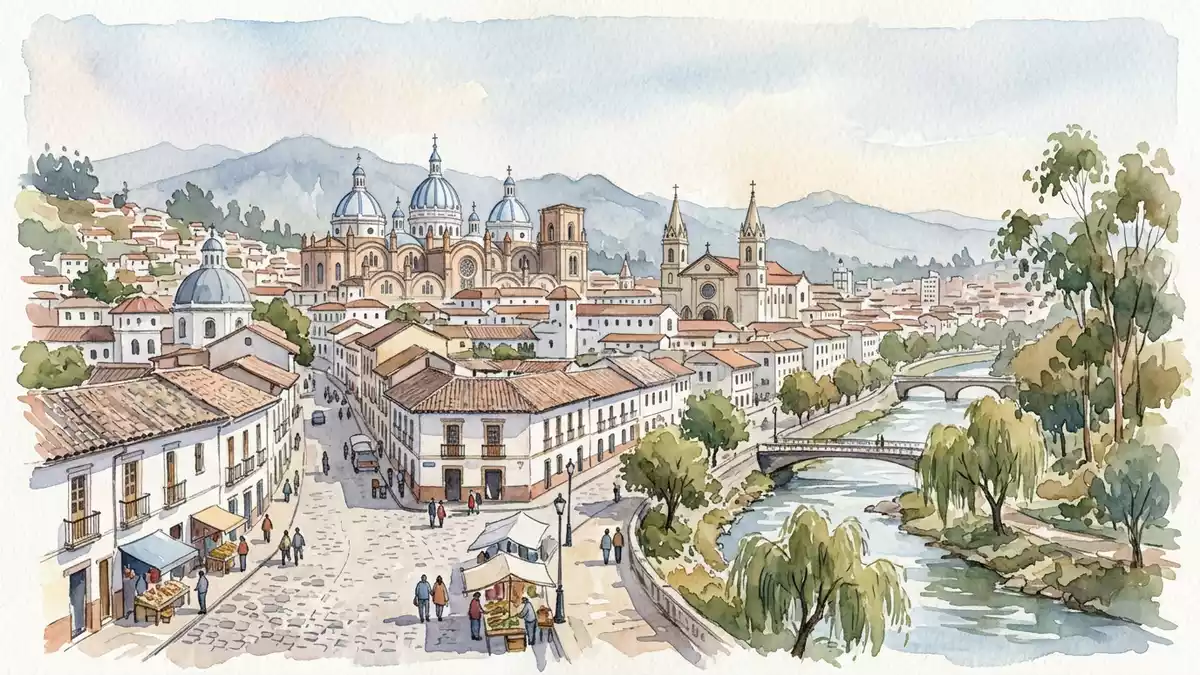
Centro Historico de Cuenca in southern Ecuador is the historic core of Santa Ana de los Ríos de Cuenca, a highland city laid out on a planned grid above several rivers and recognised as a UNESCO World Heritage site since 1999. The historic centre gathers churches, plazas and townhouses into a compact Andean cityscape where straight streets frame views to tiled roofs and distant hills.
A Renaissance grid in the Andes
The historic centre of Cuenca follows a Renaissance-inspired urban grid, imposed after the Spanish foundation of the city in 1557 during the colonial expansion of the sixteenth century.Spanish foundation of the city in 1557 Regular blocks extend from a central plaza, giving the city a rectilinear street pattern that distinguishes it from the surrounding Andean landscape.rectilinear street pattern
The area recognised by UNESCO as the Historic Centre of Santa Ana de los Ríos de Cuenca includes the territory occupied by the town until the first half of the twentieth century and covers more than 200 hectares of urban fabric and archaeological zones.Historic Centre of Santa Ana de los Ríos de Cuenca Within this grid, straight streets descend gently towards the Río Tomebamba and other rivers, crossing at regular junctions where smaller neighbourhood squares punctuate the layout.
Stone, stucco and tiled roofs
Centro Historico de Cuenca is built largely in masonry and stucco, with many buildings combining solid ground floors and lighter upper storeys that reflect both local materials and Andean seismic conditions.buildings combining masonry ground floors Townhouses line the streets with rendered façades, wooden doors opening into interior courtyards and balconies that overlook the pavements.
Church towers, domes and civic buildings rise above the roofline, giving the skyline an alternating rhythm of tiled slopes and taller silhouettes. Architectural styles range from Baroque and neoclassical to early twentieth-century influences such as art deco, reflecting the way Cuenca evolved from a colonial town into a republican-era provincial capital.architectural styles range from Baroque and neoclassical
UNESCO recognition and layered heritage
Cuenca stands on a highland plateau irrigated by rivers including the Tomebamba, Yanuncay, Tarqui and Machángara, and its historic centre incorporates both Spanish-colonial planning and pre-Hispanic remains such as the archaeological area of Pumapungo.plateau irrigated by rivers including the Tomebamba This combination of colonial grid, Andean topography and archaeological corridors contributed to its inscription on the World Heritage List.
Centro Historico de Cuenca was declared national cultural heritage of Ecuador in 1982 and later, on 1 December 1999, UNESCO inscribed the Historic Centre of Santa Ana de los Ríos de Cuenca as a cultural World Heritage site for its well-preserved urban fabric and the fusion of different cultures in Latin America.declared national cultural heritage of Ecuador in 1982UNESCO inscribed the Historic Centre The designation emphasises both the preservation of the original street grid and the coexistence of Spanish, Cañari and Inca cultural elements within the city.
Visiting Centro Historico de Cuenca: what travellers from Western Europe should know
- Centro Historico de Cuenca occupies the historic core of the city of Cuenca in Azuay Province, southern Ecuador, on a highland plateau bordered by rivers such as the Río Tomebamba.
- The streets in the historic centre follow a regular grid but include cobbled sections, kerbs and pavements with changes in level that require attention when walking.
- Cuenca’s historic centre lies inland in Ecuador’s Andes and is reached by road from Mariscal Lamar International Airport and from regional bus terminals that connect the city with other parts of the country.
- The official language is Spanish and the currency is the US dollar.
- Entry requirements depend on your nationality; UK travellers can check the FCDO travel advice at gov.uk/foreign-travel-advice, Irish travellers the Department of Foreign Affairs at ireland.ie.
Searching for Centro Historico de Cuenca on social platforms
These links open searches for Centro Historico de Cuenca on each platform.
Frequently asked questions about Centro Historico de Cuenca
Where is Centro Historico de Cuenca?
Centro Historico de Cuenca is the historic centre of the city of Cuenca in Azuay Province, southern Ecuador, on a highland plateau crossed by rivers such as the Tomebamba.
What should visitors expect in the historic centre?
Visitors encounter a planned colonial grid of streets, plazas, churches and townhouses, with cobbled sections, tiled roofs and a mixture of Baroque, neoclassical and later architectural styles.
What makes Centro Historico de Cuenca distinctive?
Centro Historico de Cuenca combines a sixteenth-century Spanish grid, Andean topography, archaeological remains and layered architecture that gained recognition as a UNESCO World Heritage site in 1999.


