
Zuma Rock, the stone monolith on Abuja’s northern edge
Published on 09/15/2026 at 07:13 | Editorial responsibility: Rafael Müller, Editor-in-Chief AD HOC NEWS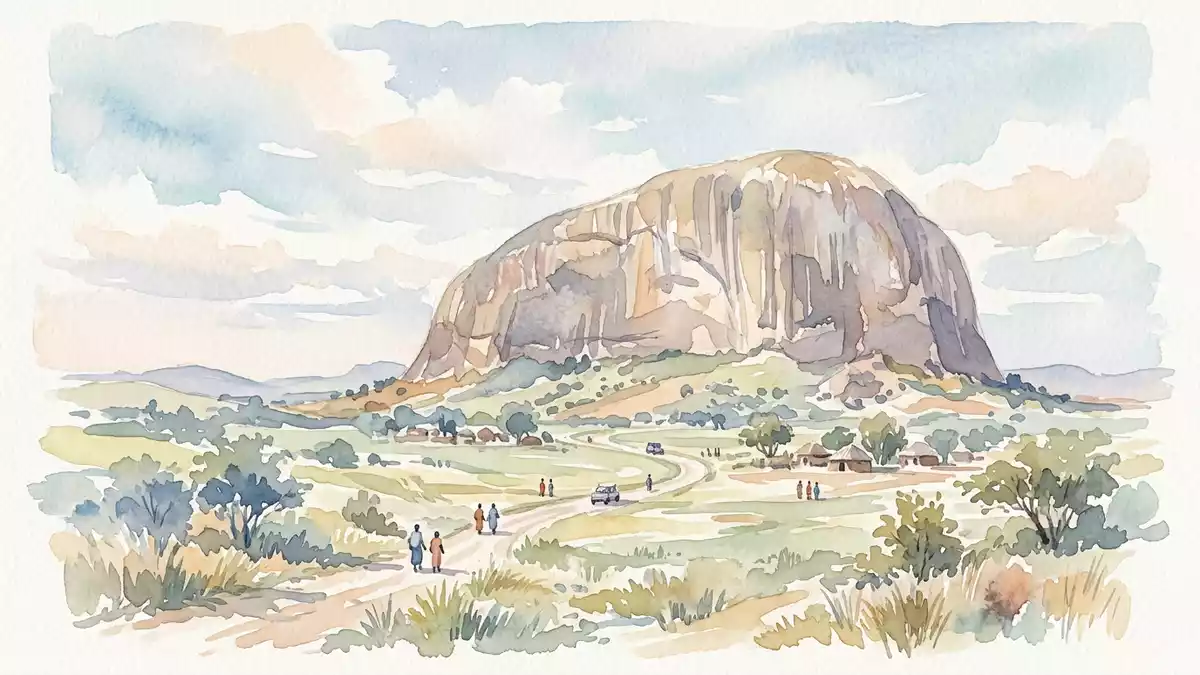
North-west of Abuja, a single mass of dark stone rises from the savannah and holds its line against the sky. This is Zuma Rock, a large monolithic outcrop of igneous rock beside the Abuja–Kaduna road near Madalla in Niger State, whose sheer faces and weathered markings have made it one of Nigeria’s best known natural landmarks.a large natural monolith
A solitary block of ancient igneous rock
Zuma Rock stands just north of the town of Madalla in Niger State, close to the boundary with the Federal Capital Territory and beside the main highway that runs from Abuja towards Kaduna.near Madalla beside the Abuja–Kaduna road It forms part of the wider savannah landscape north-west of Abuja, but in profile it appears detached from the low hills around it, a single block of rock rising straight from the plain.
Geologically, Zuma Rock is described as an igneous intrusion composed mainly of gabbro and granodiorite, solidified magma exposed as surrounding rock eroded away over geological time.composed of gabbro and granodiorite The rock dates back to the Precambrian, a period that ended more than 540 million years ago, so standing below it places a visitor against material far older than any human settlement in the region.of Precambrian age
Height, profile and the “stone face”
Above the surrounding plain, Zuma Rock rises by roughly 300 m (980 ft), with its summit reaching an elevation in the region of 725 m (2,379 ft) above sea level, figures that account for the different heights sometimes given for it.around 300 metres above the plainan elevation of about 725 metres The base runs to several kilometres in circumference, and from the roadside the mass of rock occupies much of the horizon, its upper slopes darkened by weathering and sparse vegetation.
One detail that tends to appear in photographs is the pattern on one of its faces, where a combination of weathered streaks and patches of vegetation traces features widely read as eyes, a nose and a mouth.a monolith with a face-like marking The overall effect is of a stone face looking out across the road and the savannah, a visual feature that gives the rock a presence distinct from other inselbergs and links it strongly to the imagery of central Nigeria.
A landmark for Abuja and the road to Kaduna
Zuma Rock stands near the point where the Abuja–Kaduna road crosses from the Federal Capital Territory into Niger State, a position that has led to its description as a gateway for travellers approaching Abuja from Suleja.a gateway from Suleja Road traffic passes close beneath its flank, so the rock functions as an immediate reference point for journeys north from the capital or south towards it.
Beyond the road, Zuma Rock has been taken up in wider national imagery. It appears on the Nigerian 100 naira banknote, and is regularly named alongside Aso Rock as part of the set of natural landmarks associated with Abuja and its environs.pictured on the 100 naira note Local accounts link the rock to the Gbagyi people of central Nigeria, for whom such outcrops have long carried cultural meaning, and its status as a symbol of the capital’s wider landscape follows directly from its location on one of the main northern approaches.linked to the Gbagyi people
Visiting Zuma Rock: what travellers from Western Europe should know
- Zuma Rock stands north-west of central Abuja near Madalla in Niger State, beside the highway towards Kaduna, and is reached by road journeys that leave the Federal Capital Territory for Niger State.
- The rock rises steeply from the surrounding plain, and the ground near its base includes uneven terrain and natural slopes rather than formal paved walkways.
- The wider setting is a savannah landscape with roadside facilities in Madalla and Suleja, so a visit usually combines views of the rock with short walks near the highway.
- The official language is English and the currency is the Nigerian naira.
- Entry requirements depend on your nationality; UK travellers can check the FCDO travel advice at gov.uk/foreign-travel-advice, Irish travellers the Department of Foreign Affairs at ireland.ie.
Searching for Zuma Rock on social platforms
These links open searches for Zuma Rock on each platform.
Frequently asked questions about Zuma Rock
Where is Zuma Rock in relation to Abuja?
Zuma Rock stands near Madalla in Niger State, north-west of Abuja, beside the highway that links the capital with Kaduna and close to the Federal Capital Territory boundary.
What can visitors expect when they reach Zuma Rock?
Visitors encounter a single large block of dark igneous rock rising sharply from the savannah beside the road, with uneven ground near its base and roadside viewpoints giving clear profiles of the rock.
What makes Zuma Rock distinctive among Nigeria’s landforms?
The combination of its height above the plain, its location beside a major highway approaching Abuja, its Precambrian igneous composition and the weathered “stone face” pattern on its flank gives Zuma Rock a distinctive place in Nigeria’s landscape imagery.


