
Zuma Rock, the towering monolith on Abuja’s edge
Published on 08/20/2026 at 06:09 | Editorial responsibility: Rafael Müller, Editor-in-Chief AD HOC NEWS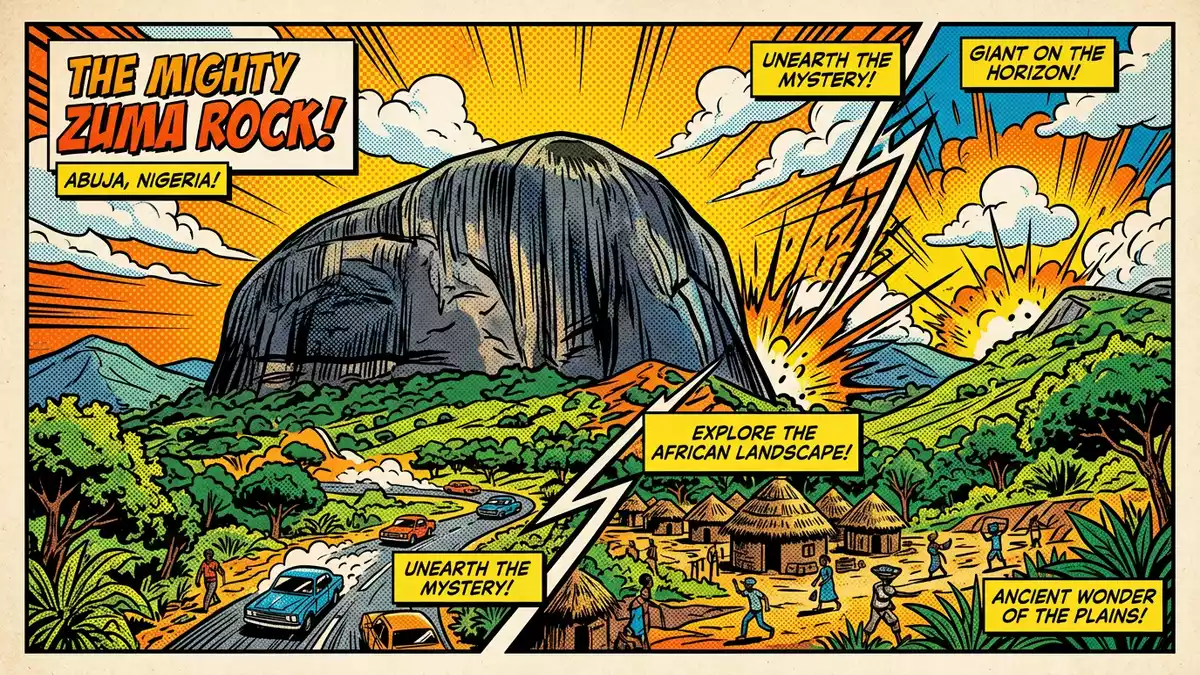
North-west of Abuja, a single vast block of rock rises from the plains and dominates the surrounding landscape. Zuma Rock, a natural monolith in Niger State near the boundary with the Federal Capital Territory, has become one of Nigeria’s most recognisable landforms and a landmark for travellers approaching the capital from the north-west.
A monolith that anchors the approach to Abuja
Zuma Rock stands just north of the town of Madalla beside the main road linking Abuja and Kaduna, where the highway crosses from the Federal Capital Territory into Niger State. The rock is frequently described as a gateway from Suleja towards Abuja, a role that follows directly from its position overlooking one of the principal northern approaches to the capital.large natural monolith Above the surrounding plain the rock rises by roughly 300 m (980 ft), with its summit reaching an elevation of about 725 m (2,379 ft) above sea level.about 300 m above the terrain From a distance, particularly along the Abuja–Kaduna road, the sheer vertical faces and the way the rock appears to stand alone give it a presence that dominates the horizon.
The footprint of Zuma Rock is substantial, with its base forming a perimeter of several kilometres around the inselberg.3.1 kilometres in circumference Travellers driving from Abuja towards Madalla see the rock emerge gradually on the right-hand side of the road, shifting from a distant outline into a detailed mass of dark, weathered stone. Around its foot lie small settlements and roadside stalls, underlining the contrast between everyday traffic on the expressway and the scale of the geological feature rising above it.
Rock, face and national symbolism
Geologically, Zuma Rock is an igneous intrusion: a block of magma that solidified underground and was later exposed as surrounding softer rocks eroded away. The main rock types are gabbro and granodiorite, giving the surfaces a dark grey tone with lighter patches and veins.igneous intrusion composed of gabbro and granodiorite The formation is of Precambrian age, meaning its origins lie hundreds of millions of years before human settlement in the region.of Precambrian age Seen up close, weathering, runoff and mineral differences create streaks and patches on the surfaces, giving each flank its own character.
On the southern side of Zuma Rock, these natural markings form an arrangement that is widely described as resembling a human face, with darker areas suggesting eyes and a nose within the lighter stone. This pattern has become part of the rock’s identity, reproduced in illustrations and photographs and helping to distinguish Zuma Rock visually from other Nigerian inselbergs.natural face pattern on its southern flank The rock’s national significance is reinforced by its presence on the 100-naira banknote, where a stylised view appears on the reverse and marks the rock out as one of the country’s emblematic natural features.on the reverse of the 100-naira banknote
Culture, stories and the surrounding landscape
Long before Abuja became Nigeria’s capital, Zuma Rock already held significance for communities living in what is now Niger State and the surrounding region. Accounts in Hausa and other local traditions describe the rock as a place associated with defence and with the movements of the Gbagyi people during conflicts, underlining its role as a reference point in regional history rather than simply a scenic landmark.place associated with the Gbagyi people As Abuja grew and transport routes were upgraded, the rock maintained this dual identity: rooted in local narratives yet increasingly visible to travellers from across Nigeria.
In physical terms, Zuma Rock stands in a gently undulating savanna landscape north-west of Abuja, its steep cliffs emerging from terrain of low hills, scattered trees and farmland. The contrast between the vertical rock faces and the surrounding fields makes it easy to understand why the rock is sometimes described as a natural marker of the country’s centre.regarded as the geographical centre of Nigeria Nearby, travellers can see other outcrops and the urban area of Suleja, but none approach Zuma Rock in height or mass, and the main highway, service buildings and small-scale commerce unfold in its shadow.
Visiting Zuma Rock: what travellers from Western Europe should know
- Zuma Rock stands near Madalla in Niger State, north-west of Abuja along the Abuja–Kaduna expressway, and is reached by road from the capital.
- The main roadside viewing areas are on level ground close to the highway, with informal paths over uneven terrain leading towards clearer vantage points near the base of the rock.
- The landscape around Zuma Rock is open savanna with little shade away from trees and buildings, so travellers encounter exposed conditions when walking any distance from parked vehicles.
- English is an official language in Nigeria and the national currency is the Nigerian naira.
- Entry requirements depend on your nationality; UK travellers can check the FCDO travel advice at gov.uk/foreign-travel-advice, Irish travellers the Department of Foreign Affairs at ireland.ie.
Searching for Zuma Rock on social platforms
These links open searches for Zuma Rock on each platform.
Frequently asked questions about Zuma Rock
Where is Zuma Rock in relation to Abuja?
Zuma Rock is situated near Madalla in Niger State, north-west of Abuja, beside the main Abuja–Kaduna road and close to the boundary of the Federal Capital Territory.
What can travellers expect when visiting Zuma Rock?
Travellers encounter a large freestanding rock rising steeply above open savanna, viewed mainly from roadside areas and informal paths near its base rather than from constructed platforms.
What makes Zuma Rock distinctive among Nigerian landmarks?
Zuma Rock is notable for its height above the surrounding plain, its human-like face pattern on the southern flank and its depiction on the 100-naira banknote, which cement its status as a national symbol.


