
Zuma Rock, Nigeria’s giant monolith beside Abuja’s northern road
Published on 09/19/2026 at 21:15 | Editorial responsibility: Rafael Müller, Editor-in-Chief AD HOC NEWS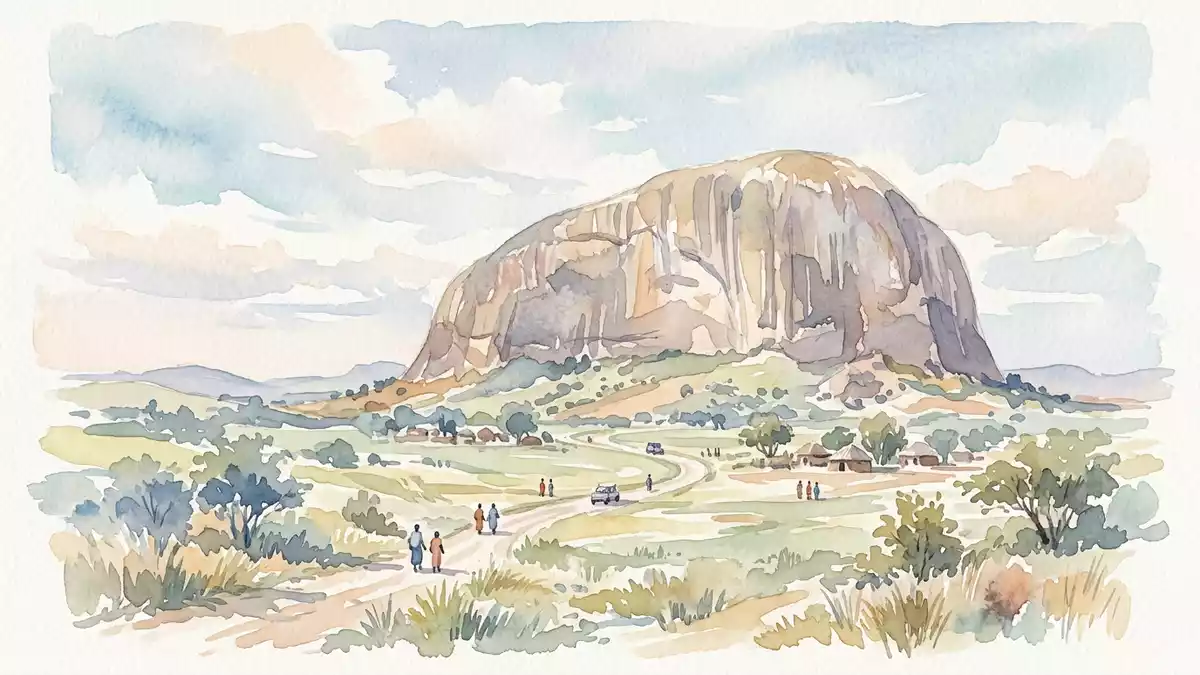
North-west of Abuja, a single mass of dark rock rises from the savannah beside the highway towards Kaduna. This is Zuma Rock, a towering igneous monolith near the town of Madalla in Niger State whose sheer faces and prominence have made it one of the most recognisable natural landmarks in Nigeria’s central region.
A freestanding inselberg on Abuja’s outer edge
Zuma Rock stands near Madalla in Niger State, close to the boundary with the Federal Capital Territory and beside the main highway that links Abuja with Kaduna. Road journeys leaving Abuja towards the north-west pass directly by the base of the rock, which has long been described as a kind of gateway on the northern approach to the capital.near Madalla in Niger State From the surrounding plains the rock appears as a compact mountain standing alone, detached from the lower hills and farmland around it.
Geologically, Zuma Rock is a natural inselberg formed by an igneous intrusion composed mainly of gabbro and granodiorite, rock types that solidified from magma deep below the surface before erosion exposed them above the savannah.igneous intrusion composed mainly of gabbro and granodiorite The formation is dated to the Precambrian period, giving Zuma Rock an origin far older than the modern settlements and roads that now run around its base.formation dated to the Precambrian period
Height, faces and the stone “mask”
The mass of Zuma Rock rises by roughly 300 m (980 ft) above the surrounding plain, with its summit reaching an elevation of about 725 m (2,379 ft) above sea level. These two figures together characterise the rock as both high in absolute terms and strongly prominent in its immediate landscape.summit reaching an elevation of about 725 m Its base runs to a circumference measured in kilometres, so that the inselberg reads visually as a compact mountain even though it stands alone amid relatively low terrain.circumference measured in kilometres
The faces of Zuma Rock are steep and largely bare, with limited vegetation clinging to ledges and cracks on the lower slopes. Weathering has darkened much of the surface, and on the main south-eastern face vertical streaks and markings have formed that resemble a stylised human face or mask when viewed from a distance.weathered markings that resemble a human face This perceived “face” has become one of the defining visual characteristics of Zuma Rock in photographs and illustrations, emphasising the impression of the monolith watching over the highway and the approach to Abuja.
A landscape and cultural reference point for central Nigeria
Zuma Rock lies in the savannah landscape north-west of Abuja, in a belt of low hills and farmland that stretches between the capital and the older town of Suleja. The rock is part of a wider zone of granitic and igneous formations in central Nigeria, and it is frequently linked with other monoliths such as Aso Rock in Abuja itself.linked with other monoliths such as Aso Rock In broader geological descriptions it is associated with the Jos Plateau region, where intrusive rocks have emerged through older crust to form a chain of inselbergs and outcrops.part of the plateau of Jos
The rock has also acquired a cultural and symbolic role. It is closely associated with the Gbagyi people of central Nigeria, for whom the surrounding terrain has long formed part of their homeland.linked to the Gbagyi people of central Nigeria Beyond local tradition, Zuma Rock appears on Nigeria’s 100 naira banknote, placing its silhouette alongside other national symbols in everyday currency and underlining its status as a visual emblem of the country.appears on Nigeria’s 100 naira banknote For travellers, its position beside a major highway and its scale in relation to the surrounding plain make it a fixed reference point in the wider landscape of Abuja and Niger State.
Visiting Zuma Rock: what travellers from Western Europe should know
- Zuma Rock stands north-west of central Abuja near the town of Madalla in Niger State, beside the Abuja–Kaduna highway, and is reached by road journeys that leave the Federal Capital Territory for Niger State.
- The terrain immediately around the rock consists of savannah and farmland, with approaches on foot involving uneven ground and low slopes rather than constructed paths or steps on the main faces.
- The monolith lies in Nigeria, where the official language is English and the currency is the naira.
- Entry requirements depend on your nationality; UK travellers can check the FCDO travel advice at gov.uk/foreign-travel-advice, Irish travellers the Department of Foreign Affairs at ireland.ie.
Searching for Zuma Rock on social platforms
These links open searches for Zuma Rock on each platform.
Frequently asked questions about Zuma Rock
Where is Zuma Rock in relation to Abuja?
Zuma Rock is near the town of Madalla in Niger State, north-west of Abuja, beside the highway that runs from the capital towards Kaduna.
What should visitors expect when they see Zuma Rock?
Visitors encounter a large freestanding inselberg rising sharply from the savannah, with dark steep faces and a perceived “human face” marking on its main side.
What makes Zuma Rock distinctive among Nigerian landmarks?
Its scale, igneous geology, roadside position near Abuja and appearance on the 100 naira note combine to give Zuma Rock a distinctive status in Nigeria’s landscape.


