
Zuma Rock, the giant monolith watching over Abuja’s northern road
Published on 09/16/2026 at 17:55 | Editorial responsibility: Rafael Müller, Editor-in-Chief AD HOC NEWS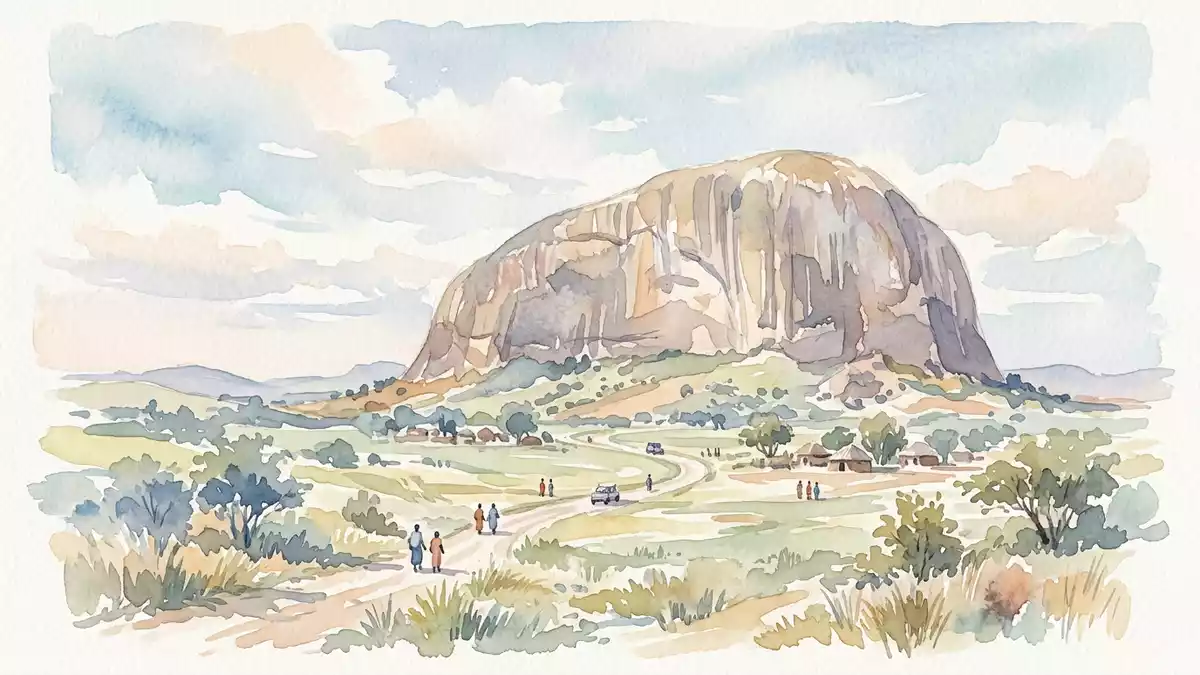
North-west of Abuja, a single mass of dark stone rises from the plains beside the road towards Kaduna: Zuma Rock, a monumental outcrop that has become a visual shorthand for Nigeria’s capital region. Set near Madalla in Niger State and long associated with the approach from Suleja, it forms a geological landmark whose height and solitary bulk give structure to journeys in and out of Abuja.
A freestanding inselberg of ancient igneous rock
Zuma Rock is a large freestanding inselberg, a natural monolith of igneous rock that stands just beyond the boundary of the Federal Capital Territory near the town of Madalla in Niger State. The rock rises roughly 300 m (980 ft) above the surrounding plains, with its summit reaching an elevation of about 725 m (2,379 ft) above sea level, measurements that account for the different figures sometimes quoted for its height.Zuma Rock rises roughly 300 m Its base runs to several kilometres in circumference, giving it the presence of a compact mountain even though it stands alone amid low-lying terrain.circumference measured in kilometres
The rock is composed of gabbro and granodiorite, intrusive igneous rocks of Precambrian age that hardened deep underground before later erosion exposed them above the savannah.gabbro and granodiorite of Precambrian age Weathering has darkened much of its surface, while the lower slopes carry patches of vegetation where soil has accumulated in cracks and ledges. From lay-bys along the Abuja–Kaduna highway the mass of stone occupies a wide section of the horizon, its upper flanks forming a near-vertical wall above the lighter tones of the surrounding plain.a freestanding monolith north of Madalla
Gateway to Abuja and a national emblem
The road that runs north-west from Abuja towards Kaduna passes close to Zuma Rock near Madalla, so drivers leaving the capital encounter the monolith as the land opens out beyond the built-up edge of the city. The rock stands near the frontier between Niger State and the Federal Capital Territory, a position that has given rise to its longstanding description as a kind of gateway on the northern approach to Abuja.“Gateway to Abuja” on the A2 highway From the carriageway its bulk marks the transition from the administrative territory to the rural landscape beyond, an association that has become part of its identity as a landmark.
Beyond its roadside role, Zuma Rock has taken on wider symbolic significance within Nigeria. The rock has been printed on the country’s 100 naira banknote since the late 1990s, placing its silhouette and face-like markings among the everyday imagery of the national currency.printed on the 100 naira note since 1999 Locally it is linked to the Gbagyi people of central Nigeria, for whom the monolith forms part of the cultural landscape that stretches around Abuja and Suleja.linked to the Gbagyi people These layers of association mean that a single geological outcrop north-west of the capital carries both geographic and symbolic weight far beyond its immediate surroundings.
Shape, surface and the “stone face”
Approached from the highway, Zuma Rock presents a broad, steep face that rises above open grassland and scattered trees. The monolith’s outline is asymmetrical, with one side forming a longer slope and the other a more abrupt drop, and the upper section narrows into a rounded summit that stands clear of any neighbouring ridge. On its southern flank, variations in rock colour and patterns of weathering align to form markings that resemble facial features when seen from a distance, a configuration that has become one of the rock’s most photographed aspects.monolith with a human face
Rainwater run-off and temperature changes have opened fissures and ledges across the surface, and in these sheltered niches shrubs and small trees gain a foothold, softening some portions of the cliff with bands of green. Lower down, boulders and broken fragments lie at the foot of the slopes where pieces have detached over geological time, forming a rough apron between the main wall and the surrounding plain. From viewpoints near the road, visitors see this interplay of dark rock, lighter weathered patches and vegetated ledges stacked in a vertical sequence that emphasises the height of the formation.monolith rising around 300 metres
Visiting Zuma Rock: what travellers from Western Europe should know
- Zuma Rock stands north-west of central Abuja near Madalla on the main road towards Kaduna, where the highway leaves the Federal Capital Territory for Niger State. Travellers reach the area by road from Abuja, passing suburbs such as Kubwa before the monolith appears beside the carriageway.
- The terrain around Zuma Rock is open savannah with gently undulating ground and patches of scrub, but the slopes of the rock itself are steep and rocky, with loose stones and uneven surfaces at the base.
- Nearby, the town of Madalla provides a low-rise backdrop of buildings and roadside stalls, and from some lay-bys on the highway the view includes both the monolith and the line of the Abuja–Kaduna road stretching towards Suleja.
- The official language is English and the currency is the Nigerian naira.
- Entry requirements depend on your nationality; UK travellers can check the FCDO travel advice at gov.uk/foreign-travel-advice, Irish travellers the Department of Foreign Affairs at ireland.ie.
Searching for Zuma Rock on social platforms
These links open searches for Zuma Rock on each platform.
Frequently asked questions about Zuma Rock
Where is Zuma Rock in relation to Abuja?
Zuma Rock stands near Madalla in Niger State, north-west of Abuja, beside the main highway towards Kaduna and close to the boundary of the Federal Capital Territory.
What should visitors expect when they see Zuma Rock?
Visitors encounter a vast freestanding monolith rising around 300 m above open savannah, with steep rock faces, vegetated ledges and a face-like marking on its southern flank.
What makes Zuma Rock distinctive among Nigeria’s landmarks?
Its combination of height, solitary bulk beside a major highway and its appearance on the 100 naira banknote give Zuma Rock a dual role as both a physical landmark and a national emblem.


