
Zion National Park’s sandstone gorge around the Virgin River
Published on 08/29/2026 at 22:22 | Editorial responsibility: Rafael Müller, Editor-in-Chief AD HOC NEWS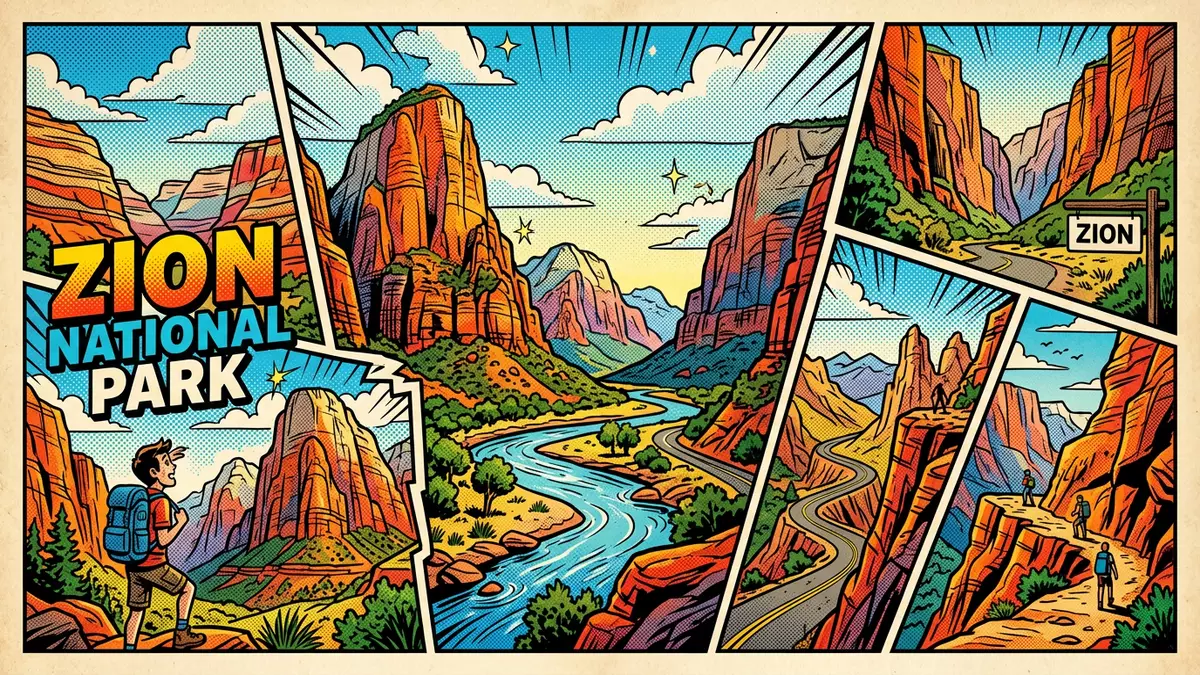
Zion National Park in south?western Utah is built around a sandstone gorge where the North Fork of the Virgin River cuts between high cliffs near the town of Springdale. The canyon walls rise steeply above the valley floor, giving the park its defining contrast between flowing water and towering rock in the desert landscape.
Sandstone walls shaped by the Virgin River
The core of Zion National Park is Zion Canyon, a deep valley carved by the North Fork of the Virgin River as it cuts down through layers of sedimentary rock on the margin of the Colorado Plateau. The river has excavated a gorge where canyon walls rise several hundred metres above the valley floor, exposing colourful cliffs of sandstone and shale along the river’s course.Zion Canyon carved by the North Fork of the Virgin River
Much of the rock visible in the canyon walls belongs to the Navajo Sandstone, a thick formation of lithified desert dunes that reaches substantial thicknesses in the region and forms many of Zion’s sheer cliffs. Below and above this unit lie formations such as the Kayenta, Moenave and Chinle formations, which add bands of red, brown and other colours to the slopes and ledges beneath the highest faces.Navajo Sandstone and other formations
A national park on the Colorado Plateau
Zion National Park lies in south?western Utah in the United States, on the south?western margin of the Colorado Plateau, a high region of layered sedimentary rock extending across much of the interior of the western United States.South?western margin of the Colorado Plateau The park is reached through Springdale, a small town at the mouth of the main canyon where the North Fork of the Virgin River emerges from the high walls.
The area was reserved as Mukuntuweap National Monument in 1909, reflecting early recognition of its striking canyon scenery. In 1918 the monument was enlarged and its name changed to Zion, and in 1919 the site became Zion National Park by act of the United States Congress.Creation of Zion National Park in 1919 Within the park, exposures of rock range from Permian units to much younger deposits, recording a long sequence of changing environments on the Colorado Plateau.Geodiversity across Permian to Quaternary units
Canyons, formations and named viewpoints
Zion National Park contains several distinct canyon areas, including the main Zion Canyon and the Kolob Canyons sector to the north?west, where parallel gorges cut into a high mesa of Navajo Sandstone. The main canyon features a sequence of viewpoints and formations such as the Great White Throne and the Court of the Patriarchs, where sandstone monoliths named Abraham, Isaac and Jacob rise above the valley floor.Court of the Patriarchs sandstone monoliths Trails lead to river?level walks, canyon overlooks and routes that climb towards narrow ridges.
Along the river, sections such as the Narrows mark places where the canyon walls stand close together above the channel, while higher benches and side canyons expose contrasts between vertical cliffs and more gently sloping ledges.Profile of canyon walls and Narrows The combination of high plateaus, mesas, narrow sandstone canyons and rock towers gives Zion a varied topography that visitors see from river level and from higher viewpoints.
Visiting Zion National Park: what travellers from Western Europe should know
- Zion National Park lies in south?western Utah in the United States, with the main entrance reached through the town of Springdale on the North Fork of the Virgin River.
- The terrain in the main canyon includes steep sandstone slopes, sections of trail with substantial elevation gain, and narrow paths where the route follows ledges above drops.
- Kolob Canyons, a separate section of the park to the north?west, are accessed from a different entrance along a high mesa cut by parallel sandstone gorges.
- The official language is English and the currency is the United States dollar.
Searching for Zion National Park on social platforms
These links open searches for Zion National Park on each platform.
Frequently asked questions about Zion National Park
Where is Zion National Park located?
Zion National Park is in south?western Utah in the United States, centred on Zion Canyon near the town of Springdale and the North Fork of the Virgin River.
What should visitors expect on a first visit?
Visitors encounter a sandstone canyon with steep cliffs, river?side paths, trails that climb towards high viewpoints and, in places, narrow sections where the canyon walls stand close above the river.
What makes Zion National Park distinctive among Utah’s parks?
Zion combines a deeply incised river gorge, thick cliffs of Navajo Sandstone and accessible viewpoints along the canyon, all framed by the wider landscape of the Colorado Plateau.


