
Zion National Park’s sandstone canyon around the Virgin River
Published on 08/14/2026 at 14:03 | Editorial responsibility: Rafael Müller, Editor-in-Chief AD HOC NEWS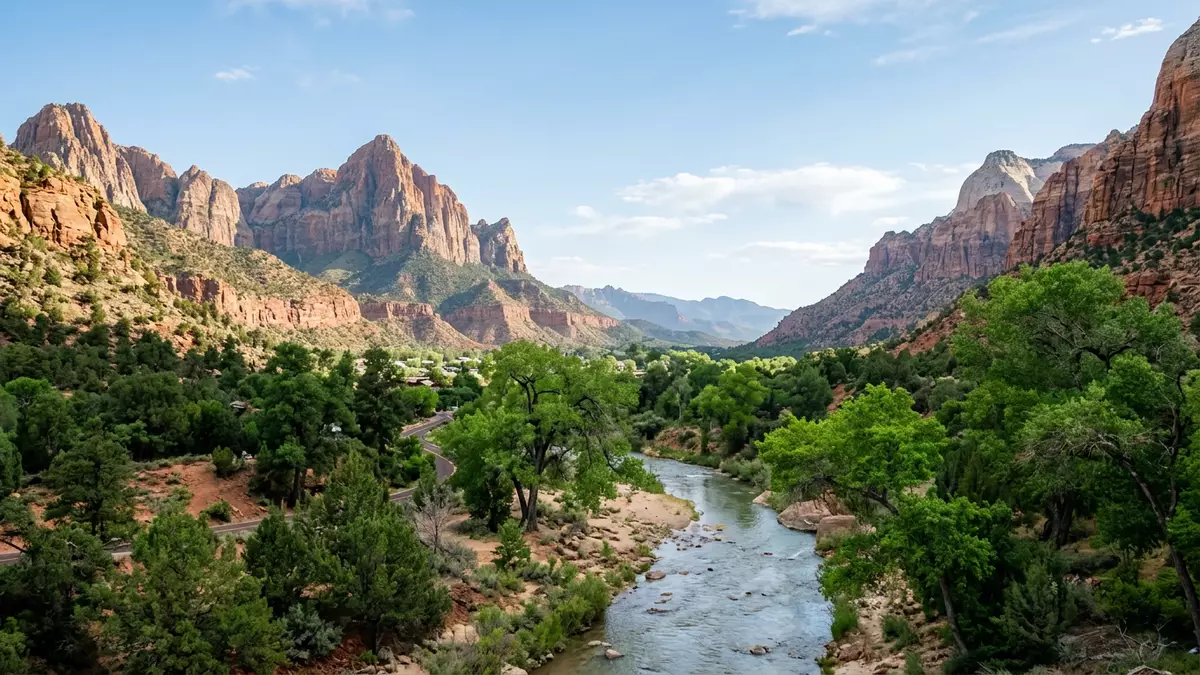
Zion National Park in Utah centres on a deep sandstone canyon carved by the North Fork of the Virgin River, where sheer cliffs rise in warm colours above the valley floor. Established as a national park in 1919 and reached through the small town of Springdale, it preserves a landscape shaped by water cutting into thick desert sandstones over millions of years.
A river-carved canyon in the Colorado Plateau
Zion lies on the south-western margin of the Colorado Plateau, a high region of layered sedimentary rock extending across much of the interior of the western United States.south-western margin of the Colorado Plateau Here the North Fork of the Virgin River has cut down through sandstone and other sedimentary layers to create the steep-sided gorge most visitors associate with the park.North Fork of the Virgin River
The canyon walls are dominated by Navajo Sandstone, a thick sequence of cross-bedded desert dunes lithified into rock and later exposed by erosion.Navajo Sandstone Above and below this unit sit other formations such as the Temple Cap and Kayenta formations, together recording hundreds of metres of sediment deposited in deserts, rivers and shallow seas between roughly 110 and 270 million years ago.formations recording hundreds of metres of sediment
From Mukuntuweap to Zion: a protected landscape
The landscape now known as Zion National Park was first given federal protection on 31 July 1909, when President William Howard Taft proclaimed Mukuntuweap National Monument in Little Zion Canyon.Mukuntuweap National Monument in Little Zion Canyon In March 1918 the protected area was enlarged and renamed Zion National Monument, before the United States Congress approved national park status in November 1919, giving the canyon the designation it still holds.
Subsequent changes expanded the park to include the Kolob Canyons area, with the monument and park combined by an act of Congress in 1956.monument and park combined by an act of Congress Today Zion National Park covers more than 140,000 acres of cliffs, mesas and canyons, offering a cross-section through rock units that together preserve well over 100 million years of regional geological history.
Sandstone cliffs, side canyons and classic trails
Within the main canyon, the Virgin River winds past terraces and benches where trails and roads give access to views of the vertical sandstone walls. The most conspicuous cliffs are formed from orange to white Navajo Sandstone, which in parts of Zion stands more than 600 m (2,000 ft) thick, creating towering faces above the river course.more than 600 m thick cliffs of Navajo Sandstone Elsewhere, banded slopes and ledges reveal the underlying Kayenta, Moenave and Chinle formations, adding reds and browns to the canyon palette.Kayenta, Moenave and Chinle formations
Two routes have come to symbolise the experience of walking inside this landscape. Angels Landing climbs from the canyon floor up a steep sandstone fin, with a final section following a narrow crest high above the valley. Further upstream, the Narrows leads into a slot section of Zion Canyon where the walls rise steeply on either side and the route follows the Virgin River itself between the cliffs.Angels Landing and the Narrows routes
Visiting Zion National Park: what travellers from Western Europe should know
- Zion National Park lies in the south-west corner of Utah, with the main canyon accessed from the town of Springdale along the Virgin River corridor.
- The terrain in the main canyon combines paved routes with steeper trails on sandstone, and some paths climb significant height onto exposed ridges.
- Beyond the main canyon, the Kolob Canyons area presents higher plateaus and deep side gorges reached by roads and trails from the north-west.
- The official language is English and the currency is the United States dollar.
- Entry requirements depend on your nationality; UK travellers can check the FCDO travel advice at gov.uk/foreign-travel-advice, Irish travellers the Department of Foreign Affairs at ireland.ie.
Searching for Zion National Park on social platforms
These links open searches for Zion National Park on each platform.Frequently asked questions about Zion National Park
Where is Zion National Park and what is its setting?
Zion National Park lies in south-western Utah in the United States, centred on a sandstone gorge carved by the North Fork of the Virgin River near Springdale.
What kind of landscape can visitors expect?
Visitors encounter high sandstone cliffs, terraces and benches above a river valley, with trails leading onto ridges, into narrow sections and across varied sedimentary rock formations.
What makes Zion National Park distinctive among canyon landscapes?
The combination of very thick Navajo Sandstone cliffs, the protected status established in 1919 and accessible trails such as Angels Landing and the Narrows gives Zion a characteristic canyon profile.


