

Yulong Xueshan, the snow dragon guarding Lijiang
Published on 09/14/2026 at 12:41 | Editorial responsibility: Rafael Müller, Editor-in-Chief AD HOC NEWS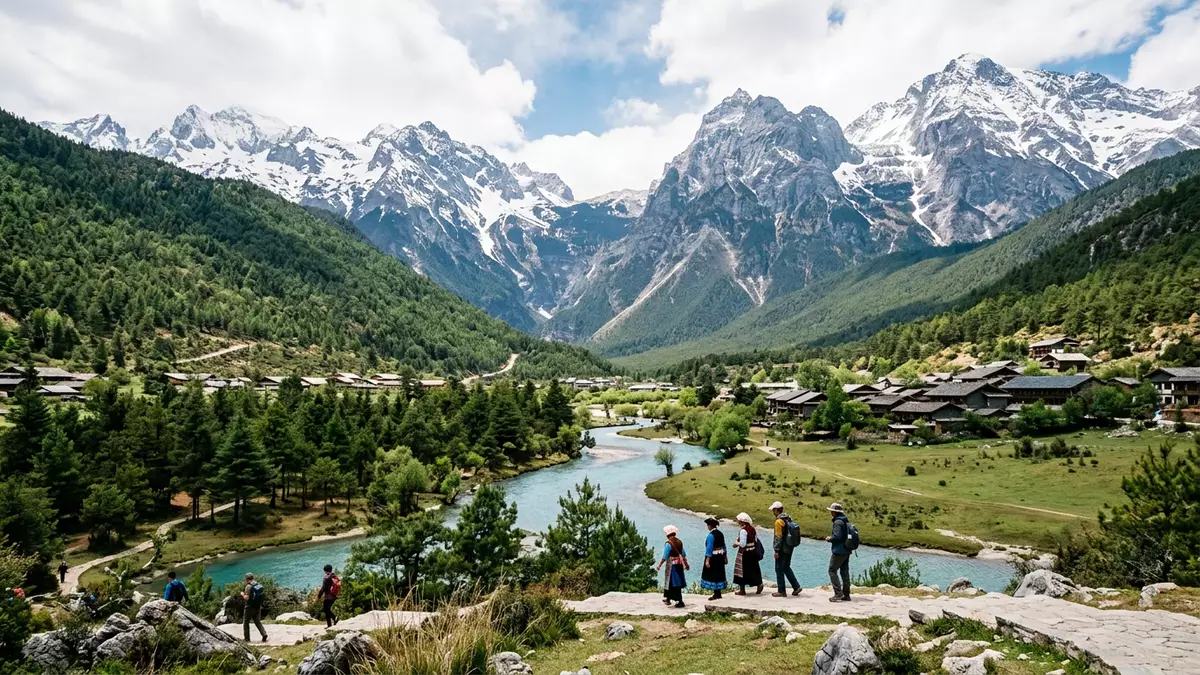
Yulong Xueshan, internationally known as Jade Dragon Snow Mountain, is a high mountain massif rising just north of Lijiang in Yunnan, western China. Forming a compact range with perennial snow and glaciers above the city’s tiled roofs, it anchors the northern skyline and has long been intertwined with Naxi cultural landscapes.
A glaciated massif above Lijiang
Yulong Xueshan forms a mountain range in Yulong Naxi Autonomous County, directly north of Lijiang in the north-west of Yunnan province.mountain range in Yulong Naxi Autonomous County The massif’s highest summit, Shanzidou, reaches about 5,596 m (18,360 ft) above sea level, giving the range a sharply serrated profile of snow and rock above the valleys.Shanzidou reaches 5,596 m The Chinese name Yulong Xueshan translates directly as “Jade Dragon Snow Mountain”, a phrase that captures the way its succession of high peaks resembles the back of a dragon.
The massif lies within the Yulong Snow Mountain National Scenic Area and National Geological Park, a protected landscape that combines alpine terrain with forested lower slopes.Yulong Snow Mountain National Scenic Area The range holds several summits above 5,000 m (16,404 ft), and Shanzidou is widely recorded as the highest point of the massif.Shanzidou as the highest summit Glaciers drape the upper slopes, forming bright snowfields and crevassed ice against darker bands of limestone and other rock, while below, meadows and forested valleys provide a gentler foreground.
Snow, glaciers and high-altitude terrain
From the lower meadows, visitors looking up towards Shanzidou see glacier tongues descending from the high cirques into steep gullies, with permanent snowfields clinging to the ridges. Wooden walkways and platforms reach elevations above 4,500 m (14,764 ft), bringing people close to the edge of these glacier surfaces where the ice breaks into deep cracks and seracs.walkways and platforms above 4,500 m The air thins markedly at these heights, and the landscape shifts from shrub and meadow to bare rock and ice.
The massif is recognised as the southernmost snow mountain within a commonly cited regional classification, underlining how far south persistent snow and glaciers extend in this part of East Asia.southernmost snow mountain in a regional sense The glaciated summits form a striking contrast with the lower valleys, where fields, villages and the old town of Lijiang occupy milder elevations. Seasonal snow can reach down towards the meadows, while high ridges retain ice year round, creating a layered mountain scene visible from many points in and around the city.
Cultural landscapes and views towards Lijiang
For Lijiang and the surrounding Naxi communities, Yulong Xueshan has long been a defining presence, standing as a snow-covered backdrop above the old town’s lanes and traditional courtyard houses.backdrop above the old town The massif’s profile is visible along many of the waterways and slate roofs that structure the historic centre recognised on international heritage lists, and clear days reveal its peaks outlined sharply against the sky.
Approach roads and paths lead towards meadows and viewing areas where the cultural and natural landscapes meet more directly. From these vantage points, visitors look back towards Lijiang’s basin and out across other ranges of northern Yunnan, seeing how Yulong Xueshan rises abruptly from the plateau. The combination of snow-covered summits, forested lower slopes and the ordered geometry of fields and villages gives the area around the massif a distinct character within Yunnan’s varied mountain terrain.
Visiting Yulong Xueshan: what travellers from Western Europe should know
- Yulong Xueshan stands just north of Lijiang in Yulong Naxi Autonomous County, in the north-west of Yunnan province in China, reached by road from the city’s urban districts.
- The terrain within the scenic area includes high-altitude boardwalks and stairways, with sections above 4,500 m (14,764 ft), where gradients and elevation can demand steady walking and awareness of thin air.
- The massif forms part of a wider mountain landscape in northern Yunnan, and weather conditions in the high areas can change quickly, so sturdy footwear and layered clothing suit the combination of meadows, forest and exposed viewpoints.
- The official language is Chinese and the currency is the Chinese yuan.
- Entry requirements depend on your nationality; UK travellers can check the FCDO travel advice at gov.uk/foreign-travel-advice, Irish travellers the Department of Foreign Affairs at ireland.ie.
Searching for Yulong Xueshan on social platforms
These links open searches for Yulong Xueshan on each platform.
Frequently asked questions about Yulong Xueshan
Where is Yulong Xueshan located?
Yulong Xueshan stands in Yulong Naxi Autonomous County north of Lijiang, in the north-west of Yunnan province in China, forming a high massif above the town.
What can visitors expect during a visit?
Visitors encounter a combination of high-altitude boardwalks, stairways and meadows, with views towards glacier tongues, permanent snowfields and the contrasting lower valleys around Lijiang.
What makes Yulong Xueshan distinctive among mountains in Yunnan?
Its elevation above 5,500 m (18,044 ft), glaciated summits and position directly above a historic city give Yulong Xueshan a distinctive presence within Yunnan’s mountain ranges.


