
Yulong Xueshan, the snow dragon above Lijiang
Published on 09/07/2026 at 21:31 | Editorial responsibility: Rafael Müller, Editor-in-Chief AD HOC NEWS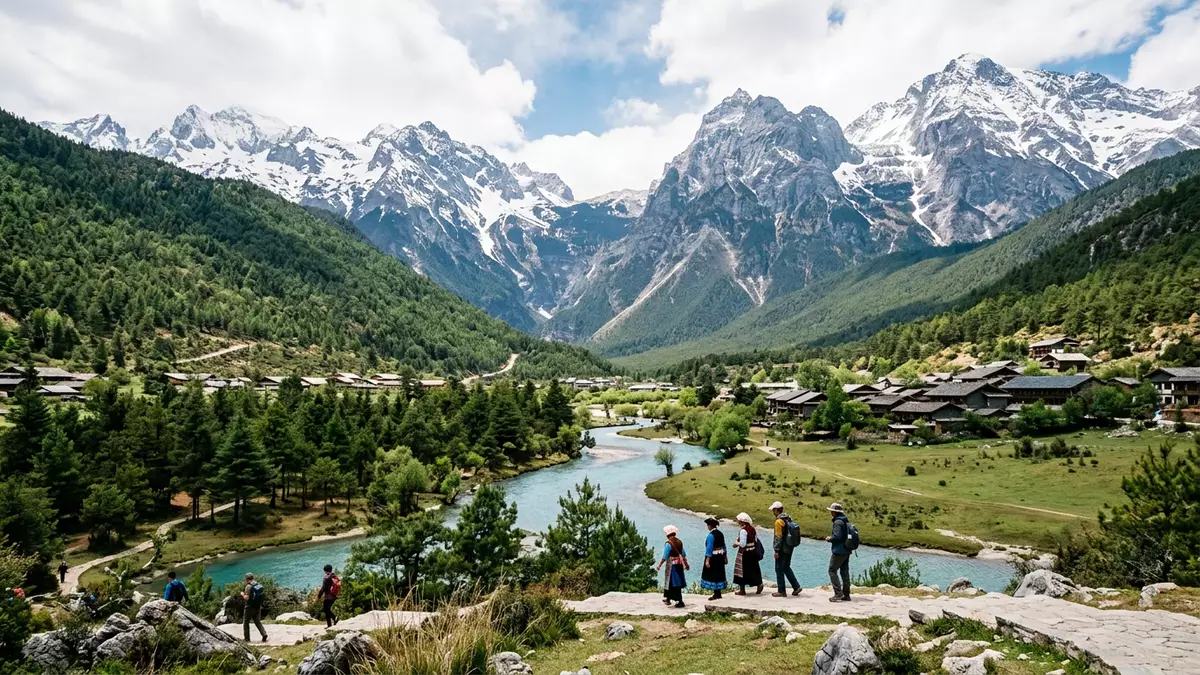
Yulong Xueshan, known in English as Jade Dragon Snow Mountain, is a high mountain massif rising north of Lijiang in Yunnan and crowned with perennial snow and glaciers. Its serrated skyline of peaks gives the range a dragon-like profile that has become a defining feature of the landscape and of local Naxi culture in this corner of China.
A snow-capped massif at the edge of Lijiang
Yulong Xueshan forms a compact mountain range in Yulong Naxi Autonomous County, just north of Lijiang in north-western Yunnan province. The massif stretches roughly north–south for several tens of kilometres, forming a wall of rock and ice that dominates views from the plains around Lijiang and from the nearby valleys.Yulong Naxi Autonomous County The highest summit of the range is Shanzidou, a peak rising to about 5,596 m (18,360 ft) above sea level, making it one of the towering mountains of Yunnan.Shanzidou at 5,596 m
The massif consists of a series of snow-covered summits whose ridges and glaciers form a skyline visible from Lijiang Old Town on clear days. In clear conditions the contrast between the dark rock lower down and the bright snow on the upper peaks is sharply defined, with glaciers and snowfields clinging to cirques and high gullies. The range’s position at the edge of the plateau means its slopes drop steeply towards river valleys carved into the surrounding terrain.
Glaciers, high viewpoints and alpine meadows
For visitors coming from Lijiang, Yulong Xueshan is experienced as a collection of distinct areas, each highlighting a different aspect of the mountain environment. One of the best-known sections is the Glacier Park, where boardwalks and viewing platforms bring travellers into close visual contact with the mountain’s glaciers and ice-clad slopes.Glacier Park The altitude here reaches well above 4,000 m (13,123 ft), and the terrain consists of bare rock, snow, and man-made walkways fixed to the mountainside.
Lower down, the scenic area around Blue Moon Valley offers a contrasting view of turquoise-coloured pools, a riverbed and rock terraces set against the snowy backdrop of Yulong Xueshan.Blue Moon Valley and Spruce Meadow Other sections such as Spruce Meadow and Yak Meadow present high pastures and forest clearings where the massif rises sharply beyond grassy slopes and conifer stands. Together, these areas provide varied perspectives on the same mountain range: glaciers and snowfields at altitude, pasture and woodland below, and water features that mirror the peaks above.
Naxi heritage and the snow dragon name
Yulong Xueshan carries cultural significance for the Naxi people, whose autonomous county shares its name with the mountain. The Chinese name ???? translates directly as “Jade Dragon Snow Mountain”, a reference to the outline formed by its line of peaks and to the snow and rock that appear like carved jade in certain light.Jade Dragon Snow Mountain name In Naxi and other local traditions the massif features as a sacred peak, and its presence is woven into stories and rituals that connect the town of Lijiang to the surrounding landscape.
The mountain’s proximity to Lijiang Ancient Town makes it part of a broader cultural setting in north-western Yunnan, where traditional Naxi architecture, cobbled lanes and canals sit beneath a skyline marked by snow-clad summits. Yulong Xueshan thus stands both as a physical landmark and as an emblematic backdrop to the historical townscape, linking the built environment with the high country of rock, snow and forest.
Visiting Yulong Xueshan: what travellers from Western Europe should know
- Yulong Xueshan lies north of Lijiang in Yulong Naxi Autonomous County in Yunnan; visits typically start from Lijiang Old Town, with travel by road towards the scenic area.
- Terrain within the scenic area ranges from river valleys and meadows to high-altitude boardwalks near glaciers, with substantial stairways and steep gradients at the upper viewpoints.
- Snow and ice persist on the higher parts of the massif, and weather at altitude can differ markedly from conditions in Lijiang on the same day.
- The official language is Chinese and the currency is the Chinese yuan.
- Entry requirements depend on your nationality; UK travellers can check the FCDO travel advice at gov.uk/foreign-travel-advice, Irish travellers the Department of Foreign Affairs at ireland.ie.
Searching for Yulong Xueshan on social platforms
These links open searches for Yulong Xueshan on each platform.
Frequently asked questions about Yulong Xueshan
Where is Yulong Xueshan located?
Yulong Xueshan stands in Yulong Naxi Autonomous County north of Lijiang, in the north-west of Yunnan province in China, forming a high massif above the town.
What can visitors expect on a visit to Yulong Xueshan?
Visitors encounter alpine terrain ranging from glacier viewpoints and high boardwalks to meadows, forest clearings and water features such as Blue Moon Valley set beneath snowy peaks.
What makes Yulong Xueshan distinctive among Yunnan’s mountains?
The combination of a snow-capped massif with a highest peak around 5,596 m (18,360 ft), glaciers, varied scenic areas and close ties to Naxi cultural traditions gives Yulong Xueshan its distinctive character.


