
Yokohama Chukagai, the Chinese quarter by the harbour
Published on 08/30/2026 at 11:26 | Editorial responsibility: Rafael Müller, Editor-in-Chief AD HOC NEWS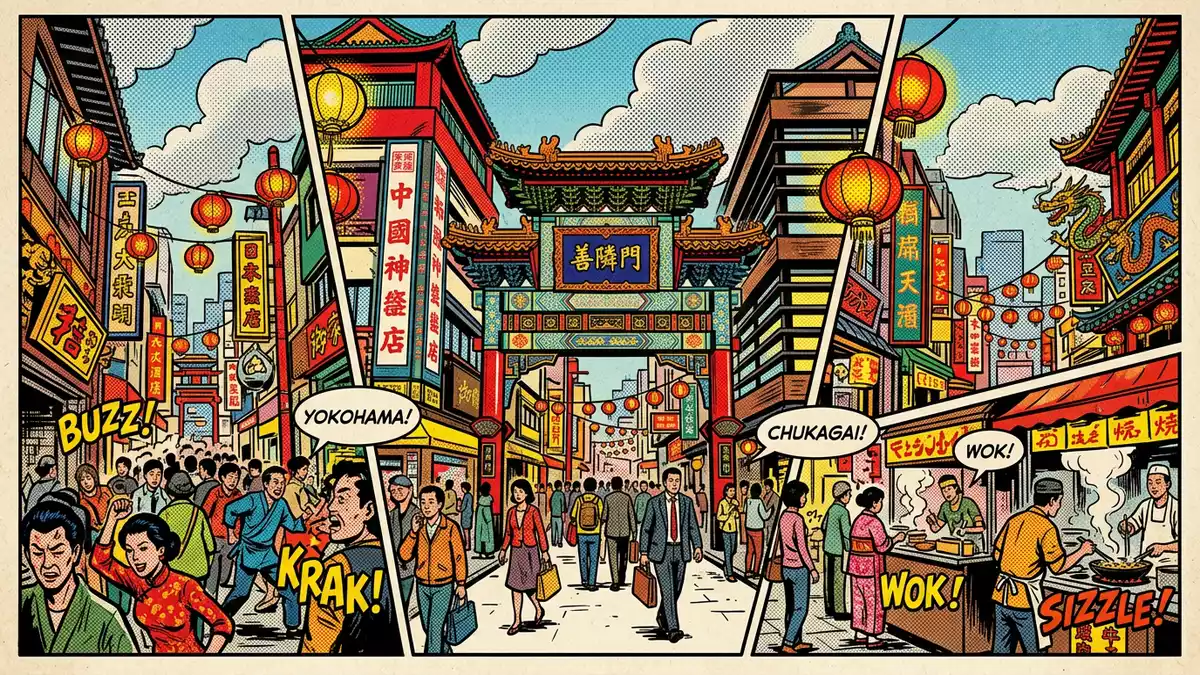
Yokohama Chukagai, known in English as Yokohama Chinatown, is the Chinese quarter close to the harbour of Yokohama in Japan. It grew from a nineteenth?century community of Chinese merchants after Yokohama opened as an international port in 1859, and it remains a compact district where Chinese architecture, food culture and religious life sit inside a Japanese coastal city.
From treaty port to established Chinese district
Yokohama’s role as a gateway for foreign trade began in 1859, when its port was opened in the final years of the Edo period. Chinese immigrants from coastal cities such as Hong Kong and Shanghai settled near the new harbour as intermediaries in the tea and silk trade, forming a distinct community that later became Yokohama Chukagai.history dates back to 1859 The area developed in the late nineteenth century, with institutions such as a Chinese school, temple and assembly hall supporting the growing community.Chinese school and temple were built
Yokohama Chukagai experienced disruption in the early twentieth century, notably during the Great Kanto Earthquake of 1923, which damaged large parts of Yokohama, including the Chinese quarter.Great Kanto Earthquake of 1923 Post?war reconstruction led to renewed growth, and in 1955 the district received official recognition under the name “Yokohama Chukagai”, marked by the construction of a major goodwill gate at one of its entrances.officially recognized and called Yokohama Chukagai in 1955
Gates, temples and streets of colour
The most striking features of Yokohama Chukagai are its Chinese?style gates and temples, which frame a grid of compact streets. Ten highly decorated pailou?style gates mark boundaries and junctions around the district, including the Zenrinmon goodwill gate erected in 1955 as the first of these structures.ten highly decorated traditional gates The gates carry Chinese characters, coloured panels and tiered roofs, announcing entry into a neighbourhood shaped by Chinese culture.
In the centre of the quarter stands Kanteibyo, a temple dedicated to the deity Guan Yu, associated with business and prosperity. The temple was first constructed in 1871 with donations from Chinese residents and rebuilt after earthquake damage.constructed in 1871 with donations from Chinese residents Its layered roofs, decorative stone lions and vivid panels make it a focal point of the streetscape, and its presence underlines the religious and communal role the district has held since the nineteenth century.Kanteibyo temple traces its origins to the late nineteenth century
Food, commerce and cross?cultural everyday life
Yokohama Chukagai is a commercial district built around Chinese food, retail and services, shaped by generations of merchants. Restaurants, shops and small businesses line narrow streets, with façades that use bright colours, Chinese characters and decorative motifs. The area reflects the long?standing role of Chinese traders in Yokohama’s economy, from interpreters and go?betweens in the nineteenth century to restaurateurs and shopkeepers.Chinese immigrants have settled here since the end of the 19th century
Alongside commerce, the neighbourhood carries educational and cultural institutions founded by the Chinese community. A Chinese school and community centre historically anchored social life, while temples such as Kanteibyo and, later, Mazu Miao have added further religious spaces.Mazu Miao temple established in 2006 Together, these buildings form a district where Chinese heritage is visible in both daily business activity and the built environment, framed by the larger Japanese city around it.
Visiting Yokohama Chukagai: what travellers from Western Europe should know
- Yokohama Chukagai lies in the Yamashitacho area of Naka ward, close to Yokohama’s waterfront. Rail travellers can reach it via Motomachi?Chukagai Station on the Minatomirai Line, whose exits lead directly into the district.
- The streets of Yokohama Chukagai are compact and laid out in a small grid, with several gates and a mix of level surfaces and short flights of steps near temple entrances.
- The official language is Japanese and the currency is the yen.
- Entry requirements depend on your nationality; UK travellers can check the FCDO travel advice at gov.uk/foreign-travel-advice, Irish travellers the Department of Foreign Affairs at ireland.ie.
Searching for Yokohama Chukagai on social platforms
These links open searches for Yokohama Chukagai on each platform.Frequently asked questions about Yokohama Chukagai
Where is Yokohama Chukagai located in Yokohama?
Yokohama Chukagai is in Yamashitacho, Naka ward, near the harbour in central Yokohama. It sits close to Motomachi?Chukagai Station on the Minatomirai Line.
What can visitors expect when walking through the district?
Visitors encounter a compact network of streets lined with Chinese restaurants and shops, framed by decorated gates and temples such as Kanteibyo, with façades using bright colours and Chinese characters.
What makes Yokohama Chukagai distinctive among Japanese urban districts?
Yokohama Chukagai is distinctive for its concentration of Chinese?style gates, temples and businesses developed since 1859, forming a long?standing Chinese quarter within a major Japanese port city.


