
Yokohama Chukagai and its ring of colourful gates
Published on 09/04/2026 at 06:41 | Editorial responsibility: Rafael Müller, Editor-in-Chief AD HOC NEWS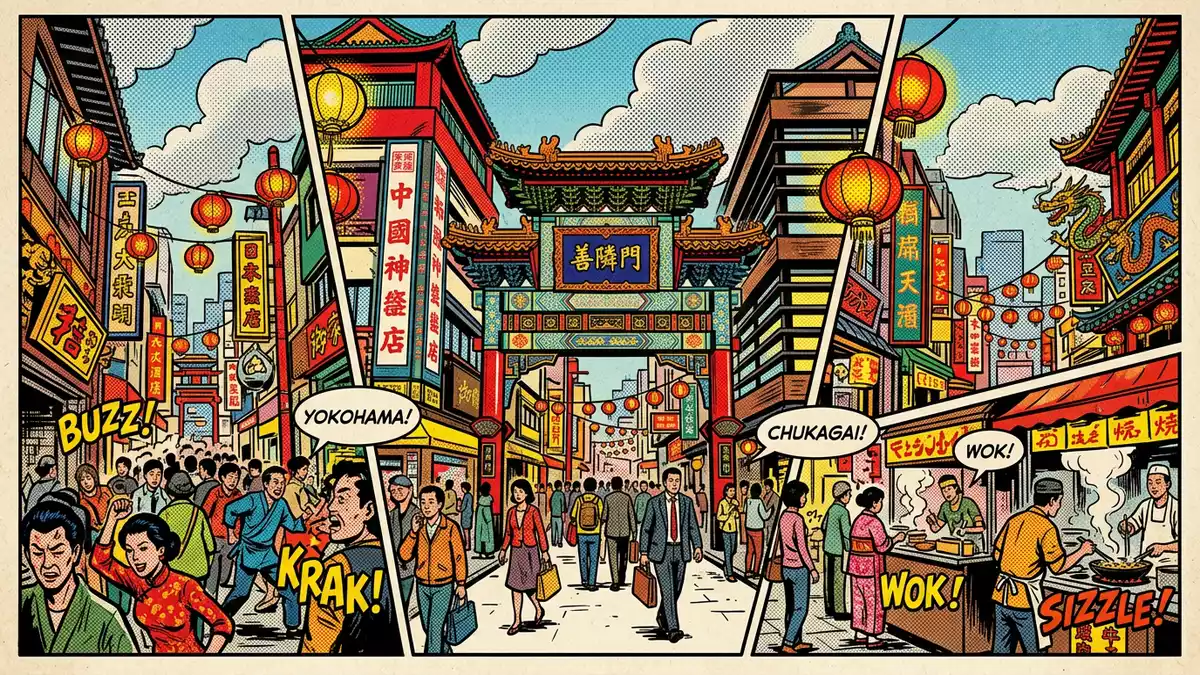
Yokohama Chukagai, known in English as Yokohama Chinatown, is the Chinese quarter close to the harbour in Yokohama in Japan. Its streets formed around a nineteenth?century Chinese community linked to the opening of Yokohama Port in 1859, and the district is now marked by a ring of decorated gates, temples and restaurant fronts that make it feel like a compact city within the city.Chinese quarter close to the harbour
Harbour roots and a Chinese community by the bay
The roots of Yokohama Chukagai lie in the late nineteenth century, when Yokohama was opened as an international port at the end of the Edo period and regular trading routes with Hong Kong and Shanghai were established.Yokohama Chinatown’s history dates back to 1859 Chinese merchants, traders and interpreters settled close to the harbour, forming a community that built its own school, assembly hall and temple in the designated foreign settlement area.Chinese school and temple
One of the most important religious anchors of this community is Kanteibyo, a temple dedicated to Guan Yu, a third?century general venerated as a god of commerce and kept promises.Kanteibyo temple to Guan Yu Merchants began praying here in the 1870s, linking everyday business life in Yokohama Chukagai with religious practice and turning the temple into one of the cultural centres of the neighbourhood.
Gates, streets and ornamental architecture
Yokohama Chukagai is framed by a set of large Chinese?style gates, with approaches from the north, south, east and west marked by vivid structures painted in strong colours.colourful gates at the approaches Inside this ring, further gates stand along important streets, so that moving through the district means passing a sequence of gateways before entering clusters of restaurants, shops and temples.four main gates and smaller gates
A milestone in the modern identity of the area came in 1955, when the Zenrinmon gate, adorned with the characters for “Chinatown”, was constructed and Yokohama Chukagai gained official status under that name.given official status in 1955 The gates use the paifang or pailou style familiar from many Chinese cities, and together with the painted facades and hanging signs they give the streetscape a distinct appearance that contrasts with neighbouring Yokohama districts.pailou-style gateways
Temples, food streets and a district that rebuilt itself
Religion and food form a visible pairing in Yokohama Chukagai, with temples such as Kanteibyo and later Mazu Miao woven into a pattern of restaurant streets and shopfronts.Mazu Miao temple established in 2006 The Chinese community established businesses in many fields, from dining and confectionery to furniture and tailoring, and this mix still shapes the area’s identity as a commercial and cultural quarter.Chinese immigrants expanded their businesses
The physical fabric of Yokohama Chukagai shows how the district has rebuilt itself after major upheavals. The Great Kanto Earthquake of 1923 caused severe damage in Yokohama and affected the Chinatown area, leading to reconstruction of streets and buildings in the following decades.Great Kanto Earthquake devastated Chinatown Later, after the Second World War and the establishment of diplomatic relations between Japan and the People’s Republic of China in the 1970s, the neighbourhood grew as a sightseeing district, while retaining its role as a place of worship, trade and everyday life.growth as a tourist attraction
Visiting Yokohama Chukagai: what travellers from Western Europe should know
- Yokohama Chukagai lies close to the harbour area of Yokohama, south of central Tokyo, and is reached by urban rail services that stop at Motomachi?Chukagai Station and Ishikawacho Station.
- The streets form a compact grid with short blocks and an approach on foot that passes through decorated gates; within the district, some side streets are narrow and can feel enclosed.
- Nearby districts include Motomachi, a shopping street area immediately to the west, and Yamashita Park along the waterfront, which can be combined with a visit to Yokohama Chukagai.
- The official language is Japanese and the currency is the Japanese yen.
- Entry requirements depend on your nationality; UK travellers can check the FCDO travel advice at gov.uk/foreign-travel-advice, Irish travellers the Department of Foreign Affairs at ireland.ie.
Searching for Yokohama Chukagai on social platforms
These links open searches for Yokohama Chukagai on each platform.
Frequently asked questions about Yokohama Chukagai
Where is Yokohama Chukagai located?
Yokohama Chukagai stands close to the harbourfront in Yokohama in Japan, near Motomachi?Chukagai Station and Yamashita Park along Tokyo Bay.
What should visitors expect from a walk through the district?
A walk through Yokohama Chukagai passes under decorated gates into a network of short streets lined with Chinese restaurants, shops, temples and ornamental facades.
What makes Yokohama Chukagai distinctive among urban districts in Japan?
Yokohama Chukagai is distinctive for its nineteenth?century Chinese roots linked to port trade, its ring of paifang gates and its combination of temples and food streets.


