
Wat Rong Suea Ten and its vivid blue world in Chiang Rai
Published on 09/14/2026 at 07:37 | Editorial responsibility: Rafael Müller, Editor-in-Chief AD HOC NEWS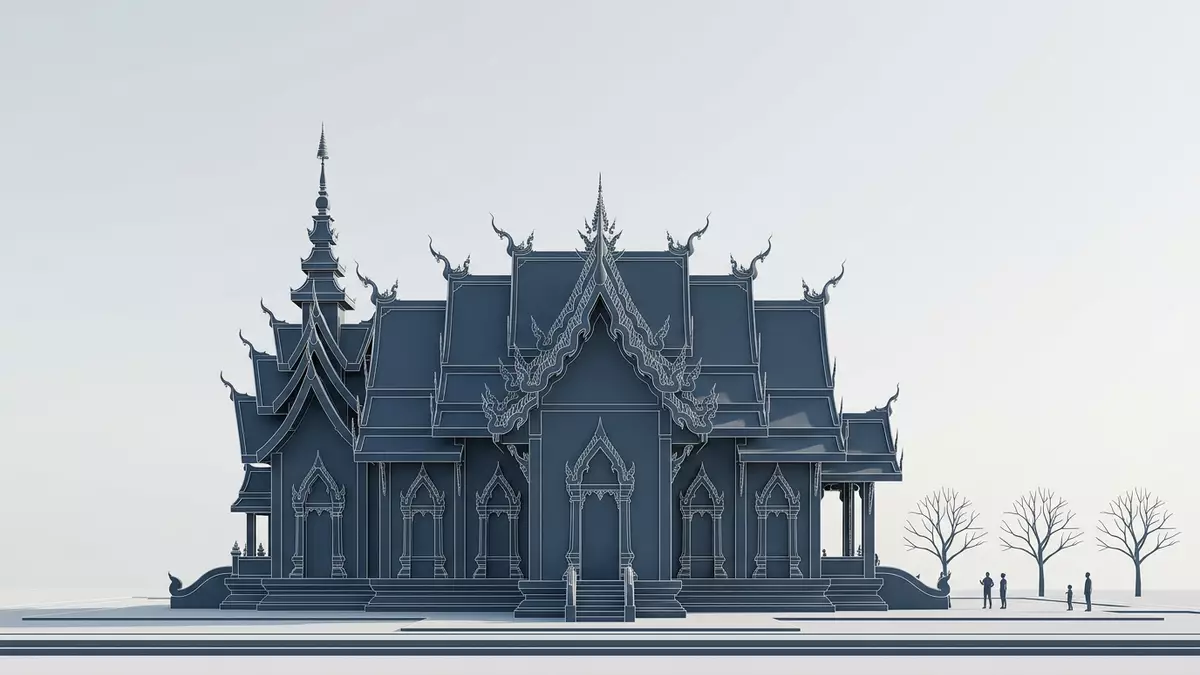
Wat Rong Suea Ten in Chiang Rai is a Buddhist temple that takes familiar Thai forms and immerses them in an intense blue palette, so that every surface seems to glow against the skyline. Completed in its present form in 2016 under Chiang Rai artist Phuttha Kabkaew, the complex stands in the Rim Kok area north of the Kok River and has become a clear marker of the city’s contemporary temple art.
A modern blue temple on the Kok River
Wat Rong Suea Ten stands in Rong Suea Ten village in the Rim Kok Subdistrict, on the north side of the Kok River in Chiang Rai Province, in a residential area rather than an old royal or monastic quarter.Rong Suea Ten village in Rimkok District The temple complex is laid out around an ordination hall, with shrines and smaller structures clustered nearby, so that visitors move through a compact site with elements close together.
The Thai name “Wat Rong Suea Ten” is linked to local stories of tigers associated with the river crossing, and the temple’s alternative English name, the “Blue Temple”, comes directly from its colour. The site had been associated with an older, abandoned temple before its redevelopment, but the present ensemble belongs to the twenty-first century and reflects a wave of new-build temples around Chiang Rai.built on the site of a former abandoned temple
Phuttha Kabkaew’s neotraditional vision in blue
The present design of Wat Rong Suea Ten is by local artist Phuttha Kabkaew, sometimes known as Sala Nok, who trained with Chalermchai Kositpipat, the creator of Wat Rong Khun west of Chiang Rai.Phuttha Kabkaew, a student of Chalermchai Kositpipat In line with a neotraditional Thai art movement associated with the city, his work at Wat Rong Suea Ten combines recognisable temple silhouettes with highly stylised decorative elements drawn from Buddhist and Thai mythological imagery.belongs to a neotraditional Thai art movement identified with Chiang Rai
The main hall rises on a raised platform, with roof tiers marked by sweeping finials and gable ends familiar from central Thai temple architecture, yet almost every structural surface is painted in saturated blue, accented by gold ornament and sculptural work. Mythical creatures and guardian figures line the entrance approaches, sit along balustrades and mark transitional points between exterior and interior, so that visitors pass repeatedly between carved and painted representations of protective beings, Buddhist symbols and stylised flames. This continuous ornament contributes to the impression that colour and sculpture are integral to the structure rather than applied decoration.
Inside the ordination hall: white Buddha within blue space
Within the ordination hall, the dominant focal point is a large white Buddha image that stands against the blue interior surfaces, creating a high-contrast composition between figure and background.large white Buddha image inside the blue ordination hall Murals and decorative motifs run along the walls and ceiling, echoing the blue-and-gold scheme of the exterior, so that the hall feels visually continuous from entrance threshold to inner shrine. The spatial arrangement remains that of an ordination hall in the Theravada tradition, with clear zones for worshippers, monks and the principal images.
Outside, smaller structures and sculptural groups extend the blue theme around the complex. Staircases, platforms and minor shrines use the same colour language and ornamental vocabulary, giving Wat Rong Suea Ten a strong identity among the newer temples of northern Thailand.Wat Rong Suea Ten as an attraction in northern Thailand The ensemble stands as an example of how contemporary temple artists in Chiang Rai have taken traditional forms and reinterpreted them through focused colour choices and elaborate sculptural detail.
Visiting Wat Rong Suea Ten: what travellers from Western Europe should know
- Wat Rong Suea Ten stands in Rim Kok Subdistrict on the north side of the Kok River in Chiang Rai, reached from the city by local road connections and short urban transport journeys.
- The temple complex is largely level at courtyard height, but access to terraces or certain shrines may involve staircases with several flights and ornamental balustrades.
- Wat Rong Suea Ten lies in northern Thailand, where the official language is Thai and the currency is the baht.
- Entry requirements depend on your nationality; UK travellers can check the FCDO travel advice at gov.uk/foreign-travel-advice, Irish travellers the Department of Foreign Affairs at ireland.ie.
Searching for Wat Rong Suea Ten on social platforms
These links open searches for Wat Rong Suea Ten on each platform.
Frequently asked questions about Wat Rong Suea Ten
Where is Wat Rong Suea Ten located in Chiang Rai?
Wat Rong Suea Ten is in Rong Suea Ten village in the Rim Kok Subdistrict of Chiang Rai, on the north side of the Kok River within the urban area.
What can visitors expect when they enter the temple complex?
Visitors encounter a compact complex dominated by a blue ordination hall with elaborate sculptural ornament, smaller shrines and guardian figures arranged along courtyards and steps.
What makes Wat Rong Suea Ten distinctive among Chiang Rai’s temples?
The temple combines a twenty-first-century completion date and neotraditional Thai art with an intense blue colour scheme and a large white Buddha image inside the main hall.


