
Wat Rong Suea Ten and its luminous blue vision in Chiang Rai
Published on 09/08/2026 at 17:41 | Editorial responsibility: Rafael Müller, Editor-in-Chief AD HOC NEWS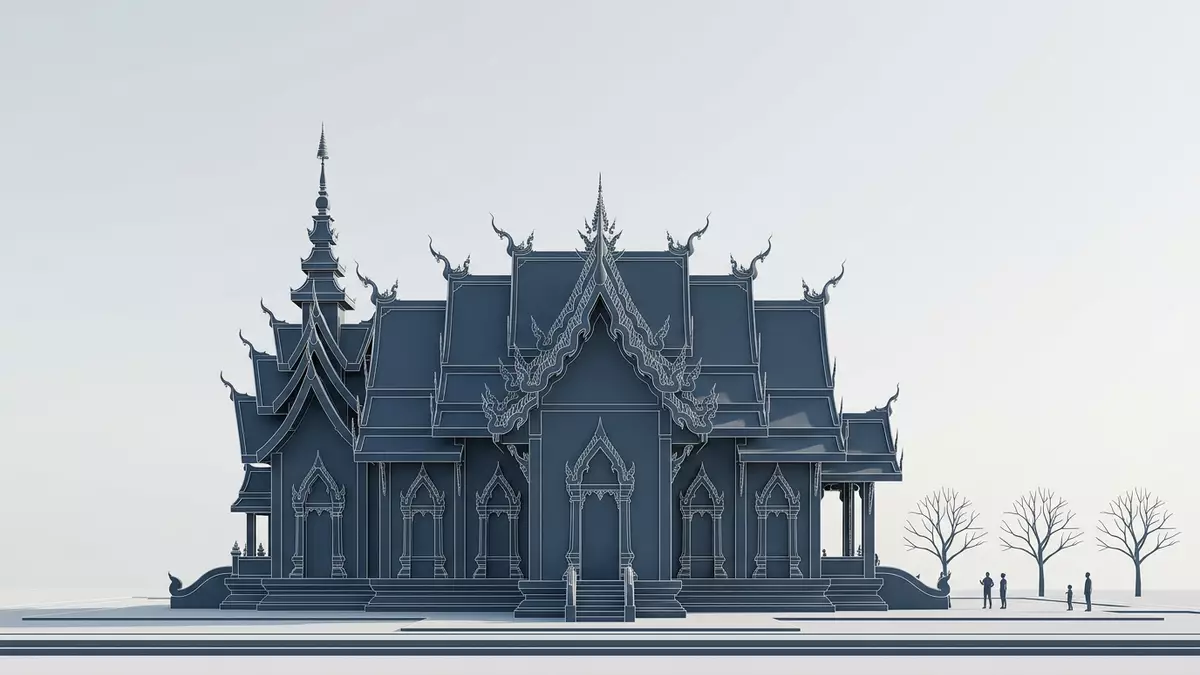
Wat Rong Suea Ten in Chiang Rai, widely known as the Blue Temple, is a contemporary Buddhist temple that turns an entire sacred complex into a field of deep blue colour and gilded detail. Completed in 2016 and designed by Chiang Rai artist Phuttha Kabkaew, it stands in the Rimkok Subdistrict north of the Kok River, combining modern craftsmanship with recognisable Thai temple forms.Completed in 2016
A modern temple defined by blue and gold
The most immediately striking aspect of Wat Rong Suea Ten is the intense blue colour that covers its main vihara, roofs and sculptural elements. Against this saturated blue, ornamental details and trim in gold stand out sharply, giving ordinary structural lines a new visual weight.Sapphire-blue and gold details The main hall follows the familiar Thai temple arrangement with a multi-tiered roof and a raised platform approached by a staircase, yet its surfaces are covered by contemporary Thai motifs rendered in vivid tones.
Phuttha Kabkaew, sometimes known locally as Sala Nok, trained with Chalermchai Kositpipat, the creator of Wat Rong Khun, and his work at Wat Rong Suea Ten belongs to a neotraditional Thai art movement identified with Chiang Rai.Neotraditional Thai art style Sculptures of mythical beings and decorative flourishes are not confined to isolated corners; they run along balustrades, rise from rooflines and frame doorways, so that visitors move through an environment where colour and ornament feel continuous rather than applied.
The main vihara and its white Buddha
The highlight of the temple complex is the main vihara, a rectangular hall roughly 13 m wide and 48 m long, whose entrance is guarded by two large naga figures.Dimensions of the vihara These serpents stretch alongside the approach, their bodies covered in scales and ornament picked out in blue, green and gold, bringing movement to the steps leading up to the hall.
Inside, the deep blue of the walls and ceiling is balanced by a luminous white Buddha image, officially named Phra Buddha Ratchamongkol Bodi Trilokanat.Pearl white Buddha image Murals in strong blue tones and other bright colours surround the statue and depict scenes from the Buddha’s life in a contemporary visual language, with swirling patterns and celestial imagery that extend across the ceiling. The contrast between the blue surfaces and the porcelain-like figure gives the interior a distinctive visual rhythm, quite different from the darker or more muted palettes of many older temples in Thailand.
Name, setting and symbolism by the Kok River
The name “Wat Rong Suea Ten” is commonly translated as “House of the Dancing Tiger”, a phrase linked to stories of tigers once associated with the area around the Kok River.Meaning of the temple name The temple stands in Rong Suea Ten village within the Rimkok District, on the north side of the river, so that water, settlement and religious architecture form a compact landscape on the edge of Chiang Rai’s urban area.Rong Suea Ten village location
Behind the main hall rises a stupa whose form and colouring differ from the dominant blue and gold of the vihara, adding another vertical element to the complex. The temple is affiliated with the Maha Nikaya order of Theravada Buddhism, and the overall arrangement of vihara, stupa and auxiliary structures reflects this mainstream religious context even as the surface treatment pushes strongly into modern artistic territory.Maha Nikaya affiliation
Visiting Wat Rong Suea Ten: what travellers from Western Europe should know
- Wat Rong Suea Ten stands in the Rimkok Subdistrict of Chiang Rai, north of the Kok River, and is reached from the city by local road connections such as Maekok Road.
- The temple complex includes exterior steps leading up to the main hall and further stairways behind it, so a visit involves climbing staircases between outdoor courtyards and interior spaces.
- The official language is Thai and the currency is the Thai baht; English appears in some signage, but most devotional texts are written in Thai.
- Entry requirements depend on your nationality; UK travellers can check the FCDO travel advice at gov.uk/foreign-travel-advice, Irish travellers the Department of Foreign Affairs at ireland.ie.
Searching for Wat Rong Suea Ten on social platforms
These links open searches for Wat Rong Suea Ten on each platform.
Frequently asked questions about Wat Rong Suea Ten
Where is Wat Rong Suea Ten located?
Wat Rong Suea Ten stands in Rong Suea Ten village in the Rimkok Subdistrict of Chiang Rai, on the north side of the Kok River.
What should visitors expect during a visit?
Visitors encounter exterior naga sculptures, staircases leading into the main vihara, an interior filled with blue murals, and a prominent white Buddha image.
What makes Wat Rong Suea Ten distinctive among temples?
Its extensive use of blue and gold, neotraditional Thai art style and modern completion date give the complex a contemporary character within a traditional temple layout.


