
Wat Rong Suea Ten and its blue Lanna form
Published on 09/16/2026 at 15:16 | Editorial responsibility: Rafael Müller, Editor-in-Chief AD HOC NEWS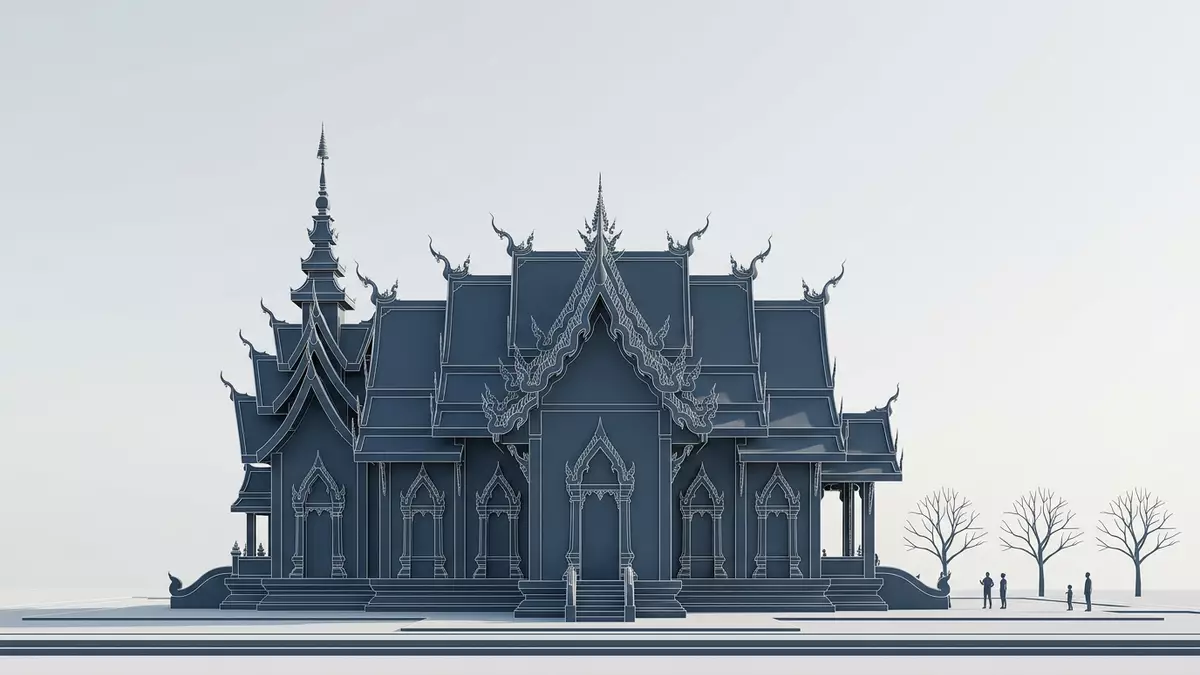
Wat Rong Suea Ten in Chiang Rai is a Buddhist temple whose strongest feature is its blue and gold surface. The name is paired with Phuttha Kabkaew and completed in 2016 on the site of a contemporary temple in Rimkok.
Blue surfaces, gold trim and tiger figures
The temple’s colour scheme is immediate: blue walls, gilded ornament and a white Buddha image inside the main hall. Its tiger imagery links the building to the meaning of Wat Rong Suea Ten, while the outer surfaces, doorway details and sculpted elements keep the same visual language throughout.
The hall itself is recorded as 13 metres wide and 48 metres long. That scale gives the temple a long, horizontal profile, while the main Buddha image stands in strong contrast to the saturated blue around it13 metres wide and 48 metres long.
Phuttha Kabkaew and a contemporary temple idiom
Wat Rong Suea Ten is linked to the artist Phuttha Kabkaew, and its finished form belongs to Chiang Rai’s recent temple tradition. The building uses familiar Buddhist temple language, then shifts it through intense colour, decorative surfaces and stylised animal imagery.
The temple stands in Rimkok Subdistrict, north of central Chiang Rai, near the Mae Kok River. That setting places it within the city’s temple landscape rather than in an isolated rural compoundRimkok Subdistrict.
What the temple hall emphasises
The interior centres on the white seated Buddha and a dark, polished background of blue ornament, mirrors and gold accents. The effect is created by visible materials rather than by size alone, and the decorative programme continues across columns, walls and roofline.
Wat Rong Suea Ten also carries the older idea of a temple as a place for image, colour and devotion rather than plain enclosure. Its present form belongs to a modern period, yet it keeps the grammar of a Thai Buddhist sanctuarya large white Buddha image.
Visiting Wat Rong Suea Ten: what travellers from Western Europe should know
- The temple is in Rimkok, north of central Chiang Rai, and road access is straightforward from the city. Songthaew, tuk-tuk and Grab are the transport options most often used for the final approach.
- The main hall is broad and low rather than tall. The visual impact comes from colour, ornament and the long façade, not from height.
- The site sits close to the Mae Kok River. That riverside setting places the temple within a wider pattern of Chiang Rai religious sites.
- The official language is Thai and the currency is the Thai baht.
- Entry requirements depend on your nationality; UK travellers can check the FCDO travel advice at gov.uk/foreign-travel-advice, Irish travellers the Department of Foreign Affairs at ireland.ie.
Searching for Wat Rong Suea Ten on social platforms
These links open searches for Wat Rong Suea Ten on each platform.
Frequently asked questions about Wat Rong Suea Ten
Where is Wat Rong Suea Ten?
Wat Rong Suea Ten is in Rimkok Subdistrict, north of central Chiang Rai, in northern Thailand. It stands near the Mae Kok River.
What does a visit involve?
The temple presents a blue exterior, gilded details and a white Buddha inside the main hall. The setting is compact and urban rather than remote.
What makes Wat Rong Suea Ten distinctive?
Its blue-and-gold palette and tiger-linked imagery give the temple a strong identity. The completed 2016 form associated with Phuttha Kabkaew is part of Chiang Rai’s contemporary temple landscape.


