Wat Rong Suea Ten and its blue Lanna form
Published on 09/03/2026 at 20:27 | Editorial responsibility: Rafael Müller, Editor-in-Chief AD HOC NEWS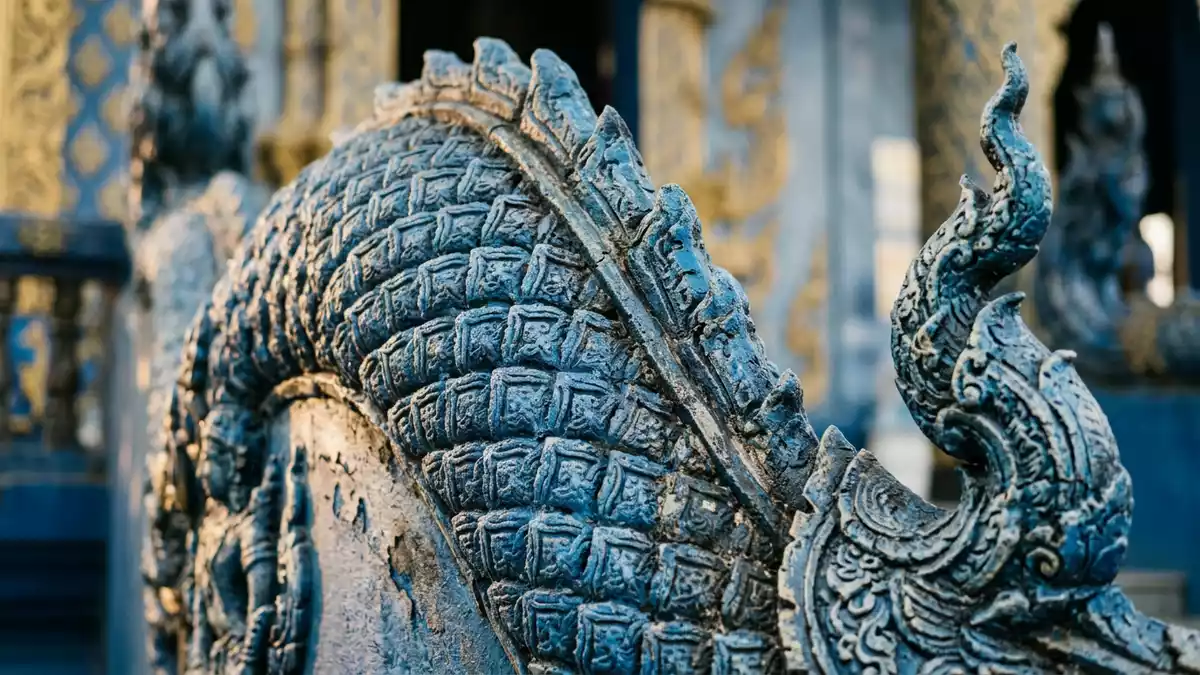
Wat Rong Suea Ten in Chiang Rai is a Buddhist temple whose most immediate feature is its saturated blue and gold exterior. Completed in 2016, it is linked to the artist Phuttha Kabkaew and the city’s contemporary temple tradition.
Blue surfaces and gold details in Chiang Rai
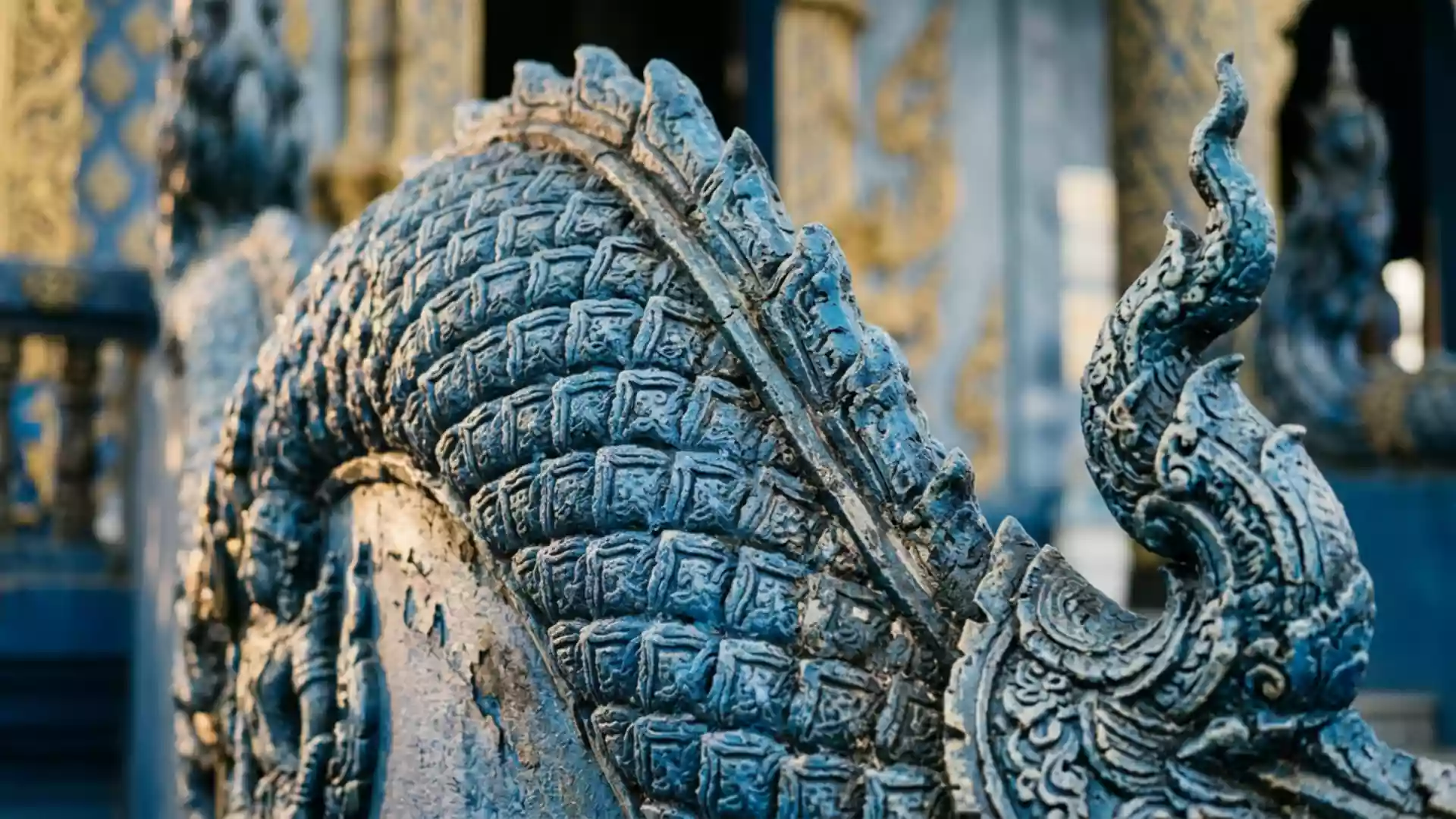
The temple is better known as the Blue Temple, and that nickname makes sense as soon as the buildings come into view. The main hall uses a strong blue finish against gold ornament, while the white Buddha image inside adds a third visual note. Completed in 2016 and shaped by Phuttha Kabkaew, it belongs to the recent wave of temple design in northern Thailand.
The temple’s appearance is ceremonial rather than austere. Carved surfaces, decorative trim and painted figures give the complex a dense, layered look that reads differently from older brick or stucco temples in the region. The result is not a museum piece frozen behind glass, but an active place of worship with a distinctly contemporary visual language.
Phuttha Kabkaew and the temple’s modern idiom
Phuttha Kabkaew is the name most closely associated with the finished temple. He was a Chiang Rai artist, and Wat Rong Suea Ten is one of the clearest expressions of the local art-temple movement that also produced Wat Rong Khun. The structure’s blue surfaces, gilded trim and stylised decoration place it firmly within that lineage.
The building also carries a clear formal identity. It stands in Rimkok Subdistrict, Mueang District, Chiang Rai, and the temple’s main hall is recorded as 13 metres wide and 48 metres long. Those dimensions give the hall a long horizontal profile, which suits the way its façade stretches across the approach. Rimkok Subdistrict and the hall’s 13 metres wide and 48 metres long are part of what gives the temple its recognisable form.
The site’s older religious layer
Wat Rong Suea Ten stands on a site with an older sacred history. The temple’s earlier phase is connected with an abandoned predecessor and remnants of old brickwork, a reminder that the present complex is part of a longer religious landscape in the Rimkok area. That history sits behind the polished surfaces of the present buildings without dominating their appearance.
The name itself points to local memory as well as place. In Thai, the temple is ???????????????, and the English name is usually rendered as Wat Rong Suea Ten. Its identity therefore rests on both a specific neighbourhood in Chiang Rai and a temple form that has been reimagined for the early twenty-first century. Rong Suea Ten Village and the temple’s older temple site both belong to that layered identity.
Visiting Wat Rong Suea Ten: what travellers from Western Europe should know
- The temple stands in Rimkok, north of central Chiang Rai, and road access is the simplest way to reach it. It is a short drive from the city area and lies close to the Mae Kok River.
- The main hall is long and low rather than tall and tower-like. The temple grounds include steps, painted surfaces and sculptural details that reward a slow walk around the complex.
- The official language is Thai and the currency is the Thai baht.
- Entry requirements depend on your nationality; UK travellers can check the FCDO travel advice at gov.uk/foreign-travel-advice, Irish travellers the Department of Foreign Affairs at ireland.ie.
Searching for Wat Rong Suea Ten on social platforms
These links open searches for Wat Rong Suea Ten on each platform.
Frequently asked questions about Wat Rong Suea Ten
Where is Wat Rong Suea Ten?
It is in Rimkok Subdistrict, north of central Chiang Rai in northern Thailand. The temple sits near the Mae Kok River.
What does a visit involve?
The main hall, painted surfaces and sculptural details are the core of the experience. The complex is compact enough to read as one ensemble rather than a scattered set of buildings.
What makes it distinctive?
The dominant blue colour, the gold detailing and the contemporary hand of Phuttha Kabkaew give it a very clear identity. Its connection to the local temple-art movement also separates it from more conventional Thai monastery design.