
Wat Rong Suea Ten and its luminous blue vision in Chiang Rai
Published on 09/01/2026 at 13:31 | Editorial responsibility: Rafael Müller, Editor-in-Chief AD HOC NEWS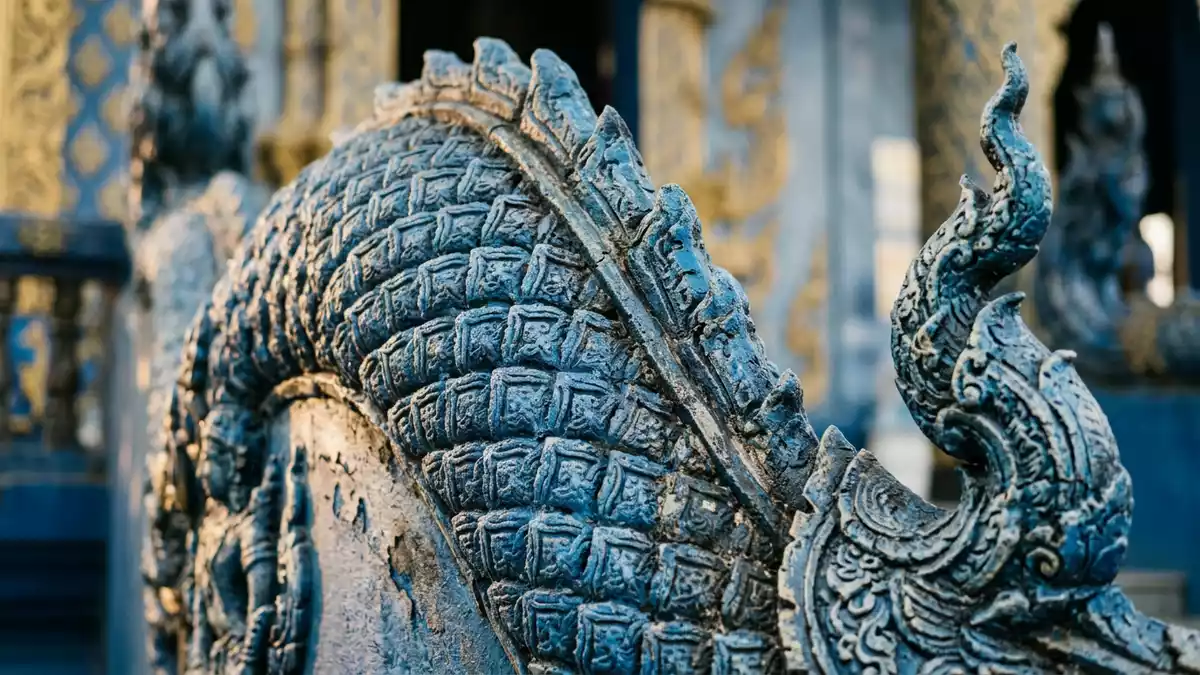
Wat Rong Suea Ten in Chiang Rai, widely known as the Blue Temple, is a contemporary Buddhist temple that turns a familiar northern Thai form into an intense world of saturated blue and luminous white. Completed in 2016, it stands in the Rim Kok area north of the city centre and has rapidly become one of the region’s most recognisable modern religious sites. Designed by local artist Phutta Kabkaew, a former student of Chalermchai Kositpipat, it carries forward the experimental spirit of Chiang Rai’s art temples while keeping the structure firmly rooted in Buddhist practice.
Blue exterior, white Buddha: colour as architecture
The most striking first impression at Wat Rong Suea Ten is the interplay between deep blue surfaces and bright white statuary across the main ordination hall and surrounding structures. The ubosot, or ceremonial hall, rises from a base richly decorated with naga serpents and guardian figures painted in vivid blue, their scales and ornament picked out in gold and green. On the facade, stylised flames and swirling forms climb towards the roof, creating a dense, almost textile-like skin of relief work that catches the light differently throughout the day. At the centre of this setting, a large seated Buddha in white porcelain creates a deliberate contrast with its surroundings, the figure standing out sharply against murals and decorative details worked in blue tones. The combination of saturated colour and reflective white has become one of the temple’s defining images. Inside the hall, murals extend the palette onto walls and ceilings, mixing traditional Buddhist iconography with cosmic and fantastical scenes rendered in the same blue-and-gold spectrum, a style that links Wat Rong Suea Ten with other contemporary temples in Chiang Rai.
The temple’s present form was completed in 2016 under the direction of Phutta Kabkaew, known locally as Sala Nok, who had previously worked with Chalermchai Kositpipat at Wat Rong Khun. Wat Rong Suea Ten therefore belongs to a cluster of art-focused temples in Chiang Rai where individual artists take on the full design of a religious complex, combining conventional monastic layouts with personal visual languages. The blue surfaces here are not only paint but part of an integrated design, covering statues, balustrades and smaller shrines so that even functional elements such as stairways and railings contribute to the overall colour field. In the grounds around the main hall, further Buddha images, smaller pavilions and decorative structures continue the same aesthetic, making the transition from exterior to interior feel like a single extended artwork. This approach has made Wat Rong Suea Ten a reference point for contemporary temple architecture in northern Thailand.Wat Rong Suea Ten article
“House of the Dancing Tiger”: name and setting by the Mae Kok River
The Thai name Wat Rong Suea Ten translates as “House of the Dancing Tiger”, a phrase tied to the history of the Rim Kok area on the north bank of the Mae Kok River. Rong refers to a creek or channel, suea to tigers and ten to leaping, a combination that evokes stories of wild tigers once moving through the waterways and forest here. The temple stands in Rong Suea Ten village in the Rim Kok subdistrict of Mueang Chiang Rai, close to the river and a short distance from central Chiang Rai, so the name continues to locate the site within its immediate landscape as well as local memory. Tiger motifs appear in various decorative details across the complex, from sculpted figures to smaller reliefs, linking the legend to the visual language of the temple.description of the name and location
Physically, Wat Rong Suea Ten occupies a riverside plot in an urban fringe setting rather than a remote hill or forest monastery. The address on Maekok Road in Rim Kok places it near other small businesses and residential areas, with the Kok River flowing nearby and Chiang Rai Municipal Office lying to the south across the water. Within the grounds, the main hall forms the focus of the site, with a pagoda and monastic buildings arranged to maintain the usual functions of a working temple. The complex covers several acres, enough space for visitors to walk between structures and observe details without leaving the urban fabric around it. This combination of accessible location and distinctive design has helped Wat Rong Suea Ten sit alongside other Chiang Rai landmarks such as Wat Rong Khun and the Black House as part of an informal circuit of contemporary Buddhist and artistic sites.address and setting on Maekok Road
A modern temple shaped by Chiang Rai’s art movement
Wat Rong Suea Ten stands out as a twenty-first century addition to Chiang Rai’s religious landscape, part of a wave of new construction driven by artists rather than traditional temple committees alone. Construction began in 2005 on the site of an earlier, abandoned temple and continued for more than a decade before the complex opened to visitors in 2016, giving the building a clear dating within the recent history of Thai religious architecture. Its chronology ties directly to the influence of Wat Rong Khun, Chalermchai Kositpipat’s white temple south of Chiang Rai, whose experimental approach helped create a space for artist-designed temples that reinterpret familiar forms. Phutta Kabkaew’s work at Wat Rong Suea Ten reflects this climate: the layout follows standard monastic patterns, but details such as the intense colour scheme, fantastical figures and cosmic interior murals take full advantage of the freedom available within contemporary northern Thai temple design.construction dates and designer
As with other recently built temples in the region, Wat Rong Suea Ten combines its role as a place of worship with a strong visual presence that attracts visitors from across Thailand and abroad. Within the interior, the large white Buddha, known formally as Phra Buddha Rajamongkol Bodhi Trilokanat, sits on a lotus base in a meditative pose, providing a conventional devotional focus framed by the more experimental mural work around it. Outside, the arrangement of statues, gateways and ornamental elements guides visitors through views that highlight the blue-and-gold surfaces from different angles. The temple’s relatively recent completion date makes it an example of how Buddhist architecture in Thailand continues to evolve, integrating local stories, artistic innovation and established religious forms into a single complex that is both recognisably a temple and unmistakably a contemporary artwork in built form.details of the principal Buddha image
Visiting Wat Rong Suea Ten: what travellers from Western Europe should know
- Wat Rong Suea Ten stands in the Rim Kok area north of central Chiang Rai, on Maekok Road close to the Mae Kok River, reached most easily by road from the city.
- The temple grounds are level and paved, with the main hall approached by stairways flanked by sculpted naga guardians and other figures, so visits involve climbing several flights of outdoor steps.
- The official language is Thai and the currency is the baht.
- Entry requirements depend on your nationality; UK travellers can check the FCDO travel advice at gov.uk/foreign-travel-advice, Irish travellers the Department of Foreign Affairs at ireland.ie.
Searching for Wat Rong Suea Ten on social platforms
These links open searches for Wat Rong Suea Ten on each platform.
Frequently asked questions about Wat Rong Suea Ten
Where is Wat Rong Suea Ten located in Chiang Rai?
Wat Rong Suea Ten stands in Rong Suea Ten village in the Rim Kok subdistrict of Mueang Chiang Rai, north of the city centre and close to the Mae Kok River.
What can visitors expect during a visit to Wat Rong Suea Ten?
Visitors encounter a working Buddhist temple whose main hall and surrounding structures are covered in intense blue decoration, centred on a large white seated Buddha and detailed interior murals.
What makes Wat Rong Suea Ten distinctive among Chiang Rai’s temples?
Its combination of deep blue surfaces, a luminous white porcelain Buddha, contemporary mural work and its origin as a completed 2016 project by artist Phutta Kabkaew gives the temple a clearly defined modern character.


