
Wanli Changcheng in Beijing’s northern hills
Published on 09/12/2026 at 19:18 | Editorial responsibility: Rafael Müller, Editor-in-Chief AD HOC NEWS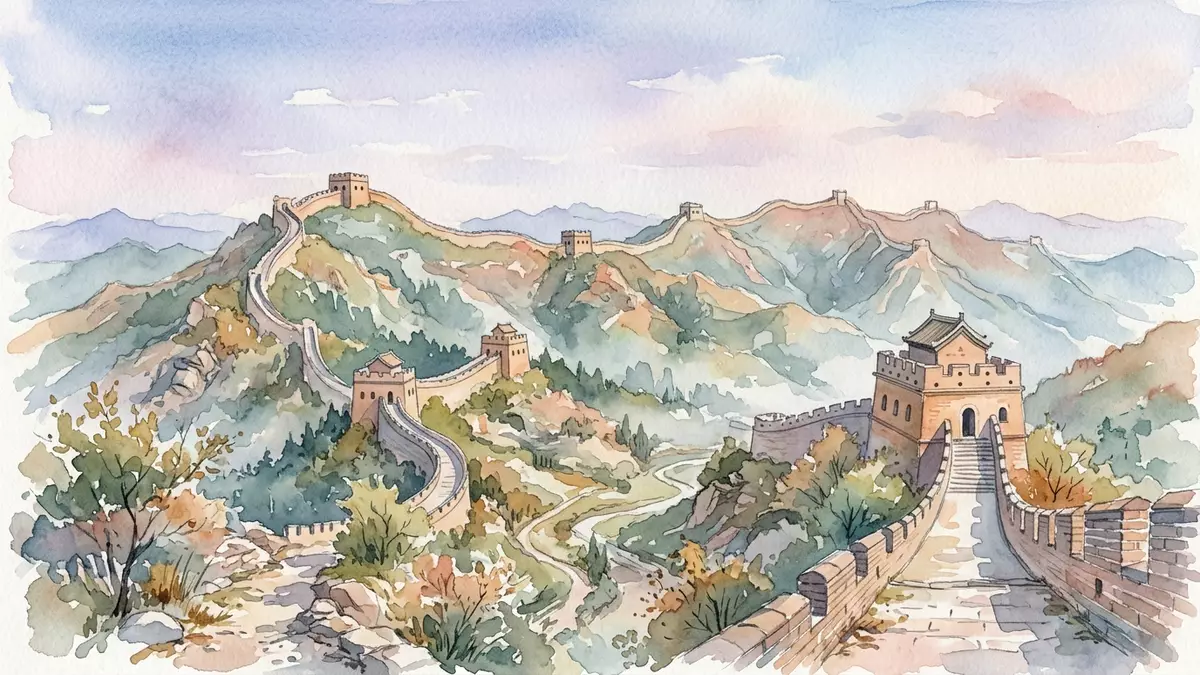
Wanli Changcheng runs north of Peking in stone and brick, tracing ridges and mountain passes across the hills. English readers know it as the Great Wall of China, a vast line of fortifications associated with the Ming dynasty and the Beijing area.
Wanli Changcheng and the Ming ridge line
The name Wanli Changcheng is linked to a defensive system that took shape across several Chinese dynasties. The best-known surviving stretches around Peking belong to the Ming dynasty, from 1368 to 1644.
Those sections are visible as a sequence of ramparts, towers and passes rather than a single uniform wall. Their masonry follows the contours of the hills, with granite and brick giving the structure a hard, regular surface.
Stone, brick and watchtowers in Beijing
North of the city, the wall rises and falls with the ground. Badaling lies in Yanqing District, while Mutianyu sits in Huairou District, and both are part of the wider Beijing landscape of Wall sections.
One of the clearest features is the repetition of watchtowers along the crest. The rampart between them is built for movement across the ridge, and the wall’s profile changes with the width of the path and the height of the parapets.
The Great Wall was designated a UNESCO World Heritage site in 1987, and its accepted English name includes Wanli Changcheng as an alternative form. The structure is associated with earlier frontier lines as well as the Qin Shi Huang period of unification.
Wanli Changcheng as a long defensive system
Wanli Changcheng is not a single wall raised at one moment. It is a layered defensive system that gathers earlier borders, later rebuilding and the stone-and-brick stretches that dominate the Beijing region.
The wall’s scale is part of its identity. Britannica gives the Ming wall as about 8,850 km (5,499 miles) long, while the wider system across China extends far beyond any single district or pass.The Ming wall is the form most visitors recognise near Peking.
Visiting Wanli Changcheng: what travellers from Western Europe should know
- Wanli Changcheng is reached through the northern districts of Beijing, including Yanqing and Huairou. Badaling and Mutianyu are among the named sections linked with the city.
- The wall follows steep ridges and passes. Walks involve stone steps, uneven masonry and changes in height along the crest.
- The official language is Chinese and the currency is the renminbi.
- Entry requirements depend on your nationality; UK travellers can check the FCDO travel advice at gov.uk/foreign-travel-advice, Irish travellers the Department of Foreign Affairs at ireland.ie.
Searching for Wanli Changcheng on social platforms
These links open searches for Wanli Changcheng on each platform.
Frequently asked questions about Wanli Changcheng
Where is Wanli Changcheng?
Wanli Changcheng runs across northern China, with well-known stretches in Beijing’s northern districts. Badaling in Yanqing and Mutianyu in Huairou are among the places most closely linked with Peking.
What does a visit involve?
A visit means moving across stone ramps, steps and watchtowers on mountain ridges. The wall is experienced as masonry and elevation rather than as a level promenade.
What makes Wanli Changcheng distinctive?
Its Ming dynasty stretches, stone and brick fabric, and route along the hills north of Peking define its character. The wall reads as both architecture and landscape.


