
Wanli Changcheng near Peking: walking the Ming Great Wall
Published on 08/20/2026 at 20:23 | Editorial responsibility: Rafael Müller, Editor-in-Chief AD HOC NEWS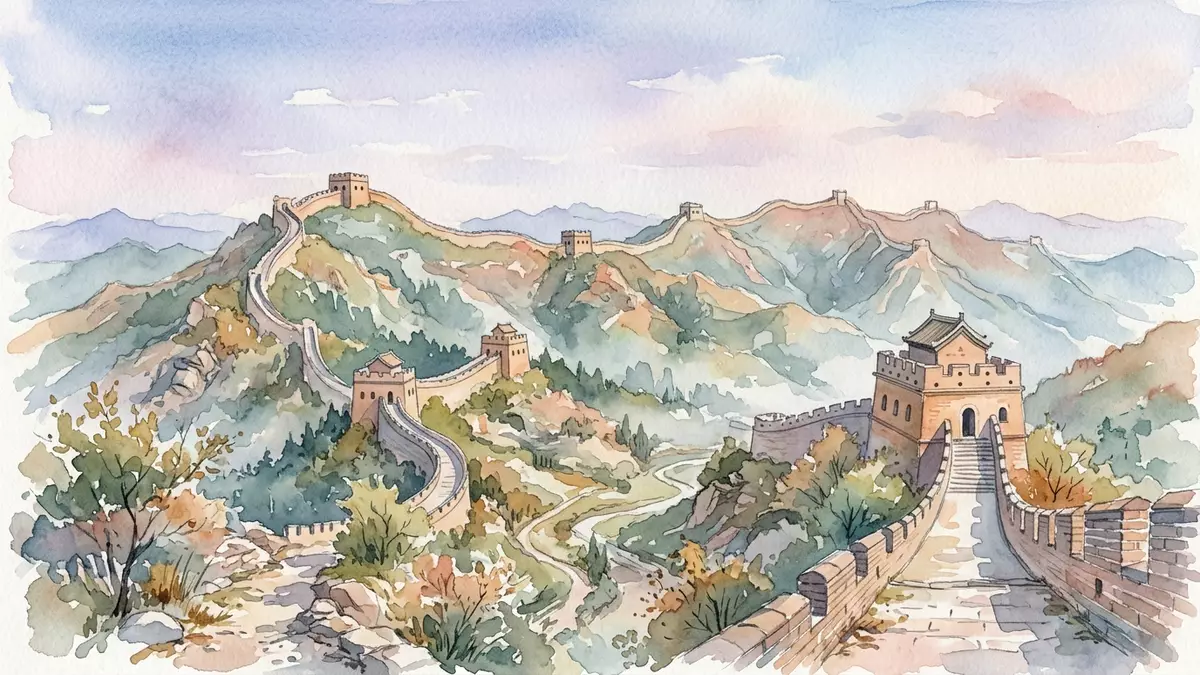
Wanli Changcheng, the Chinese name for the Great Wall, traces the crestlines of the hills north of Peking and gathers centuries of border history into a single stone and brick presence. North of the city, restored Ming sections such as Badaling and Mutianyu turn that vast defence system into a place that can be walked, climbed and seen at human scale.
Ming brickwork on the northern hills
The stretches of Wanli Changcheng most closely associated with Peking belong to the Ming dynasty, whose rulers rebuilt long runs of the wall in stone and brick and added towers and gateways across the mountain terrain.Ming dynasty rebuilding Much of the visible wall in the Beijing area follows steep ridges, with battlements and parapets running along narrow crests.
Badaling, a heavily restored section in Yanqing District north-west of central Peking, shows this Ming-era construction clearly in its brick ramparts, watchtowers and sloping stairways.Ming wall north of Beijing Nearby Mutianyu presents another Ming stretch, with fortifications stepping along wooded mountains, while other accessible sections in the region continue this pattern of walls tied closely to the contours of the hills.Ming-era Great Wall sections
A wall that became a system
Wanli Changcheng literally means “Ten-Thousand-Li Long Wall”, using li as a traditional Chinese unit, and the name points to the sheer scale of the fortifications rather than a single continuous barrier.Ten-Thousand-Li Long Wall Along northern China, walls, trenches, fortresses and natural obstacles were combined to form a defensive system that grew over many dynasties and in different materials.many border defence structures
Construction began in the Eastern Zhou period, when states of the Spring and Autumn and Warring States eras raised separate fortifications; later, Qin Shi Huang linked sections after the unification of China in the third century BC.Qin Shi Huang and early walls Subsequent dynasties, including Han and Ming, rebuilt and extended the lines, producing a total length measured in tens of thousands of kilometres when every surviving fragment and branch is counted.total length and dynastic building The Great Wall was inscribed on the UNESCO World Heritage List in 1987, fixing its status as a protected cultural monument.UNESCO World Heritage inscription
Walking Wanli Changcheng near Peking
The wall sections nearest Peking sit within the Beijing municipality, where Badaling, Mutianyu and neighbouring passes lie among the mountains to the north and north-east.Ming wall near Peking Badaling is in Yanqing District, and Mutianyu lies in a different valley to the north-east, giving travellers contrasting views of ramparts, towers and surrounding slopes.
On the ground, Wanli Changcheng near Peking appears as stone and brick pathways, stairs and terraces running along ridges, punctuated by enclosed towers and open platforms that once served as lookout points.watchtowers linked along ridges The layout invites climbs up long flights of steps, short walks between neighbouring towers or longer hikes following the crestline, always with the wall itself as a continuous guide above the valleys.
Visiting Wanli Changcheng: what travellers from Western Europe should know
- Wanli Changcheng near Peking is reached by road and rail lines that run into the northern districts of Beijing, with Badaling in Yanqing District and Mutianyu in a north-eastern valley.
- The terrain on the wall consists of steep stone steps, sloping ramps and uneven brick surfaces along high ridges, and some sections involve sustained climbing.
- The wall crosses mountain passes surrounded by hills and woodland, so weather exposure varies between open crest sections and more sheltered stretches in the folds of the terrain.
- The official language is Chinese and the currency is the renminbi.
- Entry requirements depend on your nationality; UK travellers can check the FCDO travel advice at gov.uk/foreign-travel-advice, Irish travellers the Department of Foreign Affairs at ireland.ie.
Searching for Wanli Changcheng on social platforms
These links open searches for Wanli Changcheng on each platform.
Frequently asked questions about Wanli Changcheng
Where is Wanli Changcheng in relation to Peking?
Wanli Changcheng runs across northern China, and the sections most associated with Peking lie within the Beijing municipality, including Badaling in Yanqing District and Mutianyu to the north-east.
What should visitors expect on a walk along the wall near Peking?
Visitors encounter stone and brick ramparts, stairways and watchtowers following mountain ridges, with routes that range from short climbs between neighbouring towers to longer walks along high crests.
What makes Wanli Changcheng near Peking distinctive among Great Wall sections?
The Ming-era stretches near Peking combine heavily restored brickwork, clear views of the surrounding hills and easy access from the city, making the structure’s military past tangible in a compact, walkable form.


