
Volcan Poas and its crater lakes above Alajuela
Published on 09/21/2026 at 15:14 | Editorial responsibility: Rafael Müller, Editor-in-Chief AD HOC NEWS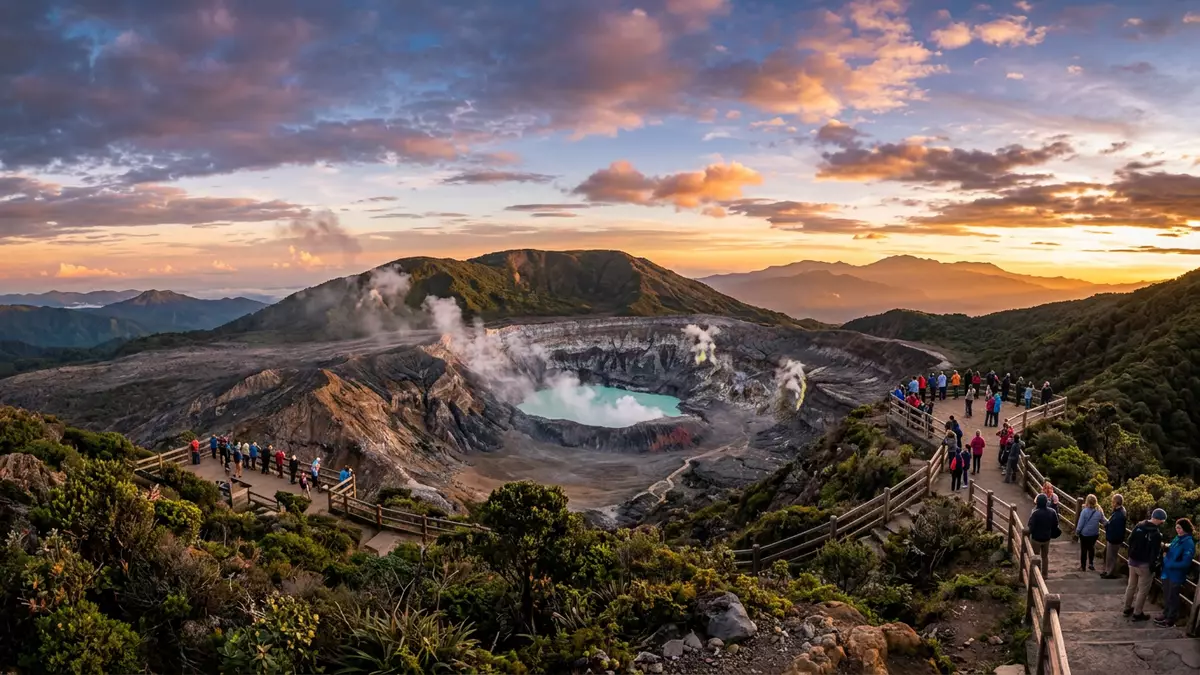
Volcan Poas in Alajuela, Costa Rica, is an active stratovolcano whose broad summit holds craters and crater lakes gathered near the top of the mountain. Its elevation of around 2,697 m (8,848 ft) places it among the major peaks of Costa Rica’s central highlands, and the volcano forms the core of Poás Volcano National Park, a protected area in the Central America Volcanic Arc.
A highland stratovolcano shaped by craters and lakes
Volcan Poas is a composite stratovolcano rising in the Central America Volcanic Arc, where the subduction of the Cocos Plate beneath the Caribbean Plate has built a chain of volcanoes across Costa Rica’s interior. The Smithsonian Global Volcanism Program records its summit elevation as 2,697 m (8,848 ft), describing Poas as a composite stratovolcano with its main vents concentrated near the summit cone.summit elevation of 2,697 m The volcano stands within Alajuela Province, north-west of San José, and its flanks are covered by cloud forest and agricultural land adapted to the cooler highland climate.large active stratovolcano located north of Alajuela
Near the summit, Poas presents a complex cratered landscape rather than a single simple cone. The principal crater forms a wide depression with a diameter of around 1.3 to 1.5 km and a depth of several hundred metres, and within it lies the crater lake known as Laguna Caliente, an extremely acidic body of water associated with vigorous fumaroles and intermittent phreatic eruptions of steam, ash and lake water.principal crater of about 1.5 km in diameter and 300 m deep A second notable crater, the Botos crater, holds a cooler freshwater lake set in dense cloud forest, giving the summit area a striking contrast between the stark, fuming main crater and the vegetated basin nearby.Botos crater lake within cloud forest
Volcan Poas within the Central Highlands and national park
The volcano sits within Poás Volcano National Park, a protected area established in the twentieth century to safeguard the summit region and the surrounding highland habitats. One Spanish-language source records that the park was founded on 25 January 1971 and covers an area of roughly 65 km² (16,000 acres), placing Poas among Costa Rica’s earlier generation of national parks.park founded on 25 January 1971 Within this area the volcano overlooks mixed ecosystems including cloud forest, high montane woodland and pasture, reflecting the range of elevations on its slopes.Poás Volcano National Park habitats
Poas lies in the northern section of the Cordillera Central, a volcanic mountain range where it stands alongside other centres such as Barva and Platanar. A geological study notes that Poas, Barba, Platanar and Porvenir form part of the north-western portion of the Cordillera Central in central Costa Rica, marking the alignment of volcanic edifices above the subduction zone.section of the Cordillera Central The volcano itself rises north of Alajuela city, and the approach by road passes through highland communities and agricultural districts before reaching the upper forest belt and the summit area.routes from San José through Alajuela to Poasito
Activity, crater lakes and highland conditions
Volcan Poas has a long record of eruptions, with historical accounts going back to the early nineteenth century. One widely used summary notes that the volcano has erupted dozens of times over the past 200 years, and its activity has included phreatic explosions that eject water and sediments from the ultra-acid Laguna Caliente crater lake.dozens of eruptions in the past 200 years The Global Volcanism Program lists a series of historical eruptions for Poas, with its last known eruption recorded in the twenty-first century and ongoing degassing and crater-lake activity identified as characteristic features of the volcano.phreatic explosions from Laguna Caliente
The conditions around the summit reflect both altitude and volcanic emissions. At over 2,600 m (about 8,500 ft), temperatures are cooler than in the lowlands, and cloud banks frequently gather around the upper slopes. Vegetation near the main crater shows the effects of volcanic gases and acid rain, with damaged stands in sectors directly exposed to emissions, while the Botos basin supports dense forest and a cold lake draining towards the Caribbean watershed through rivers such as the Ángel, a tributary of the Sarapiquí.acid rain phenomena and Botos lagoon drainage
Visiting Volcan Poas: what travellers from Western Europe should know
- Volcan Poas stands in Alajuela Province in central Costa Rica, north-west of San José, and is reached by mountain roads that climb from the Central Valley into the highlands around the volcano.
- The summit area lies at around 2,700 m (8,858 ft) above sea level, so visitors encounter cooler temperatures, thin air and exposed terrain on paths leading to crater viewpoints within Poás Volcano National Park.
- The surroundings of Volcan Poas include cloud forest and agricultural land on the mountain’s slopes, with the protected summit craters set above pasture and woodland where the uplands meet the forest belt.
- The official language of Costa Rica is Spanish and the currency is the Costa Rican colón.
- Entry requirements depend on your nationality; UK travellers can check the FCDO travel advice at gov.uk/foreign-travel-advice, Irish travellers the Department of Foreign Affairs at ireland.ie.
Searching for Volcan Poas on social platforms
These links open searches for Volcan Poas on each platform.Frequently asked questions about Volcan Poas
Where is Volcan Poas located?
Volcan Poas is in Alajuela Province in central Costa Rica, north-west of San José, forming part of the Cordillera Central volcanic range.
What can visitors expect when they reach the summit area?
The summit area of Volcan Poas includes a wide active main crater with the acidic Laguna Caliente and a separate forested crater holding the cooler Botos lake, both reached within Poás Volcano National Park.
What makes Volcan Poas distinctive among Costa Rican volcanoes?
Volcan Poas is distinctive for its complex summit with multiple craters, highly acidic crater lake, frequent historical activity and its location in a national park that protects both volcanic landforms and cloud forest.


